Introduction
If you’re tired of waiting around for water to boil, the right electric kettle can shave minutes off your morning routine. Not all kettles boil at the same speed, and the difference often comes down to a handful of specs most shoppers overlook.
This guide explains exactly what makes a fast-boiling kettle fast, which features are worth prioritising, and how to compare models without getting lost in marketing claims. We’ll also cover electric kettles, wattage, and material choices in plain, practical terms.
By the end, you’ll know precisely what to look for so you can boil water faster every single day, without overpaying for features you don’t need.
If you’re furnishing a small kitchen overall, a fast-boiling kettle pairs naturally with other space-conscious choices see our guide to compact kitchen appliances for the full picture.
What Makes a Kettle Boil Fast?
Wattage is the single biggest factor in boil speed. Higher-wattage kettles boil noticeably faster than lower-wattage models, with the difference becoming clear once you compare 1,500-watt kettles against 1,000-watt ones.
Most quality kettles sold in the US run at 1,500 watts, which is close to the practical ceiling for a standard household outlet. Most quality electric kettles in the US run at 1,500 watts, fast enough to boil a full 1.7-liter capacity in five to seven minutes without tripping a standard circuit. Dropping to 1,200 watts produces a noticeably slower boil.
It’s worth understanding one quirk of the US market here too. UK kettles run at 2,400 to 3,000 watts thanks to higher mains voltage, so they boil noticeably faster than US models built for standard 120-volt outlets. This means American kettles will never match UK boil speeds, but 1,500-watt models remain the fastest realistic option here.
Why Wattage Matters More Than Almost Anything Else
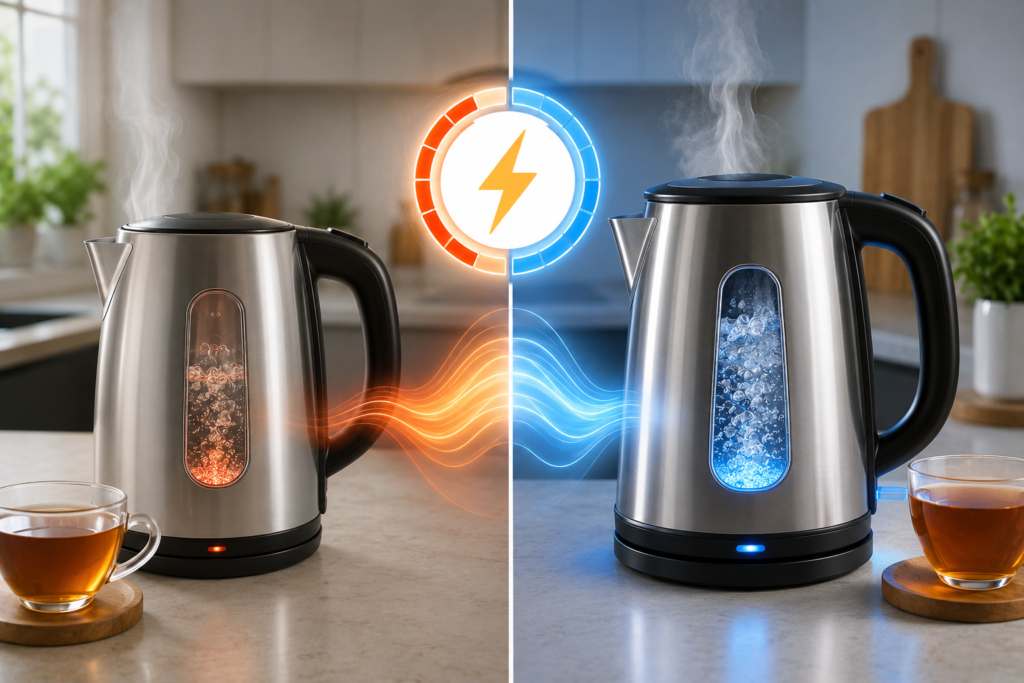
Wattage determines how much electrical energy the kettle converts into heat per second. More watts means water heats faster, all else being equal.
For pure speed, wattage is the deciding spec, with 1,500-watt kettles boiling roughly 30 to 40 percent faster than 1,000-watt models. That’s a meaningful difference if you’re boiling water daily for coffee, tea, or cooking.
| Wattage | Typical Boil Time (1.7L) | Notes |
| 1,000W | Slower, often 7–9 minutes | Common in budget or compact models |
| 1,200W | Moderate, around 6–7 minutes | Still noticeably slower than 1,500W |
| 1,500W | Fastest US standard, 5–7 minutes | Maximum practical wattage for most US outlets |
Some models specifically marketed around speed can boil smaller volumes even faster. One tested model reportedly heats a single cup in about 90 seconds using a rapid-boil setting, though full-capacity boils still take several minutes. Independent lab testing has also found that a 1,500-watt kettle can boil roughly 60 ounces of water in just over four minutes, which is considered fast for that volume.
If boil speed is your top priority, look specifically for a 1,500-watt model. Anything below that will consistently boil slower, regardless of other features.
Higher wattage means faster boiling, but it’s worth knowing this trade-off applies across most kitchen appliances see our guide on energy-efficient appliances for how this balance plays out with fridges, washers and dishwashers too
Capacity and Boil Time: Why Volume Matters Too
Wattage isn’t the only factor affecting how long you wait. The amount of water you’re boiling matters just as much.
Boiling a single cup takes far less time than boiling a full 1.7-litre kettle, even at the same wattage. If you usually only need one or two cups, a kettle with a smaller minimum fill line or a dedicated rapid single-cup setting can genuinely save time compared with always heating a full kettle.
Consumer Reports runs an ongoing lab testing program for electric kettles, measuring exact boil times for one liter of water across dozens of models most fall in the four-to-five-and-a-half-minute range, consistently faster than comparable stovetop and microwave methods tested under similar conditions.”
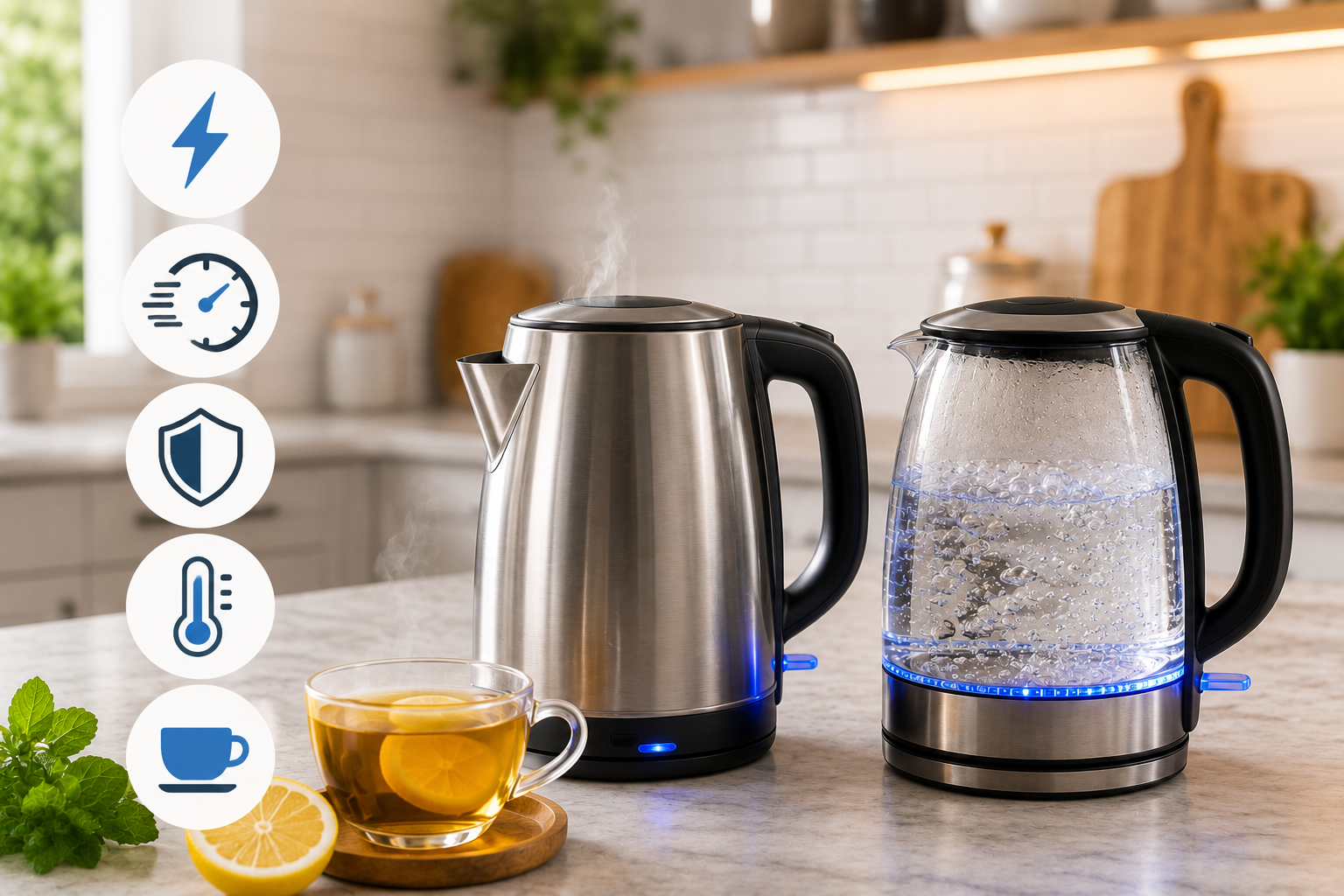
Material Matters: Stainless Steel vs Glass
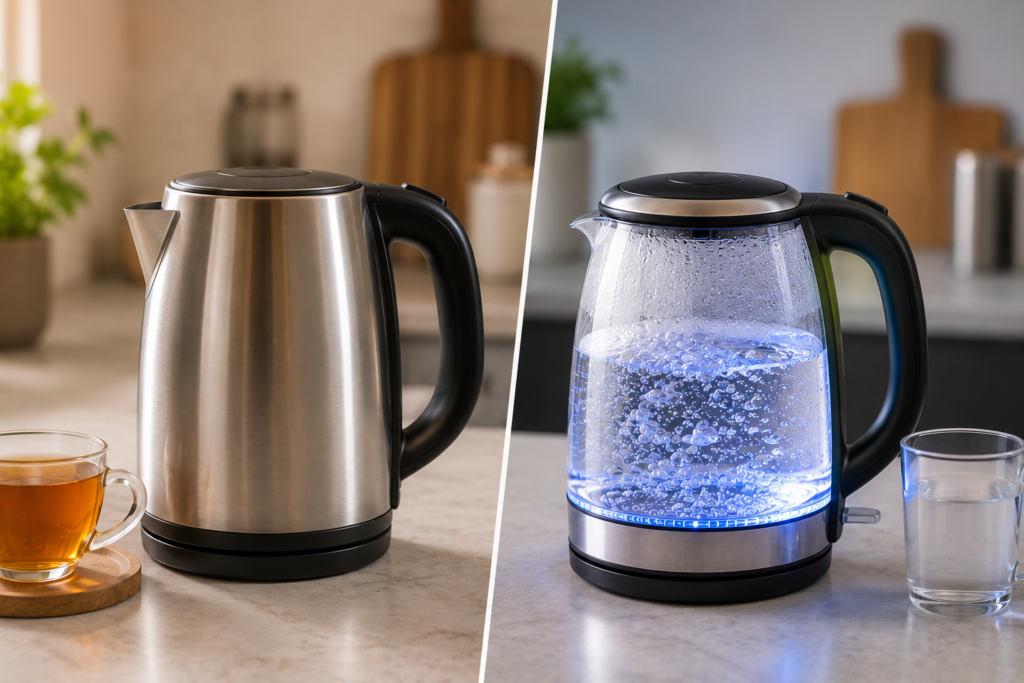
Kettle material affects durability, heat retention, and to some extent, how the kettle performs over repeated use.
Stainless Steel Kettles
Stainless steel is more durable, retains heat better, and does not shatter if dropped compared with glass alternatives. This makes it the practical choice for households using their kettle daily, since it holds up better to regular wear.
Glass Kettles
Glass lets you see the water level and boil progress, has no metallic taste, and generally looks more elegant on the counter. However, glass kettles are more fragile and typically cost less than stainless steel models.
Glass kettles tend to sit at a lower price point, generally $25 to $40, while stainless steel kettles cost more, typically $75 to $200, but last longer over time.
Our advice: For everyday, high-frequency use, stainless steel is the more practical long-term choice. Glass suits buyers who prioritise seeing the boil in progress and don’t mind more careful handling.
Temperature Control: Does It Affect Boiling Speed?
Variable temperature control doesn’t directly speed up boiling, but it does affect how efficiently you use your kettle depending on what you’re making.
If you only ever need a full rolling boil, temperature presets add convenience but not speed. If you regularly brew delicate teas or pour-over coffee that require specific temperatures below boiling, a kettle with presets saves you from overheating and then waiting for water to cool.
When temperature control matters:
- Green and white teas typically need lower temperatures, often well below a full boil
- Pour-over coffee brewing generally benefits from specific temperature ranges
- French press and black tea usually call for a full, near-boiling temperature
If you mainly need hot water fast for basic tasks like instant coffee, oatmeal, or general cooking, a simple on/off kettle without temperature presets will boil just as fast and cost less.
Auto Shut-Off and Boil-Dry Protection
These safety features don’t affect boil speed but are worth checking regardless of which kettle you choose. Auto shut-off stops the kettle once water reaches boiling point, preventing energy waste and reducing safety risks from an unattended kettle.
Boil-dry protection shuts the kettle off automatically if it’s accidentally switched on without enough water inside, protecting the heating element from damage. Most reputable kettles sold in the US include both features as standard.
Cordless Base Design
Nearly all modern electric kettles use a cordless base, where the kettle lifts off a powered stand rather than staying plugged in directly. This doesn’t affect boil speed, but it does make pouring more convenient and reduces cord clutter on the counter.
A cordless design allows for easy serving, with heating that stays convenient and safe thanks to a concealed heating element. Concealed heating elements, positioned beneath the kettle’s base plate rather than sitting exposed in the water, also help reduce mineral buildup over time.
Comparing Fast-Boiling Kettles by Price Tier
Here’s a general breakdown of what to expect at different price points based on current market patterns.
| Price Range | What You Typically Get |
| Under $35 | Basic 1,000–1,500W kettles, simple on/off operation, often stainless or basic glass |
| $35–$75 | 1,500W kettles with some temperature presets, better build quality |
| $75–$150 | Full temperature control, precision features, longer warranties |
| $150+ | Gooseneck spouts, degree-level precision, premium materials for specialty brewing |
A reliable mid-range electric kettle can offer strong performance at a reasonable price around $35, making it a solid choice for households wanting dependable daily performance without paying for extras like gooseneck spouts or degree-precise controls.
For buyers who specifically brew pour-over coffee, a gooseneck spout matters more than raw boil speed, since it controls water flow rather than affecting how fast the kettle heats.
Gooseneck vs Standard Spout: Does It Affect Speed?
Spout shape has no meaningful effect on boiling speed, but it significantly affects usability depending on how you use hot water.
Standard spout: Best for filling mugs, teapots, or pouring into wide openings like French presses or cooking pots.
Gooseneck spout: Designed for controlled, slow pouring, essential for pour-over coffee methods where water flow precision affects extraction.
If you only fill mugs or teapots, a standard spout works fine and often comes on faster, more affordable kettles. If pour-over coffee is a regular part of your routine, a gooseneck model is worth the investment regardless of boil speed differences.
Practical Buying Checklist for Fast Boiling
Before buying, run through this checklist to make sure you’re prioritising the right specs.
- Confirm wattage: Look specifically for 1,500W if boil speed is your top priority
- Check capacity: Match kettle size to your typical daily usage, not just maximum capacity
- Choose your material: Stainless steel for durability, glass for visibility and lower cost
- Decide on temperature control: Only pay extra for presets if you brew tea or coffee requiring specific temperatures
- Verify safety features: Confirm auto shut-off and boil-dry protection are included
- Match spout style to your use: Standard for general use, gooseneck for pour-over coffee
Common Mistakes When Buying a Fast-Boiling Kettle
- Assuming all kettles boil at similar speeds: Wattage differences create real, noticeable gaps in boil time, so it’s worth checking this spec specifically rather than assuming most kettles perform similarly.
- Overpaying for unused temperature presets: If you only need a full boil, paying extra for multiple temperature settings adds cost without adding value to your routine.
- Choosing glass without considering durability: Glass kettles look elegant but are more fragile, which matters in busy households or homes with children.
- Ignoring capacity needs: Buying an oversized kettle when you typically only need one or two cups means longer waits than necessary for smaller daily use.
- Overlooking descaling requirements: All kettles need periodic descaling to remove mineral buildup, and skipping this can affect both performance and boil speed over time.
Conclusion
The fastest electric kettle for your kitchen comes down to one spec above all others: wattage. A 1,500-watt kettle will consistently outperform lower-wattage models, regardless of price, material, or added features. From there, choose stainless steel for durability or glass for visibility and cost savings, and only pay extra for temperature presets if you regularly brew tea or coffee that requires specific temperatures. Focus your budget on wattage and build quality first, and you’ll end up with a kettle that genuinely saves you time every single day.
Frequently Asked Questions
1- What wattage is best for a fast-boiling kettle?
1,500 watts is the fastest wattage commonly available for US household kettles, offering noticeably quicker boil times than 1,000 or 1,200-watt models.
2- Do electric kettles boil water faster than microwaves or stovetops?
Generally yes. Controlled testing has found electric kettles boil water faster than both a standard microwave and a gas stovetop for the same volume.
3- Is stainless steel or glass better for fast boiling?
Material doesn’t significantly affect boil speed, but stainless steel retains heat better and holds up better to daily use over time.
4- Does temperature control slow down boiling?
No, temperature presets don’t slow down a full boil. They simply give you the option to stop heating at a lower temperature when needed.
5- How often should I descale my electric kettle?
Most manufacturers recommend descaling every four to eight weeks, depending on your local water hardness and how often you use the kettle.
6- Is a more expensive kettle always faster?
Not necessarily. Boil speed depends primarily on wattage, so a well-specified $35 kettle can boil just as fast as a $150 model if both run at 1,500 watts.