
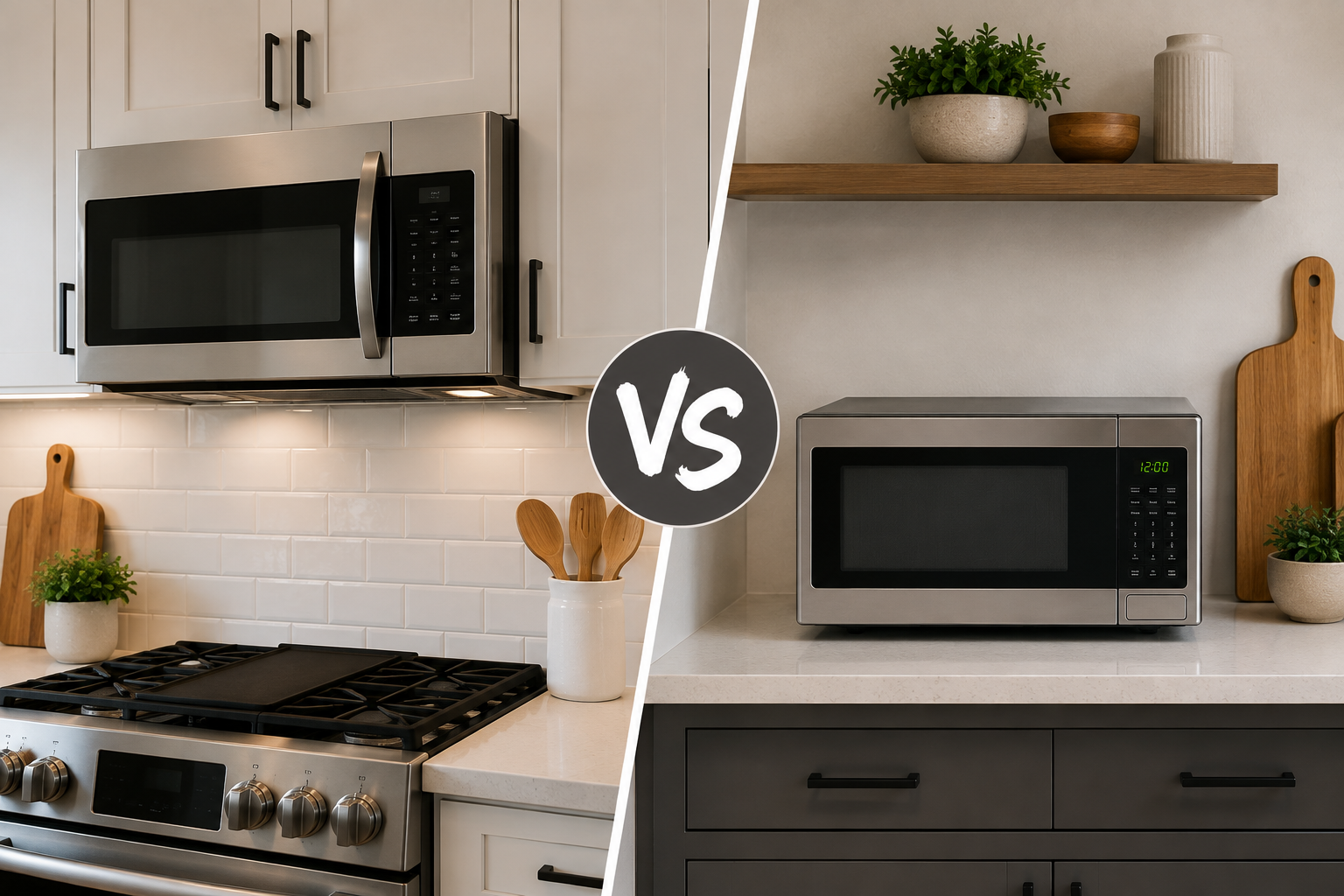
Choosing a new microwave sounds simple until you realize just how differently the two main styles function in a real kitchen. An over-the-range microwave vs countertop model isn’t just a question of appearance; it affects your counter space, your ventilation, your installation costs, and even how you cook every day.
This guide breaks down the practical differences between these two microwave types, covering space requirements, venting, cost, installation, and which option suits which kind of kitchen. By the end, you’ll have a clear answer for your own home, not just a generic recommendation.
When Is Each One a Best Choice?
For most American kitchens undergoing a renovation or upgrade, an over-the-range microwave offers the best combination of counter space savings and built-in ventilation, making it a popular default choice above the stove. A countertop microwave, however, remains the more flexible, affordable, and easier-to-install option, particularly for renters, smaller kitchens without a hood vent, or anyone not ready to commit to permanent installation. The right choice ultimately depends on your kitchen’s layout, your cooking habits, and how much you value flexibility over a built-in look.
What Is an Over-the-Range Microwave?
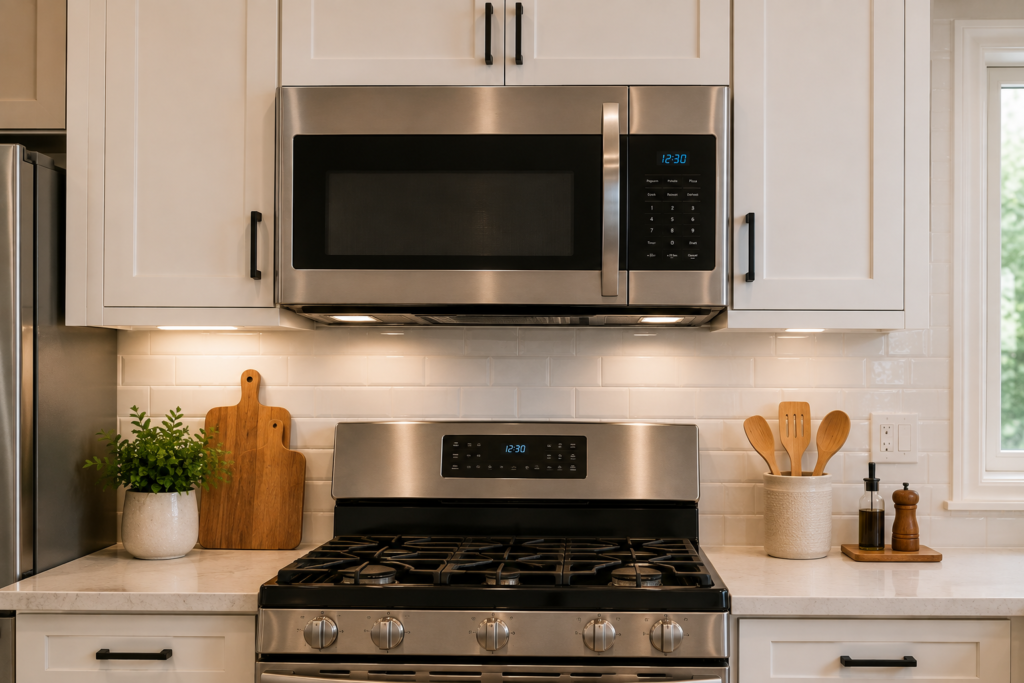
An over-the-range microwave installs directly above your stove or cooktop, typically mounted to the wall and, in most cases, vented to the cabinetry above or ducted outside. It replaces the traditional range hood, combining microwave functionality with cooking ventilation in a single unit.
This configuration has become a standard feature in many new home builds and kitchen renovations, since it frees up counter space entirely while still providing a place to heat and cook food.
What Is a Countertop Microwave?

A countertop microwave is a standalone, freestanding unit that sits on your counter, plugged into a standard outlet without any special installation. It’s the simplest and most common configuration, particularly in rental properties, apartments, and kitchens without existing venting infrastructure above the stove.
Countertop microwaves come in a wide range of sizes and price points, from compact models suited to small kitchens to larger units with advanced convection cooking features.
Side-by-Side Comparison Table
| Feature | Over-the-Range | Countertop |
| Counter Space Used | None | Yes, dedicated space required |
| Installation | Professional installation typically required | Plug-and-play, no installation |
| Ventilation | Often doubles as range hood | None, requires separate ventilation |
| Average Price | Higher | Lower |
| Portability | Fixed, permanent | Fully portable |
| Renter-Friendly | No | Yes |
| Capacity Range | Moderate to large | Compact to large |
| Best For | Renovations, permanent kitchens | Rentals, small kitchens, flexibility |
1- Space Considerations
Over-the-Range Microwaves
The single biggest advantage of an over-the-range microwave is the counter space it frees up. By mounting above the stove, it eliminates the need for a dedicated countertop footprint entirely, which can make a meaningful difference in smaller kitchens where every inch of counter space matters.
However, installation requires adequate cabinet clearance above the stove, and the microwave itself typically needs a minimum clearance height between the cooktop and the unit for safety, generally specified by the manufacturer and often required by local building codes.
Countertop Microwaves
A countertop microwave requires dedicated space somewhere in the kitchen, whether that’s directly on the counter, inside a cabinet cutout, or on a separate cart or shelf. This can be a real constraint in smaller kitchens with limited counter space, though it also means you’re not committed to a single fixed location.
Some homeowners solve this by placing a countertop microwave inside a lower cabinet or a dedicated shelf built into cabinetry, effectively gaining some of the counter-saving benefits of an over-the-range model without a full installation.
2- Ventilation: A Key Practical Difference
Ventilation is one of the most important, and most often overlooked, differences between these two microwave types.
Built-In Venting With Over-the-Range Models
Most over-the-range microwaves include a built-in fan and light, functioning similarly to a traditional range hood. Depending on the specific installation, this ventilation can either recirculate filtered air back into the kitchen or vent directly outside through ductwork, which is generally more effective at removing smoke, steam, and cooking odors.
If your kitchen doesn’t already have ductwork in place, opting for a fully vented installation can add meaningfully to the overall project cost, since it typically requires cutting through cabinetry or walls to route the venting outside.
No Built-In Venting With Countertop Models
A countertop microwave doesn’t include any ventilation function, meaning your stove still needs a separate range hood or another ventilation solution nearby. This isn’t necessarily a downside, since many kitchens already have adequate ventilation installed separately, but it’s an important factor to consider if you’re specifically hoping a new microwave will also help manage cooking smoke and odors.
3- Installation and Renovation Considerations
Over-the-Range Installation
Installing an over-the-range microwave typically requires professional installation, particularly if it involves new ducting or electrical work. It needs to be securely mounted to wall studs or a dedicated bracket, and if you’re replacing an existing range hood, the electrical and venting connections need to be compatible with the new unit.
This makes over-the-range microwaves a better fit for planned kitchen renovations or new construction, rather than a quick upgrade to an existing kitchen setup.
Countertop Installation
A countertop microwave requires essentially no installation. It simply needs a nearby standard electrical outlet and a stable, flat surface, making it the far more practical choice for anyone wanting a quick, low-effort upgrade or a temporary solution while planning a larger renovation.
Cost Comparison
Cost differences between these two microwave types can be substantial once installation is factored in.
Countertop microwaves are generally the more affordable option upfront, and since there’s no installation cost involved, the sticker price is essentially the total cost. Over-the-range microwaves typically cost more for the unit itself, reflecting the added venting and mounting hardware, and professional installation adds a further cost on top of the appliance price, particularly if new ductwork is required.
For homeowners planning a full kitchen renovation, the added cost of an over-the-range model is often absorbed into the broader project budget. For those simply looking to replace or add a microwave without a larger renovation, a countertop model usually represents significantly better value.
Capacity and Cooking Performance
Both configurations are available across a range of capacities, though there are some general tendencies worth noting.
Over-the-range microwaves are often somewhat larger on average, since they’re frequently chosen as part of a full kitchen suite alongside larger appliances. Countertop microwaves range from very compact models suited to studio apartments up to large-capacity units nearly matching over-the-range sizes, giving buyers considerably more flexibility in choosing a capacity that matches their actual cooking needs, independent of installation constraints.
Cooking performance, including features like convection cooking, sensor cooking, or inverter technology, is available across both configurations and depends more on the specific model and brand than on whether it’s mounted or countertop.
Which Option Suits Which Kitchen?
Choose an Over-the-Range Microwave If
- You’re planning a full kitchen renovation or building a new home
- Counter space is limited and highly valued
- You want a single unit that handles both cooking ventilation and microwave functionality
- You’re comfortable with the higher upfront cost and professional installation
- You want a clean, built-in look integrated with the rest of your kitchen cabinetry
Choose a Countertop Microwave If
- You’re renting or don’t want a permanent installation
- You want the flexibility to move or replace the unit easily
- Your kitchen already has adequate ventilation from an existing range hood
- You’re working with a smaller budget or want a quick, simple upgrade
- You prefer having the microwave at counter height rather than reaching upward
Safety Considerations
Both configurations are equally safe when installed and used correctly, though each comes with its own specific considerations.
Over-the-range microwaves need to be securely mounted, since a poorly installed unit above a stove poses a real safety risk if it were to become loose over time. It’s worth confirming that installation meets manufacturer specifications and local building codes, particularly regarding clearance above the cooktop.
Countertop microwaves need adequate surrounding clearance for ventilation, since blocking the vents on the back or sides of the unit can cause overheating. It’s also worth ensuring the countertop or shelf supporting the unit can handle its weight securely, particularly for larger-capacity models.
Maintenance Differences
Maintenance requirements differ somewhat between the two configurations, largely due to the added ventilation components in over-the-range models.
Over-the-range units require periodic cleaning or replacement of the ventilation filter, in addition to standard interior cleaning, since grease and cooking residue can build up in the fan and filter over time, particularly with a recirculating (non-ducted) system. Countertop microwaves only require standard interior cleaning, without any additional filter maintenance, making them somewhat simpler to maintain long-term.
Practical Buying Tips
Regardless of which configuration you’re leaning toward, a few practical tips help narrow the decision:
- Measure your available space carefully, including cabinet clearance above the stove for over-the-range models
- Confirm whether your kitchen has existing ductwork if you want a fully vented over-the-range installation
- Factor in installation costs, not just the appliance price, when comparing over-the-range options
- Consider your long-term plans, since a countertop model offers more flexibility if you might move or renovate later
- Check the capacity and wattage against your actual cooking habits, rather than assuming a larger unit is automatically better
Common Mistakes to Avoid
- Choosing an over-the-range model without checking ventilation options, resulting in unexpected installation costs for new ductwork
- Assuming a countertop microwave will always be the cheaper option, without factoring in a separate range hood if your kitchen lacks proper ventilation
- Ignoring clearance requirements, particularly the minimum distance required between an over-the-range unit and the cooktop below
- Underestimating counter space needs for a countertop model, especially in already tight kitchens
- Overlooking weight and stability when placing a larger countertop microwave on an unsupported shelf or cart
Conclusion
The decision between an over-the-range microwave vs countertop model comes down to your kitchen’s layout, your renovation plans, and how much you value built-in ventilation and freed-up counter space against flexibility and lower cost. An over-the-range microwave suits homeowners planning a permanent kitchen upgrade with existing or plannable ventilation, while a countertop microwave remains the practical, low-commitment choice for renters, smaller kitchens, or anyone wanting a straightforward replacement without installation hassle. Considering your available space, budget, and long-term plans will point you toward the option that genuinely fits your home.
Frequently Asked Questions
1- Is an over-the-range microwave better than a countertop microwave?
Neither is universally better. Over-the-range models save counter space and often include built-in ventilation, while countertop models offer more flexibility, lower cost, and no installation requirements.
2- Can I replace a range hood with an over-the-range microwave?
Yes, in most cases, provided the electrical and ventilation connections are compatible or can be adapted, though this typically requires professional installation to ensure it’s done safely and up to code.
3- Do countertop microwaves need special ventilation?
No. Countertop microwaves don’t include or require built-in ventilation, though your kitchen should still have separate ventilation, such as a range hood, for cooking on the stove.
4- Which is more affordable, over-the-range or countertop microwaves?
Countertop microwaves are generally more affordable overall, since they require no installation costs, while over-the-range models add both a higher unit price and professional installation expenses.
5- Can I install an over-the-range microwave myself?
While some experienced DIYers may attempt it, professional installation is generally recommended, particularly for the electrical work and secure wall mounting required for safety.