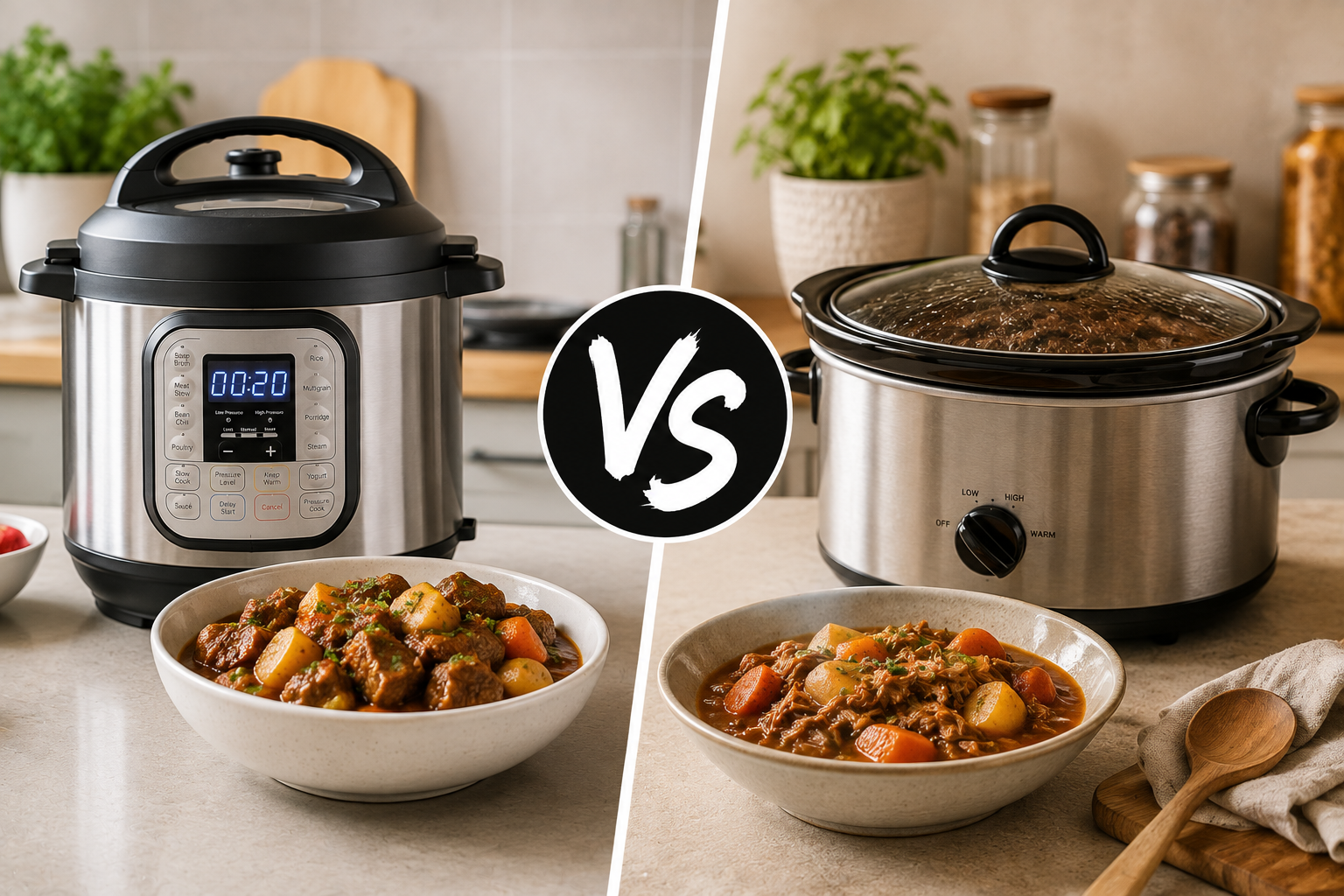
Both appliances promise the same basic outcome, a tender, flavorful meal with minimal hands-on effort, but they get there in almost opposite ways. The pressure cooker vs slow cooker decision comes down to one core trade-off: speed versus time, and how much flexibility you need in your daily schedule.
This guide breaks down how each appliance actually works, where they overlap, where they genuinely differ, and which one, or both, makes the most sense for your household’s cooking habits. Rather than declaring a universal winner, we’ll walk through the practical realities so you can choose based on how you actually cook.
Pressure Cooker vs Slow Cooker: The Quick Answer
A pressure cooker cooks food quickly under sealed, high-pressure conditions, turning what would normally take an hour into roughly 20 minutes, making it ideal for last-minute meals and busy weeknights when you’re short on time. A slow cooker does the opposite, cooking food gently over many hours at low heat, ideal for households that can start a meal in the morning and let it cook, unattended, until dinnertime. Many home cooks eventually find real value in owning both, since they solve genuinely different scheduling problems rather than competing directly for the same use case.
How Pressure Cookers Work
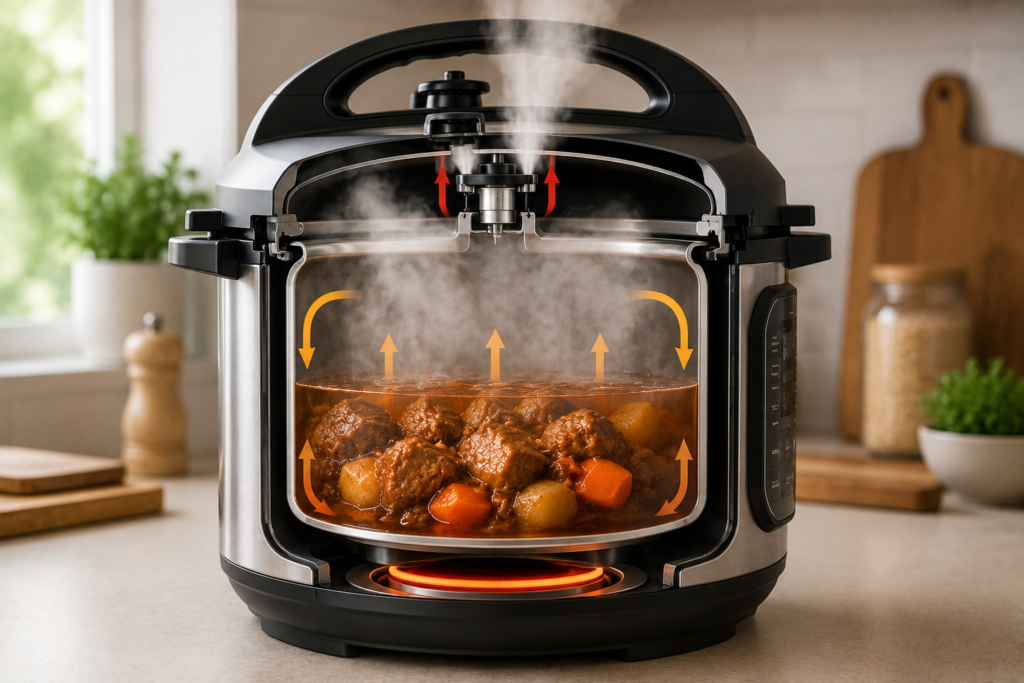
A pressure cooker uses a sealed, airtight pot to trap steam and build internal pressure, which raises the boiling point of water well above the standard 212°F. This higher-pressure, higher-temperature environment cooks food dramatically faster than conventional methods, since heat penetrates ingredients more quickly and thoroughly than it would in an open pot.
Electric pressure cookers, often generically called Instant Pots after the popular brand, automate this entire process with digital controls, programmable timers, and automatic pressure regulation, removing much of the manual monitoring that older stovetop pressure cookers required.
How Slow Cookers Work
A slow cooker, often known by the brand name Crock-Pot, cooks food at a low, steady temperature over an extended period, typically 4 to 10 hours depending on the setting. Rather than relying on pressure, it uses gentle, consistent heat to slowly break down tougher cuts of meat and meld flavors together over time.
This low-and-slow method requires essentially no monitoring once you’ve added ingredients and set the timer, making it one of the most genuinely hands-off cooking methods available for a home kitchen.
Pressure Cooker vs Slow Cooker: Key Differences
| Feature | Pressure Cooker | Slow Cooker |
| Cooking Time | Minutes (typically 15–45 min) | Hours (typically 4–10 hours) |
| Cooking Method | Sealed, high-pressure steam | Low, steady, open-lid heat |
| Best For | Last-minute meals, busy schedules | All-day cooking, hands-off convenience |
| Monitoring Needed | Minimal, but requires being present at start/finish | None once set |
| Flavor Development | Fast extraction, still flavorful | Deep, slow-developed flavor |
| Texture Results | Tender, quick-cooked | Very tender, fall-apart texture |
| Multi-Function Options | Often includes slow cook setting too | Some models add sauté/sear functions |
| Learning Curve | Slight, especially for stovetop models | Minimal |
1- Speed: The Most Obvious Difference
This is the most immediately noticeable distinction between the two appliances. A pressure cooker can take a dish that would normally require an hour of simmering or braising and complete it in around 20 minutes, thanks to the sealed, high-pressure cooking environment. This makes it genuinely useful for weeknights when you didn’t plan ahead but still want a proper home-cooked meal.
A slow cooker, by design, takes the opposite approach. It requires planning ahead, since most recipes need 6 to 8 hours or more on low heat, but in exchange, it demands essentially no attention once it’s running. For households that can prep ingredients in the morning before work, this trade-off works perfectly, dinner is ready and waiting by the time everyone’s home.
2- Flavor and Texture Comparison
- Pressure Cooker Results
Because pressure cooking works so quickly, it’s remarkably effective at tenderizing tough cuts of meat and dried beans in a fraction of the traditional cooking time, while the sealed environment helps retain moisture and flavor that might otherwise evaporate away. The result is a properly cooked, flavorful dish, though some home cooks feel slow-cooked meals develop slightly deeper, more melded flavors given the additional cooking time.
- Slow Cooker Results
The extended cooking time in a slow cooker allows flavors to develop and meld more thoroughly, particularly in dishes with multiple ingredients like stews, chilis, and braises. The low, steady heat also produces an exceptionally tender, almost fall-apart texture in tougher cuts of meat, since the collagen has more time to fully break down compared to the faster pressure-cooking process.
Neither method is objectively superior in flavor, it largely comes down to personal preference and how much time you have available.
3- Convenience and Daily Use
- Pressure Cooker Convenience
A pressure cooker suits cooks who want a proper meal without much advance planning. You can start it after work and have dinner ready within 30 to 45 minutes total, including prep time, making it a strong fit for unpredictable schedules or last-minute dinner decisions.
- Slow Cooker Convenience
A slow cooker suits cooks who can plan a few minutes ahead, typically in the morning, but then want zero further involvement until dinner. This works particularly well for households with a consistent daily routine, where starting the slow cooker before leaving for work naturally fits into the existing schedule.
4- Safety Considerations
Modern electric pressure cookers include multiple built-in safety mechanisms, such as lid-locking systems that prevent opening while the pot remains pressurized, along with automatic pressure release valves that vent excess pressure safely. These features have significantly improved the safety profile of pressure cooking compared to older stovetop models, which required more careful manual monitoring.
Slow cookers are generally considered one of the safest unattended cooking appliances, since they operate at low, steady temperatures without any pressure buildup, making them well suited to running for extended periods while you’re away from home.
5- Multi-Function Overlap
Many current electric pressure cookers include a dedicated slow cook setting, effectively offering both cooking methods within a single appliance. This can be a practical solution for households with limited counter or storage space, or for anyone not yet certain which cooking style they’ll use more often.
That said, dedicated slow cookers sometimes offer more precise, consistent low-temperature control specifically tuned for extended slow cooking, since it’s their core function rather than a secondary mode. If slow cooking is a frequent, primary use case for your household, a dedicated slow cooker may still outperform a multi-function pressure cooker’s slow cook setting.
Which Meals Suit Which Appliance?
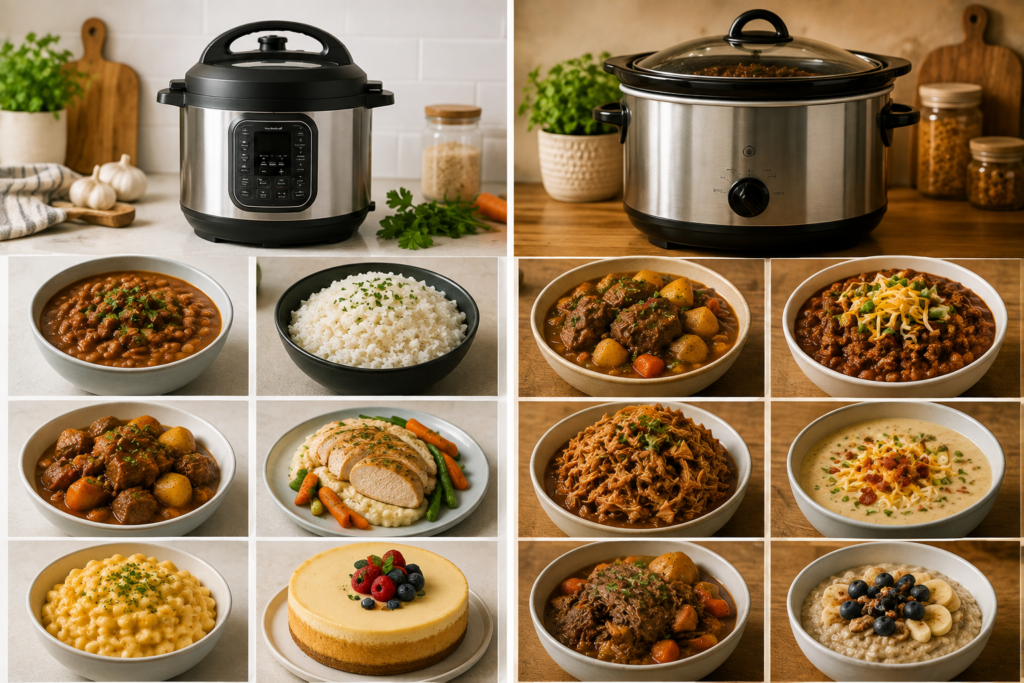
| Dish Type | Better Choice | Why |
| Weeknight chili or stew | Pressure cooker | Fast, ready in under an hour |
| All-day pulled pork or brisket | Slow cooker | Extended time develops deep flavor and tenderness |
| Rice and grains | Pressure cooker | Quick, consistent results |
| Dried beans from scratch | Pressure cooker | Dramatically reduces traditional soaking/cooking time |
| Overnight oats or breakfast prep | Slow cooker | Can run unattended overnight |
| Last-minute dinner decision | Pressure cooker | Minimal advance planning required |
| Holiday side dishes, kept warm | Slow cooker | Built-in keep-warm function frees up stovetop/oven space |
Which One Should You Buy First?
Choose a Pressure Cooker If:
- Your schedule is unpredictable, and you often decide on dinner last-minute
- You want to cook dried beans, grains, or tougher cuts of meat quickly
- You’re looking for one appliance that can also slow cook, sauté, and steam
- You value speed and don’t mind being present at the start and end of cooking
Choose a Slow Cooker If:
- You have a predictable daily routine and can prep ingredients in the morning
- You want a genuinely hands-off cooking method with zero monitoring required
- You regularly cook dishes that benefit from long, slow flavor development, like chili, stews, or pulled meats
- You want to free up your stovetop or oven for other dishes, particularly around the holidays
Consider Both If:
Many households find real value in owning both appliances, since they solve different scheduling problems rather than overlapping directly. A pressure cooker handles unplanned, last-minute dinners, while a slow cooker manages the mornings when you can prep ahead and want dinner ready without any further effort.
Capacity Considerations for Both Appliances
Whichever you choose, matching capacity to your household size affects both cooking results and everyday practicality.
| Household Size | Recommended Capacity |
| 1–2 people | 3–4 quarts |
| 3–4 people | 6 quarts |
| 5–6 people | 6–8 quarts |
| 7+ people or regular entertaining | 7.5+ quarts |
A 6-quart model, in either category, works well for most standard households, offering enough capacity for family meals with some room for leftovers.
Cleanup and Maintenance
Both appliances are generally straightforward to maintain. Most pressure cooker and slow cooker inserts, whether stainless steel, ceramic, or nonstick-coated, are dishwasher-safe, simplifying daily cleanup considerably. Pressure cookers with a sealing ring may require occasional replacement, since the silicone gasket can wear down or retain odors over time with heavy use. Slow cookers, having fewer moving parts and no pressure-sealing components, generally require less specialized maintenance overall.
Energy Use Comparison
Pressure cookers tend to be more energy-efficient per meal, since their significantly shorter cooking time reduces overall energy consumption compared to hours of continuous slow cooking. Slow cookers, while running for much longer, generally use relatively low wattage throughout the cooking process, so the total energy cost per meal, while higher than a pressure cooker’s, still tends to remain modest compared to using a full-size oven for an equivalent multi-hour cook.
Practical Buying Tips
A few practical considerations can help guide your decision, regardless of which direction you’re leaning:
- Think honestly about your daily schedule and how much advance planning you typically do for dinner
- Consider whether a multi-function pressure cooker with a slow cook setting could meet both needs in one appliance
- Match capacity to your household size rather than defaulting to the largest available option
- Factor in counter and storage space, particularly if you’re considering owning both appliances separately
- Prioritize models with strong safety features, especially lid-locking mechanisms for pressure cookers
Common Mistakes to Avoid
- Assuming one appliance can fully replace the other, when they actually serve different scheduling needs
- Choosing a multi-function pressure cooker for heavy slow-cooking use, then finding its slow cook setting less consistent than a dedicated slow cooker
- Underestimating capacity needs, resulting in an appliance too small for regular family meals
- Skipping safety feature research, particularly for households new to pressure cooking
- Ignoring your actual daily routine, buying a slow cooker despite an unpredictable schedule that rarely allows for morning meal prep
Conclusion
The choice between a pressure cooker vs slow cooker ultimately comes down to your schedule, not which appliance is objectively better. A pressure cooker rewards last-minute cooking with genuine speed, while a slow cooker rewards a bit of morning planning with a completely hands-off afternoon and evening. Think honestly about how your household actually approaches dinner on a typical day, and that answer will point you toward the appliance, or the combination of both, that will genuinely earn its place in your kitchen.
Frequently Asked Questions
1- Is a pressure cooker faster than a slow cooker?
Yes, significantly. A pressure cooker typically completes a meal in 20 to 45 minutes that would take a slow cooker 4 to 10 hours, thanks to its sealed, high-pressure cooking environment.
2- Can a pressure cooker do everything a slow cooker can do?
Many electric pressure cookers include a dedicated slow cook function, though dedicated slow cookers may offer more precise, consistent low-temperature control for extended cooking specifically.
3- Which is better for meal prep, a pressure cooker or a slow cooker?
Both work well for meal prep, though a pressure cooker suits last-minute or same-day prep, while a slow cooker suits planning ahead, particularly for batch cooking overnight or during the workday.
4- Is it safe to leave a slow cooker running while at work?
Yes, slow cookers are specifically designed for extended, unattended cooking at low, steady temperatures, making them one of the safer appliances to leave running while away from home.
5- Do pressure cookers preserve nutrients better than slow cookers?
Pressure cooking’s shorter cooking time and sealed environment can help preserve more nutrients compared to some longer cooking methods, though both methods generally retain nutrients better than boiling with an open lid.
6- Which appliance produces more tender meat?
Both can produce very tender results, though slow cookers’ extended cooking time often produces a slightly more fall-apart texture, particularly for tougher cuts, compared to the faster pressure-cooking process.
7- Should I buy a combination pressure cooker and slow cooker, or two separate appliances?
A combination multi-function model works well for households with limited space or lighter use of either function, while dedicated separate appliances generally offer better, more consistent performance for households using both cooking methods frequently.