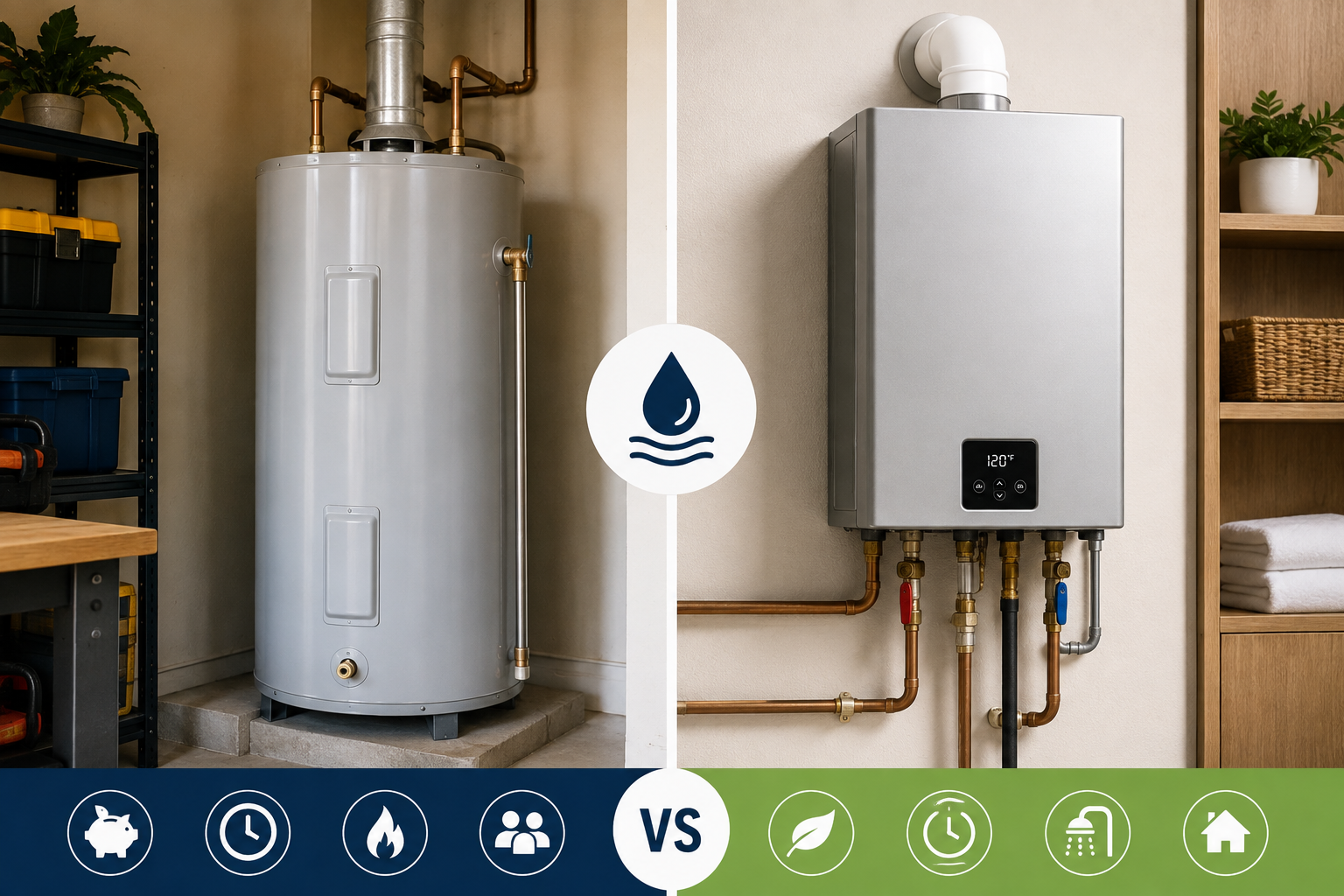
Replacing a water heater is one of those decisions that quietly affects your daily comfort and monthly bills for years to come. The core choice usually comes down to two options: a traditional tank water heater or a tankless, on-demand system.
This guide compares tank and tankless water heaters across cost, efficiency, lifespan, and maintenance, helping you decide which fits your household best. We’ll also cover water heater lifespan, energy efficiency, and installation costs for American homeowners weighing this decision.
By the end, you’ll understand the real trade-offs involved and which option makes more sense for your specific home and hot water needs.
Tank vs Tankless Water Heaters?
Tank water heaters generally suit homeowners focused on upfront cost who have high daily hot water consumption, while tankless systems tend to work better for those using less hot water, living in smaller spaces, or prioritizing a longer product lifespan. Tank units cost less initially but use more energy and typically need replacing sooner, while tankless units cost more upfront but often last considerably longer and run more efficiently.
There’s no universal “better” choice here, since the right answer depends heavily on your household size, hot water usage patterns, and how you weigh upfront cost against long-term savings.
How Tank Water Heaters Work
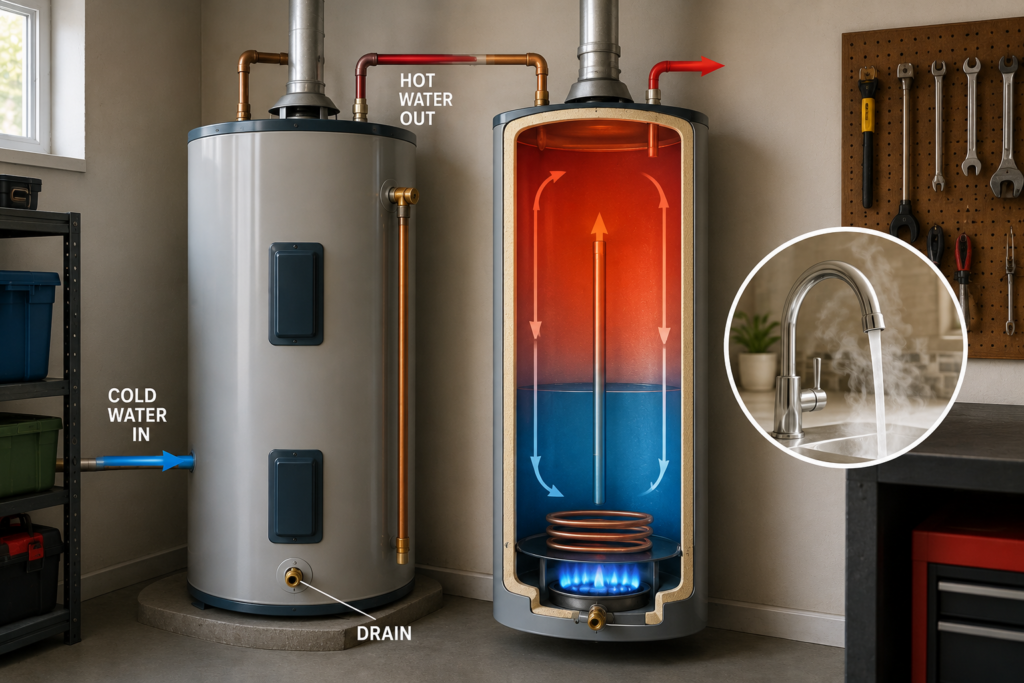
A conventional tank water heater stores a set volume of water, typically 30 to 80 gallons, keeping it heated continuously so hot water is ready whenever you need it. This constant heating means the tank uses energy even when no one is actively using hot water, a phenomenon known as standby heat loss.
How Tankless Water Heaters Work
Tankless, or on-demand, water heaters skip the storage tank entirely, instead heating water directly and instantly as it flows through the unit when you turn on a hot water tap. Because there’s no stored water to maintain, tankless systems avoid the standby heat loss that affects tank units, contributing to their generally higher efficiency.
Comparing Upfront Costs
Upfront cost is often the first major difference homeowners notice when comparing these two systems.
A new tank water heater typically costs between $1,600 and $5,400, with the exact price varying based on brand, size, and specific features. This lower initial cost makes tank systems a popular choice for homeowners working with a tighter budget.
Tankless water heaters typically cost $500 to $1,250 more upfront than traditional tank systems, and installation can be more complex, particularly if your home needs gas line or electrical upgrades to support the new unit.
Comparing Energy Efficiency
Efficiency is where tankless systems generally pull ahead, though the size of the advantage depends on your household’s hot water usage.
According to the U.S. Department of Energy, tankless water heaters are 24% to 34% more energy efficient than conventional tank models for households using 41 gallons or less of hot water daily, and still 8% to 14% more efficient for high-usage homes using 86 or more gallons per day.
The average storage tank water heater has an energy factor between 0.58 and 0.65, with typical annual operating costs of $300 to $600, while tankless units generally have an energy factor between 0.82 and 0.99, with annual operating costs typically falling between $150 and $300.
Comparing Lifespan
Lifespan is one of the most significant long-term differences between these two system types.
Tank water heaters typically last 8 to 12 years, while properly maintained tankless units can function effectively for 15 to 20 years or more. Some manufacturers report even longer results with excellent care: tankless systems can reach 25 to 30 years of service in well-maintained cases, partly because on-demand heating reduces constant wear on components and the absence of a storage tank limits long-term corrosion exposure.
Comparing Maintenance Requirements
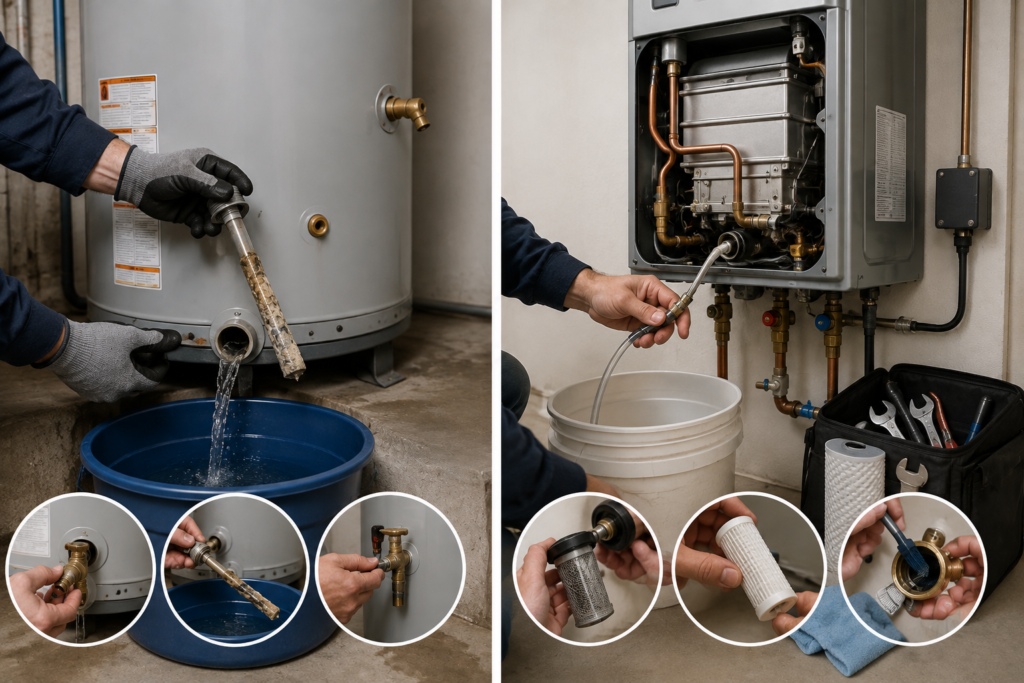
Both system types require regular maintenance, though the specific tasks and costs differ somewhat between them.
Annual maintenance for tank systems includes flushing to remove sediment buildup, checking the temperature and pressure relief valve, and inspecting the anode rod, typically costing $100 to $200 per service visit. Tankless units require periodic flushing and descaling to prevent mineral buildup, particularly in areas with hard water, with professional maintenance services typically costing $150 to $250 annually.
Skipping tankless maintenance carries real consequences: without proper annual maintenance in hard water areas, a tankless unit’s lifespan can drop to 10 to 12 years, closer to what a standard tank system offers.
Comparing Space and Installation
Physical space requirements and installation complexity also factor meaningfully into the decision.
Tank water heaters require a dedicated space for the tank itself, generally a utility closet, basement, or garage area sized to accommodate a large cylindrical unit. Tankless systems mount on a wall and take up considerably less floor space, which can be a meaningful advantage in homes with limited utility space.
Installation complexity also differs, since tankless systems can sometimes require gas or electrical upgrades that add to overall project cost and complexity compared with straightforward tank replacements.
Long-Term Cost Comparison
Looking beyond upfront price paints a more complete financial picture for comparing these two options.
For many households, a tankless water heater breaks even around year 6 to 8, after which it typically starts saving money compared with a tank system. Since tankless units often last 15 to 20 or more years, some homeowners could save $1,500 to $3,000 or more over the full lifespan compared with replacing a tank unit twice during that same period.
That said, the math doesn’t favor tankless for every household. For one- to two-person homes with normal usage, tankless units often don’t fully pay back their higher upfront cost within their lifespan, since annual energy savings of roughly $45 to $80 don’t always offset the $500 to $1,250 price premium.
Comparing Tank and Tankless at a Glance
| Factor | Tank Water Heater | Tankless Water Heater |
| Upfront cost | Lower | Higher |
| Typical lifespan | 8–12 years | 15–20+ years |
| Energy efficiency | Lower, standby heat loss | Higher, on-demand heating |
| Space required | More, dedicated tank space | Less, wall-mounted |
| Annual maintenance cost | ~$100–$200 | ~$150–$250 |
| Best for | High simultaneous demand, tighter budgets | Smaller households, long-term homeowners |
Which Households Benefit Most From Each Option
Matching the right system to your household’s specific needs matters more than choosing based on general trends alone.
When a Tank Water Heater Makes Sense
Tank systems work well for homeowners with high daily hot water consumption and a preference for lower upfront costs. Larger families needing to run multiple showers, a dishwasher, and laundry simultaneously often appreciate a tank’s ability to handle high simultaneous demand without the flow rate limitations some tankless units face.
When a Tankless Water Heater Makes Sense
Tankless systems tend to suit homeowners who use less hot water, live in smaller spaces, and prioritize long-term product lifespan over the lowest possible upfront cost. If you’re planning to stay in your home long-term, the extended lifespan and efficiency gains have more time to offset the higher initial investment.
Heat Pump Water Heaters: A Middle Ground Worth Knowing
Beyond the traditional tank versus tankless choice, heat pump water heaters offer an additional option worth understanding before you decide.
Heat pump water heaters can be two to three times more efficient than traditional tank systems, offering lower installation costs than tankless units along with better cold-climate performance in many cases. This makes them worth researching as a potential middle-ground option, particularly for households wanting efficiency gains without the full tankless price tag.
Hard Water Considerations
If your home has hard water, this factor deserves extra attention regardless of which system type you’re considering.
In hard water areas, minerals form scale inside water heaters, an issue that affects both tank and tankless systems, though tankless units are often more sensitive to mineral buildup due to their narrower internal components. Homes in hard water regions should factor in more frequent descaling and potentially a water softening system to protect either type of water heater over its lifespan.
Practical Buying Advice
A few considerations can help you make a confident, well-informed decision for your specific home.
- Calculate your household’s daily hot water usage: Understanding whether your usage falls below or above the 41-gallon-per-day threshold helps clarify how much efficiency advantage a tankless system would realistically offer you.
- Factor in your home’s existing infrastructure: If your home would need significant gas or electrical upgrades for tankless installation, factor this into your total cost comparison upfront.
- Consider how long you plan to stay in your home: Tankless systems generally offer better long-term value for homeowners planning to stay put for many years, while tank systems may suit those planning a shorter-term stay.
- Budget for ongoing maintenance: Whichever system you choose, factor in annual maintenance costs, since skipping this can shorten either system’s lifespan and efficiency.
- Research heat pump options too: Don’t overlook heat pump water heaters as a potential middle-ground choice, particularly if efficiency matters but the full tankless price tag feels like a stretch.
Conclusion
Choosing between a tank and tankless water heater comes down to weighing upfront cost against long-term efficiency, lifespan, and your household’s specific hot water needs. Tank systems remain the more affordable, straightforward choice for larger families with high simultaneous demand, while tankless systems generally reward smaller households and long-term homeowners with better efficiency and a significantly longer lifespan. Whichever direction you choose, factor in ongoing maintenance and your home’s existing infrastructure to make sure your total cost picture reflects the real, long-term value of your investment.
Frequently Asked Questions
1- Is a tankless water heater really worth the extra cost?
It depends on your household’s hot water usage and how long you plan to stay in your home. Smaller households often see a longer payback period, while larger, long-term homeowners often benefit more from the efficiency and lifespan gains.
2- How much longer do tankless water heaters last than tank systems?
Tankless units typically last 15 to 20 years or more, compared with 8 to 12 years for standard tank systems, roughly 5 to 8 years longer on average.
3- Do tankless water heaters really save on energy costs?
Yes, tankless systems are generally 24% to 34% more energy efficient than tank systems for typical household usage, primarily due to eliminating standby heat loss.
4- Is maintenance more expensive for tankless systems?
Annual maintenance costs are somewhat higher for tankless units, though their longer lifespan and lower operating costs often offset this over time.
5- Can hard water damage a tankless water heater?
Yes, hard water can cause mineral scale buildup in tankless units, making regular descaling especially important in hard water regions.
6- What’s a good alternative if tankless feels too expensive?
Heat pump water heaters offer a middle-ground option, providing significant efficiency gains over traditional tanks at a lower installation cost than most tankless systems.