
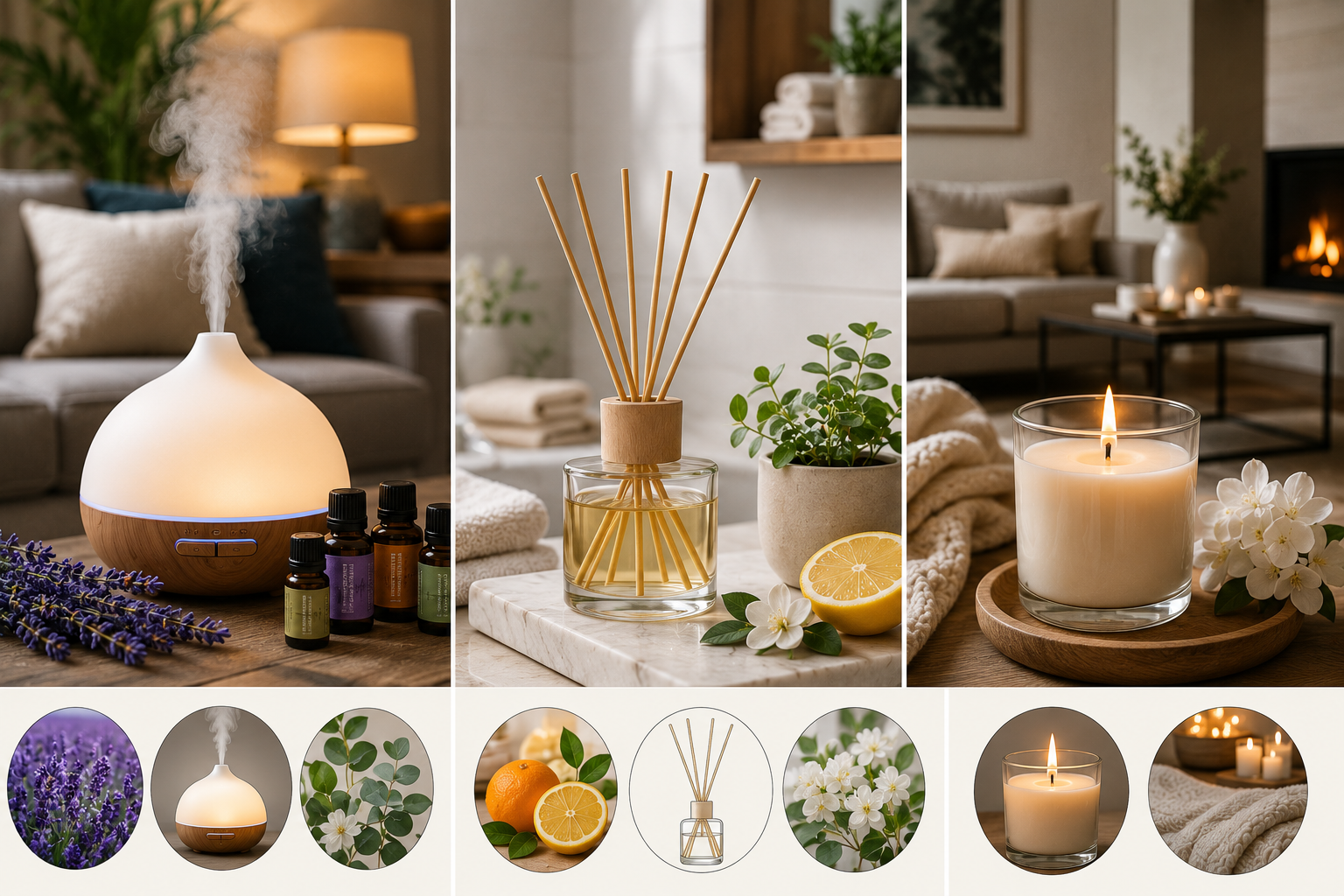
These three methods dominate the home fragrance world, but essential oils vs reed diffusers vs scented candles solve genuinely different problems depending on how you actually want scent to work in your space. One delivers instant, powerful ambiance. One runs quietly for months without a single plug or flame. One offers targeted, adjustable aromatherapy you control minute by minute.
This guide goes beyond a simple side-by-side and digs into what actually matters once you own one of these: real cost per week, how long each one genuinely lasts, placement mistakes that ruin performance, and which option fits which room and lifestyle, so you can choose based on how you’ll actually live with it.
Essential Oils vs. Reed Diffusers vs. Candles
If you want continuous, low-maintenance fragrance with zero electricity, no flame, and the lowest realistic cost per week of scent, a reed diffuser wins. If you want targeted, adjustable aromatherapy, mood-based blending, and the flexibility to change scents daily, an essential oil diffuser is the better fit, though it typically costs more per week once you factor in oil consumption. If you want the strongest, most immediate fragrance and cozy ambiance for a room you’re actively enjoying, a scented candle still delivers something neither passive option can fully replicate, but it demands your attention while it burns.
How These Three Methods Actually Differ at the Core
Reed Diffusers: Passive and Continuous
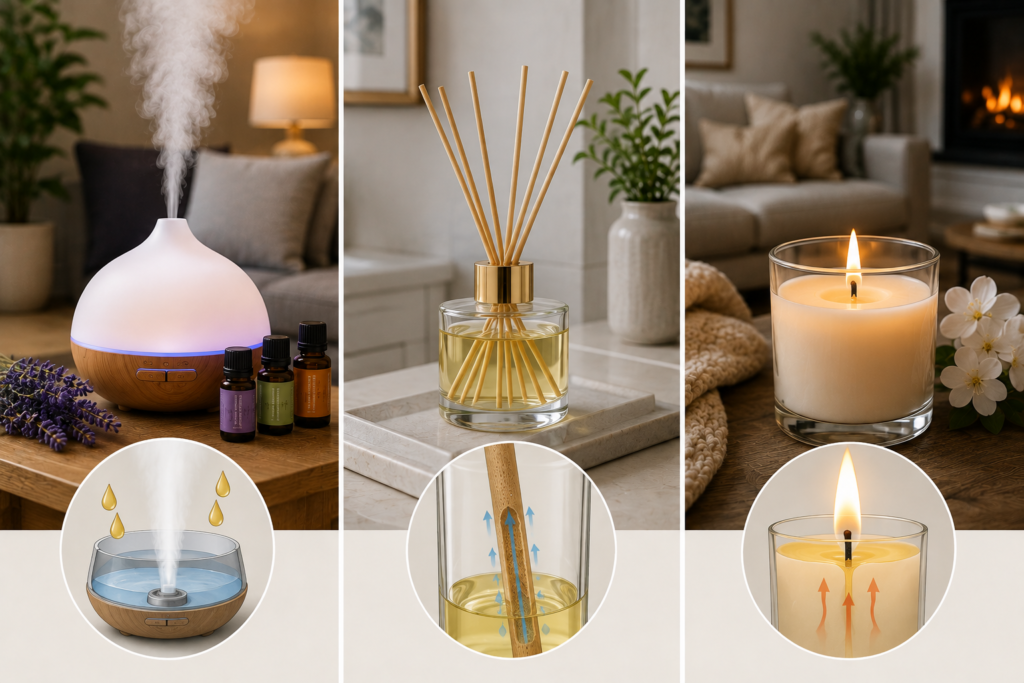
A reed diffuser is entirely passive, porous rattan reeds sit in a container of fragranced oil, and capillary action slowly wicks that oil up the reeds where it evaporates into the room. No electricity, no flame, no daily attention required beyond occasionally flipping the reeds to refresh the scent.
Essential Oil Diffusers: Active and Adjustable
An essential oil diffuser is an active device, most commonly ultrasonic, using water and high-frequency vibration to break oil into a fine mist that disperses into the air over a set number of hours per fill. Because it’s electric and adjustable, you get real control: how long it runs, how strong the mist is, and which specific oil or blend you’re using at any given moment.
Scented Candles: Combustion-Driven and Intense
Candles rely on an open flame to melt fragranced wax and vaporize the scent, which is why they consistently deliver the strongest, most immediate fragrance throw of the three, but that same flame is also what makes them the only option requiring genuine, constant supervision.
Essential Oils vs Reed Diffusers vs Candles: Full Comparison
| Factor | Reed Diffuser | Essential Oil Diffuser | Scented Candle |
| Power source | None (passive) | Electric | Open flame |
| Typical runtime per fill | 5–7 weeks | 2–8 hours | 20–80 hours (per candle) |
| Maintenance | Very low (flip reeds weekly) | Moderate (clean, refill regularly) | Moderate (trim wick, monitor) |
| Scent adjustability | Low (fixed oil blend) | High (change oils daily) | Low (fixed once lit) |
| Safety supervision needed | None | Minimal | Constant, never unattended |
| Best room fit | Bathrooms, entryways, unattended spaces | Bedrooms, offices, targeted aromatherapy | Living rooms, occupied spaces |
The Real Cost of Each Option, Not Just the Sticker Price
Why Upfront Price Is Misleading
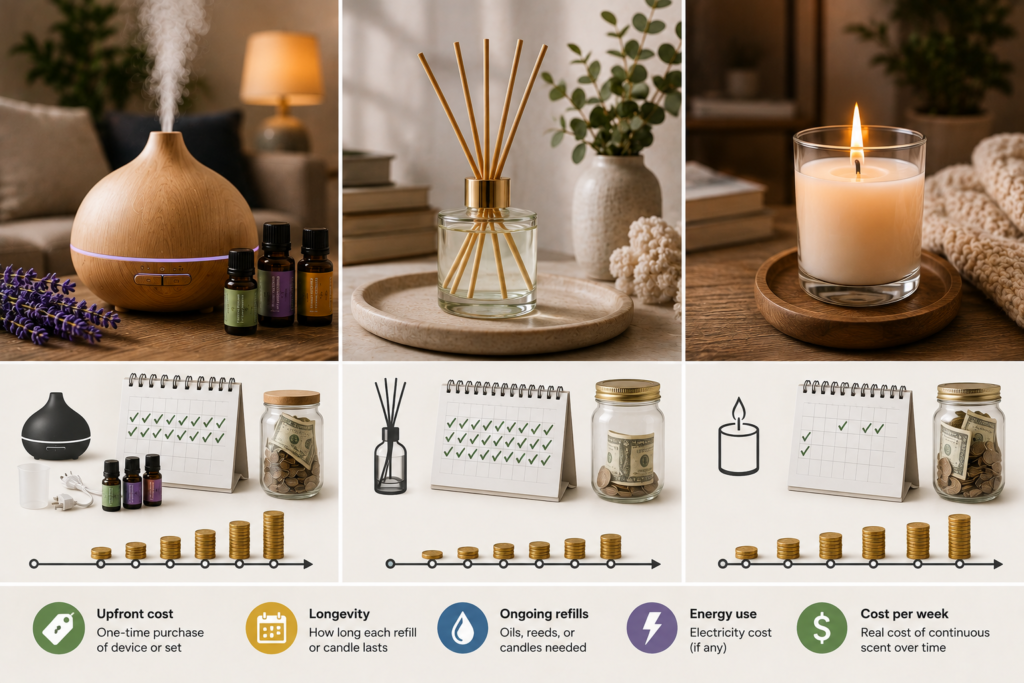
A reed diffuser set often looks more expensive sitting next to a basic ultrasonic diffuser on the shelf, but that comparison ignores what happens after purchase. Once you factor in ongoing oil consumption, the actual cost per week of continuous scent tells a very different story.
Reed Diffusers: Low Cost Once You Account for Longevity
A quality reed diffuser typically lasts 5 to 7 weeks on a single fill, running the entire time with zero additional purchases, no electricity, no refills, no replacement parts. Spread across that full runtime, the cost per week of continuous fragrance tends to land considerably lower than most people expect from a “premium-feeling” product.
Essential Oil Diffusers: Higher Ongoing Cost, More Control
A basic ultrasonic diffuser itself is often inexpensive, but daily use burns through meaningful quantities of essential oil over the course of a month, and quality, named essential oils aren’t cheap. When you add up the device plus a month of regular oil refills, the real cost per week of continuous scent frequently runs several times higher than a reed diffuser delivering similar ambient fragrance.
Candles: Mid-Range, But You’re Paying for Presence
Candles fall somewhere in between, a well-made candle can burn for dozens of hours, but you’re only getting fragrance while it’s actively lit and attended, meaning the “cost per week of ambient scent” comparison doesn’t really apply the same way, since candles aren’t meant to run continuously and unattended in the first place.
Reed Diffusers Deserve More Credit Than They Get
Why “Boring” Doesn’t Mean “Weak”
Reed diffusers sometimes get dismissed as the mild, forgettable option next to a bold candle or a trendy diffuser, but their real strength is consistency, delivering the same steady scent level day after day for weeks, without you having to think about it at all.
The Role of Carrier Oils
Most reed diffuser fragrance oils are blended with a carrier oil, a neutral base oil that dilutes the fragrance for safe, controlled release and slows evaporation, which is precisely why a reed diffuser lasts weeks rather than days. Carrier oils also help maintain the right viscosity for the reeds to properly wick fragrance upward.
How to Extend a Reed Diffuser’s Life
Flipping the reeds roughly once a week refreshes the exposed surface area and noticeably revives scent strength. Keeping the diffuser away from direct sunlight, drafts, and heating or cooling vents also meaningfully extends how long the fragrance actually lasts, since heat and airflow accelerate evaporation.
Choosing Reed Count and Placement for Your Room
More reeds, and a wider container opening, generally mean stronger, faster fragrance dispersal, useful for larger rooms, while fewer reeds in a narrower-mouthed vessel suit smaller spaces like a powder room or entryway table.
Understanding Aromatherapy Claims Honestly
What’s Genuinely Well-Established
Certain scents, particularly citrus and floral notes like lavender, are widely and consistently associated with relaxation or mood-lifting effects in general wellness and aromatherapy contexts, and many people report genuinely feeling calmer or more focused around specific scents.
What to Take With a Grain of Salt
Be cautious of marketing claims citing very specific statistics (a stated percentage improvement in sleep quality or anxiety reduction, for example) without a clearly identified, credible source behind them, this kind of precise-sounding number is common in home fragrance marketing but isn’t always backed by rigorous, independent research. Enjoy aromatherapy for the genuine mood and ambiance benefits it offers, without treating scent alone as a substitute for medical or psychological care.
Essential Oil Diffusers Offer the Most Aromatherapy Flexibility
If targeted, mood-based scent selection is genuinely important to you, energizing citrus in the morning, calming lavender before bed, an essential oil diffuser offers far more day-to-day adjustability than a reed diffuser’s fixed blend or a candle’s single scent per burn.
Matching Each Method to How You Actually Live
If You Travel Often or Forget Maintenance Easily
A reed diffuser is the clear winner, since it requires essentially no attention for weeks at a time, unlike an essential oil diffuser that needs regular refilling or a candle that needs active supervision.
If You Want Different Scents for Different Moods
An essential oil diffuser gives you that flexibility in a way neither a reed diffuser nor a candle can match, letting you swap oils in minutes based on the day or your mood.
If You Host Guests or Want Maximum Cozy Ambiance
A candle still wins here, the combination of scent, warm light, and flame genuinely creates an atmosphere the other two options simply can’t replicate, provided you’re actually present in the room to enjoy and monitor it.
If You Have Pets or Small Children
Reed diffusers, positioned out of reach, are generally the safest passive option, avoiding both flame risk and the concentrated mist exposure a diffuser can create in a small, enclosed space. Always keep any home fragrance product, essential oils included, well out of reach of curious pets and kids.
Room-by-Room Recommendations
| Room | Best Option | Why |
| Bathroom | Reed diffuser | Low maintenance, consistent scent in a small space |
| Bedroom | Essential oil diffuser | Adjustable, safe to run while sleeping |
| Living room | Scented candle | Strongest ambiance for occupied spaces |
| Entryway | Reed diffuser | Unattended welcome scent, weeks of runtime |
| Home office | Essential oil diffuser | Targeted focus/energy scent blends |
| Nursery | Reed diffuser (out of reach) | Flame-free, mild, low-maintenance |
Common Mistakes to Avoid
- Comparing upfront price without factoring in ongoing costs, missing that a reed diffuser is often cheaper per week than a diffuser plus its oil consumption
- Placing a reed diffuser in direct sun or near a vent, accelerating evaporation and cutting its usable life significantly short
- Using undiluted essential oil directly on reeds without a proper carrier oil, resulting in overpowering scent and faster depletion
- Trusting specific aromatherapy statistics from marketing copy without a clear, credible source, rather than enjoying scent for its genuine mood and ambiance value
- Leaving a candle burning unattended, assuming it’s just as low-risk as a reed diffuser or electric diffuser
Conclusion
The right answer in essential oils vs reed diffusers vs scented candles isn’t about which product is objectively best, it’s about matching the method to how you actually live. Reed diffusers reward low-maintenance, budget-conscious households wanting weeks of consistent background scent. Essential oil diffusers reward anyone who wants genuine, adjustable control over mood and fragrance day to day. Candles reward the moments you’re actually home, present, and want the strongest possible ambiance a home fragrance can deliver. Many households end up genuinely using all three, matching each one to the specific room and moment where it performs best.
Frequently Asked Questions
1- How long do reed diffusers actually last?
Most quality reed diffusers last around 5 to 7 weeks per fill, though this varies based on room temperature, sunlight exposure, and how often you flip the reeds to refresh scent output.
2- Is an essential oil diffuser more expensive than a reed diffuser?
Often, yes, once you factor in ongoing costs. While the diffuser device itself may be cheap, regular essential oil refills for daily use frequently add up to a higher cost per week of scent than a reed diffuser delivers.
3- Do reed diffusers work as well as candles for fragrance strength?
Generally not quite as strong. Reed diffusers offer a milder, more consistent background scent, while candles deliver a noticeably stronger, more immediate fragrance throw thanks to heat-driven vaporization.
4- What is a carrier oil, and why does it matter for reed diffusers?
A carrier oil is a neutral base oil used to dilute concentrated fragrance, helping it wick properly up the reeds, extend how long the scent lasts, and prevent an overpowering concentration in the room.
5- Can I use essential oils directly in a reed diffuser without dilution?
It’s not generally recommended without an appropriate carrier oil, since undiluted essential oil can be too strong, evaporate unevenly, and deplete considerably faster than a properly blended diffuser oil.
6- Which is safer around pets and kids, a diffuser or a reed diffuser?
A reed diffuser, positioned well out of reach, is generally considered the safer passive option, since it avoids both flame risk and the more concentrated airborne mist an active diffuser produces in an enclosed space.
7- Are aromatherapy benefits from essential oils scientifically proven?
Certain scents are widely associated with relaxation or mood benefits in general wellness contexts, but be cautious of very specific statistics in marketing claims without a clearly credible source behind them.