
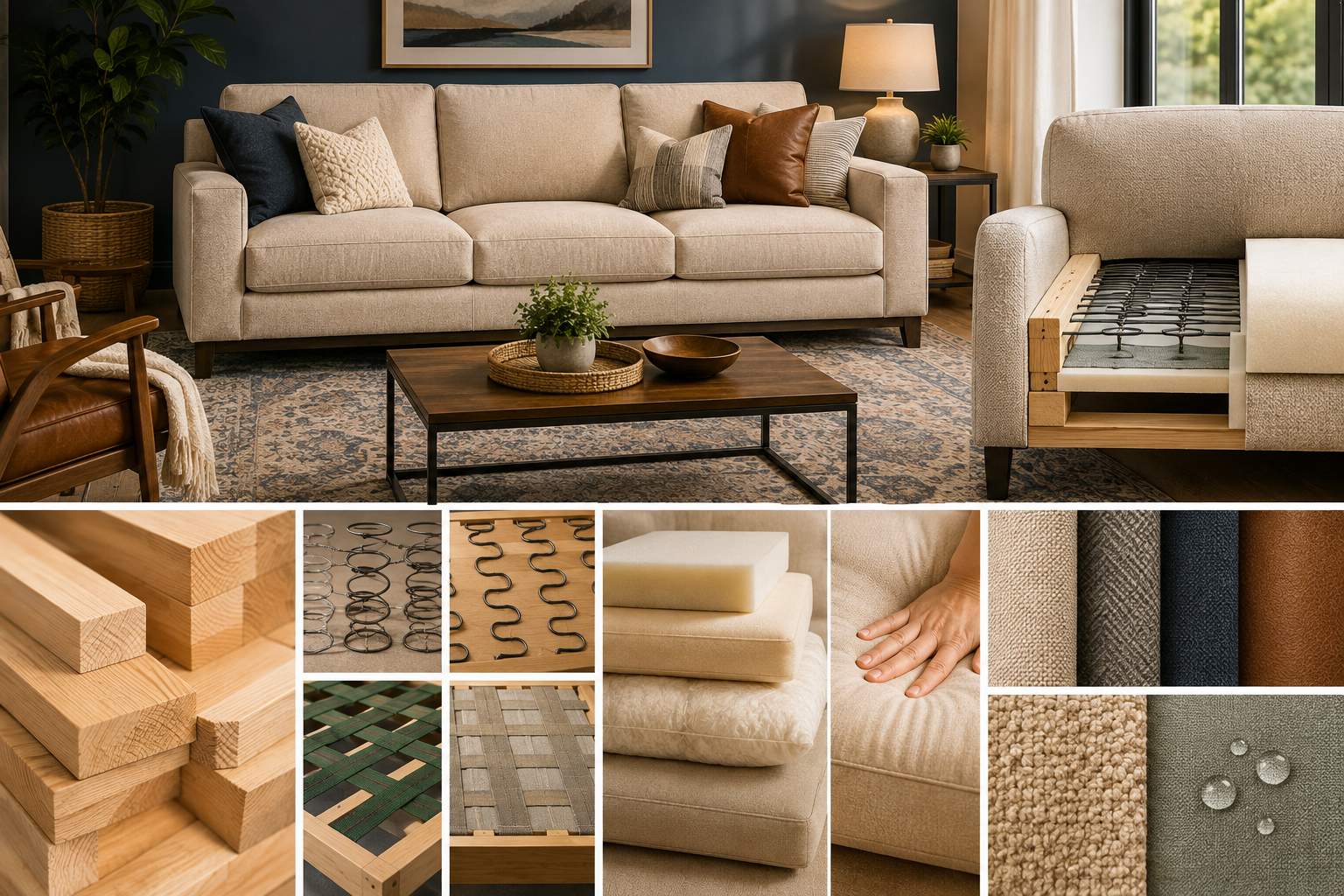
A sofa is one of the biggest furniture investments most homeowners make yet it’s also one of the easiest purchases to get wrong. It’s tempting to choose based on looks alone, but the sofa that photographs beautifully in a showroom can sag, wear out, or feel uncomfortable within a year if the construction underneath isn’t right.
A good sofa comes down to four things: a sturdy frame (kiln-dried hardwood is the gold standard), a reliable spring or suspension system, quality cushion fill that holds its shape, and upholstery suited to your household’s lifestyle. Beyond construction, the right size and style depend entirely on your room’s dimensions and how you actually plan to use the sofa day to day.
This guide walks through everything that goes into choosing a sofa the parts you can’t see as well as the parts you can so you can shop with real confidence instead of guessing based on appearance.
Why Sofa Construction Matters More Than Looks
A sofa might look identical to another one online, but the internal construction frame, springs, and cushion fill is what actually determines how long it lasts and how comfortable it stays over time. Two sofas with the same fabric and silhouette can have completely different lifespans depending on what’s built underneath the upholstery.
Understanding these fundamentals helps you avoid a common and costly mistake: paying for style without paying for durability.
Step 1: Understand Frame Construction (The Foundation of Every Sofa)
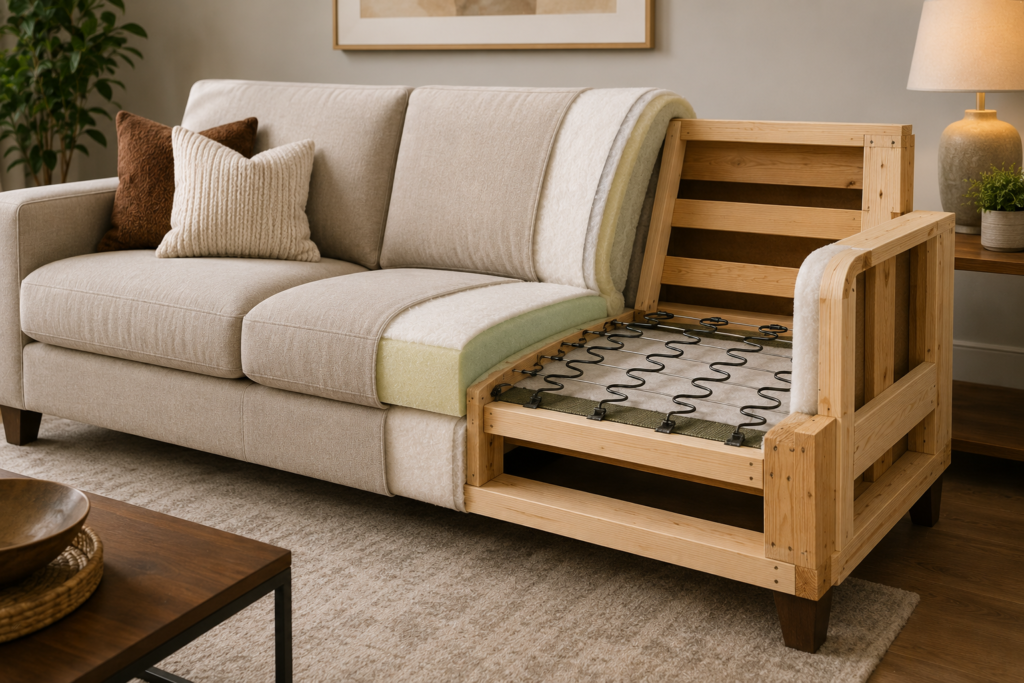
The frame is the skeleton of your sofa, and it has the single biggest impact on how long the sofa will last.
Frame Materials Compared
| Frame Material | Durability | Notes |
| Kiln-dried hardwood | Excellent | The industry standard for quality; resists warping and cracking |
| Plywood | Good | A reasonable, more affordable alternative to solid hardwood |
| Engineered wood | Moderate | Can work well if well-constructed, but varies widely in quality |
| Particle board | Poor | Cheapest and most fragile; prone to breaking under repeated stress |
| Metal | Good–Excellent | Common in modern designs; strong but can feel less “warm” |
What to look for: Kiln-dried hardwood is preferred because the drying process removes moisture that would otherwise cause the wood to warp or crack over time. Reinforced corner blocks and joints (screwed and glued, not just stapled) add meaningful extra durability.
Step 2: Learn the Spring and Suspension Systems
The spring system sits on top of the frame and supports the cushions. It’s one of the most overlooked parts of a sofa, but it significantly affects comfort and how well the sofa holds up over years of use.
Common Suspension Types
- Eight-Way Hand-Tied Springs
Considered the highest-quality construction method. Coil springs are hand-tied at eight points for maximum strength and durability, which prevents sagging over time. This method is the most labor-intensive and typically the most expensive. - Sinuous (S-Spring) Wire
Zigzag-shaped metal springs that run front to back across the frame. This is the most common suspension system in quality sofas today well-engineered, less expensive to produce than hand-tied springs, and generally reliable for many years of normal use. - Web Suspension
Interlaced bands of fabric or elastic webbing stretched across the frame. This is the least durable option and is typically found in budget sofas it works initially but tends to lose tension faster than spring-based systems, especially under heavy or repeated use. - Practical takeaway: For most households, a well-constructed sinuous spring system offers a solid balance of comfort, durability, and price. Reserve hand-tied springs for households with heavy daily use or a longer-term investment mindset, since the price difference is substantial.
Step 3: Choose the Right Cushion Fill
Cushion fill is what you’re actually sitting on, and it plays a major role in both comfort and how quickly the sofa starts to look worn.
Types of Cushion Fill
| Fill Type | Feel | Durability |
| High-density foam | Firm, supportive | Holds shape well if density is high enough |
| Low-density foam | Softer initially | Compresses and flattens faster |
| Down/feather | Very soft, plush | Requires regular fluffing; loses loft over time |
| Foam-wrapped in down | Balanced softness and support | Good middle ground between structure and plushness |
| Fiber (polyester) | Soft, budget-friendly | Compresses faster than foam |
A Key Detail: Foam Density
Foam density measured in pounds per cubic foot is one of the clearest indicators of long-term cushion quality.
- High-density foam (around 1.8 lbs/cubic foot or higher) maintains its shape well under regular use.
- Low-density foam (roughly 1.0 to 1.5 lbs/cubic foot) tends to compress and develop a flattened, sunken look much sooner sometimes within a year or two of regular use.
If a retailer lists foam density, it’s worth checking, especially for sofas you expect to use daily for years.
Attached vs. Loose Cushions
- Attached cushions are sewn directly to the frame, giving a streamlined look with minimal upkeep, but they don’t allow for rotation, so wear can become uneven over time.
- Loose cushions can be flipped and rotated periodically, helping distribute wear more evenly and making cleaning easier though they require occasional repositioning to keep a neat appearance.
Step 4: Pick Upholstery That Matches Your Lifestyle
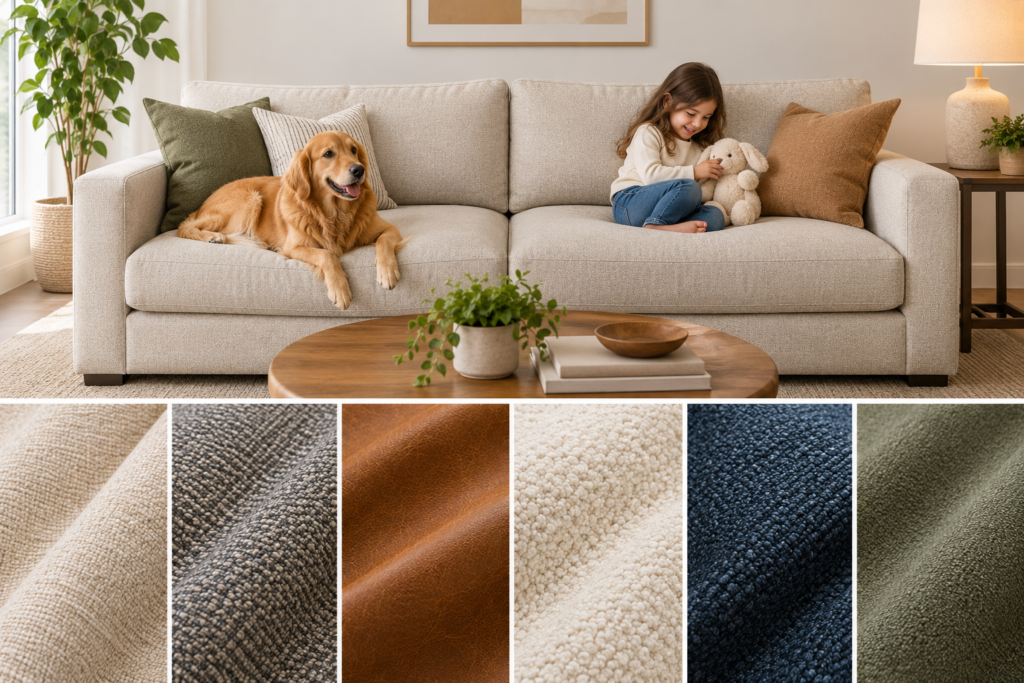
Fabric affects comfort, appearance, and critically how well the sofa holds up to daily life, kids, and pets.
Fabric Sofas
Fabric offers a huge range of colors, textures, and price points, and many modern options include performance fabrics engineered specifically to resist stains and everyday wear.
Common fabric types:
- Polyester — durable, affordable, and resistant to general wear
- Performance fabrics — designed specifically for stain resistance and durability, often a strong choice for households with kids or pets
- Natural fibers (cotton, linen) — comfortable and breathable, but generally less stain-resistant than performance blends
Leather Sofas
Leather is known for durability and a refined look. It’s generally easier to wipe clean than fabric and can develop a natural patina a worn-in character over time.
Trade-offs: Leather is typically a bigger upfront investment and can feel cooler to the touch in cold climates compared to fabric.
Faux Leather
A synthetic alternative that mimics the look of leather at a lower cost, with easier day-to-day maintenance, though it generally doesn’t age or develop the same natural character as genuine leather over time.
Choosing Based on Household Needs
| Household Type | Recommended Fabric |
| Kids or pets in the home | Performance fabric or leather (easier cleaning) |
| Allergy-sensitive household | Leather or tightly woven fabric (less fiber shedding) |
| Style-focused, lower-traffic room | Natural fibers, more delicate weaves |
| Budget-conscious | Polyester or faux leather |
Step 5: Get the Sizing Right
Sofa dimensions vary more than people expect, and getting the size wrong is one of the most common and expensive buying mistakes.
Standard Sofa Dimensions
| Measurement | Typical Range |
| Overall width (length) | 76″ to 90″ (standard sofa); 48″ to 72″ (loveseat) |
| Overall depth | 35″ to 44″ |
| Overall height | 33″ to 42″ |
| Seat height | 18″ to 22″ |
| Seat depth | 19″ to 24″ |
Seat Depth Matters More Than You’d Think
- Shorter individuals often find a seat depth of around 19 to 21 inches more comfortable, allowing feet to rest flat on the floor with knees supported.
- Taller individuals typically prefer a deeper seat, around 22 to 24 inches, for better thigh and leg support.
Measuring Your Space Correctly
- Measure the intended room location, leaving adequate walking space around the sofa.
- Measure every doorway, hallway, and stairwell the sofa needs to pass through to reach the room not just the final placement area.
- Check ceiling height against sofa back height, especially for high-backed styles, to make sure the proportions feel balanced in the room.
Step 6: Choose a Style and Configuration
Beyond construction and size, sofa style should match both your room’s layout and how you actually use the space.
Common Sofa Configurations
- Standard sofa — the most versatile option, fitting most living rooms and layouts
- Loveseat — a smaller two-seat option, ideal for tighter spaces or as a secondary seating piece
- Sectional — an L-shaped or U-shaped configuration offering more total seating, well-suited to larger rooms or households that entertain often
- Sleeper sofa — includes a pull-out mattress, useful for guest rooms or multi-purpose spaces
Low-Profile vs. High-Backed Styles
- Low-profile sofas create a sleek, modern look and work well in rooms with lower ceilings.
- High-backed sofas offer more head and neck support and tend to suit rooms with taller ceilings, where they don’t visually overwhelm the space.
Practical Buying Advice
- Prioritize frame quality above all else. A well-built frame is genuinely difficult and expensive to fix later — it’s the one element not worth compromising on.
- Ask about foam density if comfort and longevity matter to you. Higher-density foam costs more upfront but holds its shape significantly longer.
- Choose upholstery based on real household use, not just aesthetics — performance fabric or leather is worth considering if kids, pets, or heavy daily use are part of your routine.
- Test in person when possible. Sit, lean back, and press into the cushion corners to get a sense of how quickly the cushion recovers its shape.
- Measure twice — literally. Measure both the room and every doorway or hallway the sofa needs to pass through before ordering.
- Consider loose cushions if longevity matters. The ability to rotate cushions helps distribute wear more evenly over years of use.
Conclusion
The most beautiful sofa in the world won’t feel like a good purchase a year later if the frame warps, the springs sag, or the cushions flatten out. Start with the fundamentals frame material, spring system, and cushion fill and only then narrow down fabric, color, and style based on your household’s needs and your room’s dimensions.
Take your time with this one. A sofa isn’t a purchase you’ll want to repeat every couple of years, so investing a little extra attention into the construction details now will pay off in comfort and durability for a long time to come.
FAQ
1- What’s the most important factor in sofa quality?
Frame construction is generally considered the most critical factor, since it determines the sofa’s overall structural lifespan. Kiln-dried hardwood with reinforced joints is the standard to look for.
2- Is leather better than fabric for a sofa?
It depends on your priorities. Leather tends to be more durable and easier to clean, making it a strong choice for busy households, while fabric especially performance fabric offers more variety in look and feel at a range of price points.
3- How do I know if a sofa’s cushions are good quality?
Check the foam density if it’s listed (higher is generally more durable), and physically test the cushion by pressing into it and observing how quickly it returns to shape. Slow or incomplete recovery often signals lower-quality fill.
4- What’s the difference between sinuous springs and hand-tied springs?
Sinuous (S-spring) systems are more common and cost-effective, offering solid durability for most households. Eight-way hand-tied springs are considered the premium option, offering slightly more durability and comfort, but at a significantly higher price.
5- How long should a good sofa last?
A well-built frame can hold up for a decade or more, but overall lifespan also depends heavily on cushion fill quality and how the sofa is used and maintained lower-quality cushion fill can start breaking down in as little as a couple of years, even with a solid frame underneath.
6- Should I choose attached or loose cushions?
Loose cushions allow for rotation, which helps distribute wear evenly and can extend the sofa’s comfortable lifespan, while attached cushions offer a cleaner, more streamlined look with less day-to-day upkeep.