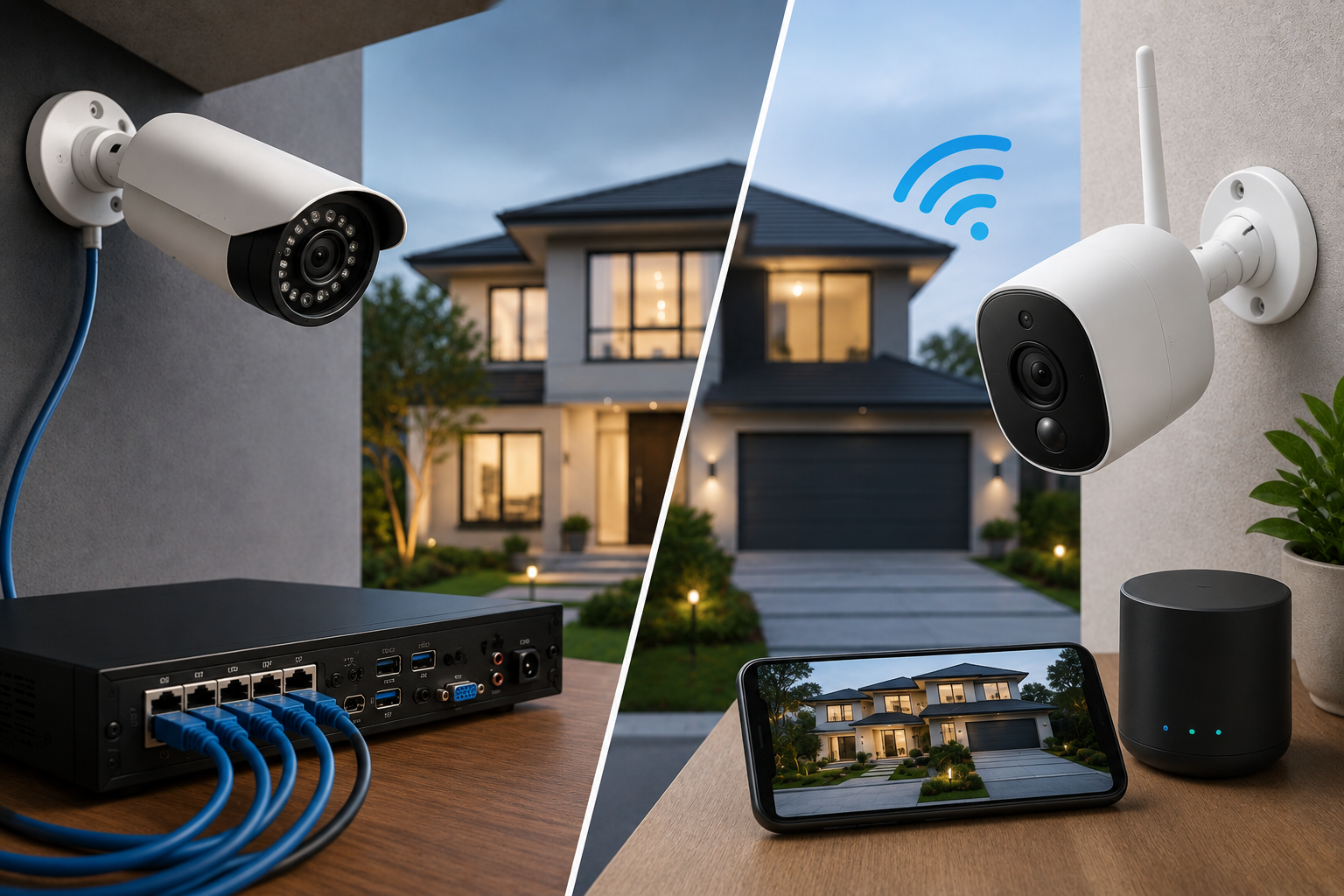
The wired-versus-wireless security camera decision comes down to a genuine trade-off: wired systems deliver the most reliable, uninterrupted performance, while wireless cameras offer flexibility and dramatically easier installation. Neither option is universally “better,” since the right choice depends heavily on your home’s layout, your internet reliability, and how much ongoing maintenance you’re willing to handle.
This guide compares wired and wireless security cameras across reliability, cost, video quality, and installation, helping you choose the right system for your specific home. We’ll also cover battery-powered cameras, PoE systems, and practical buying advice for American homeowners weighing this decision.
By the end, you’ll understand exactly what each system genuinely offers, and why many homeowners end up choosing a hybrid approach rather than committing entirely to one category.
Which Should You Choose?
Wired security cameras offer the most reliable 24/7 recording, better video quality, and lower long-term maintenance, making them the stronger choice for permanent installations and whole-home coverage. Wireless cameras offer easier, faster DIY installation and genuine placement flexibility, making them the practical choice for renters, temporary setups, or spots where running cable simply isn’t feasible.
Many homeowners land on a middle ground: wired cameras covering key entry points for continuous, dependable recording, paired with a few wireless cameras in spots where cabling would be impractical or where flexibility matters more than nonstop reliability.
How Wired Security Cameras Actually Work
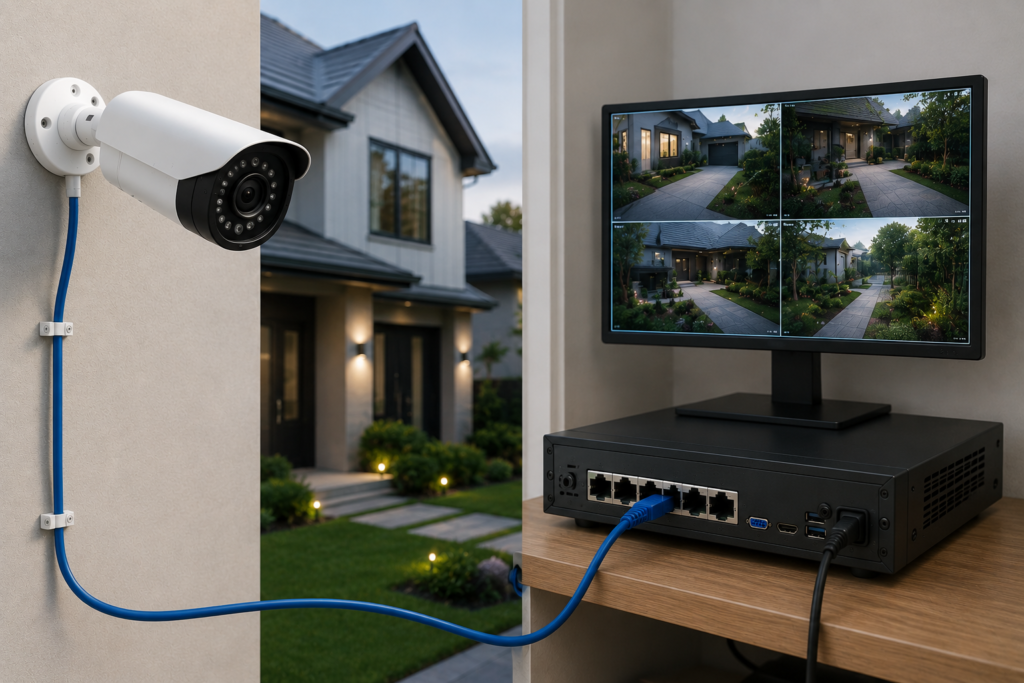
Wired cameras connect to a recorder, either a DVR or NVR, and a power source through physical cables, commonly using Ethernet or coaxial connections. Many modern wired systems use Power over Ethernet, or PoE, which sends both power and data through a single cable, simplifying the physical setup considerably compared with older systems requiring separate power and data lines.
Wired Camera Strengths
Wired systems aren’t affected by Wi-Fi congestion or signal interference, since their connection doesn’t depend on wireless bandwidth at all, making them extremely dependable for continuous, uninterrupted recording. Footage typically stores locally on an NVR or DVR, supporting far larger storage capacity than most wireless systems and higher resolution video without the compression or bandwidth throttling that can affect Wi-Fi-dependent cameras.
Wired systems are also considered more secure by design, since footage stays on a closed system rather than transmitting over radio frequencies that could theoretically be intercepted. Once properly installed, wired cameras require minimal ongoing maintenance, with no batteries to replace or charge.
Wired Camera Limitations
Installation is genuinely more involved, often requiring drilling, running cable through walls or crawl spaces, and professional help, particularly for existing homes rather than new construction where wiring can be planned in advance. Once installed, wired cameras are fixed in place and not portable, meaning repositioning a camera later usually means running new cable rather than simply moving the unit.
Upfront costs also tend to run higher for wired systems once you factor in professional installation, even though the camera hardware itself isn’t always more expensive than wireless equivalents.
How Wireless Security Cameras Actually Work
Wireless cameras transmit footage via Wi-Fi or cellular data rather than physical cables, and typically run on either a standard power outlet connection, rechargeable batteries, or solar-assisted charging.
Wireless Camera Strengths
The biggest advantage is genuinely fast, DIY-friendly installation, often set up within minutes without drilling or cabling, making wireless cameras ideal for renters, temporary setups, or urgent security needs. Cameras can be placed nearly anywhere within range of your network and repositioned easily if your needs change over time, offering a flexibility wired systems simply can’t match.
Battery-powered models also have one specific advantage during power outages: since they run on internal batteries rather than home electrical power, they continue functioning seamlessly when a wired system connected only to home power might go dark.
Wireless Camera Limitations
Wireless cameras depend on signal strength, which can be limited by walls, distance, and interference, and typically support lower resolution than wired equivalents, generally in the 720p to 2K range rather than the 4K to 8K some wired systems can handle. Fully battery-powered models require regular charging or battery replacement, typically every three to six months depending on activity levels and camera settings, which becomes a genuine ongoing chore across multiple units.
Wireless systems also transmit through radio frequencies that are technically more vulnerable to interception than a closed wired system, and their overall security depends heavily on your network password strength and router security settings.
Comparing Wired and Wireless Security Cameras at a Glance
| Factor | Wired Cameras | Wireless Cameras |
| Installation | Complex, often professional | Easy, DIY-friendly |
| Reliability | Very stable, no interference | Depends on Wi-Fi signal strength |
| Video quality | Consistent, supports higher resolution | Varies with network, typically lower resolution |
| Flexibility | Low, fixed once installed | High, easily repositioned |
| Maintenance | Minimal once installed | Battery replacement or charging |
| Upfront cost | Higher, especially with installation | Generally lower |
| Long-term cost | Lower ongoing costs | Battery replacement and possible subscription fees |
| Power outage behavior | Requires UPS backup to continue | Battery models continue running |
The Real Story on Power Outages
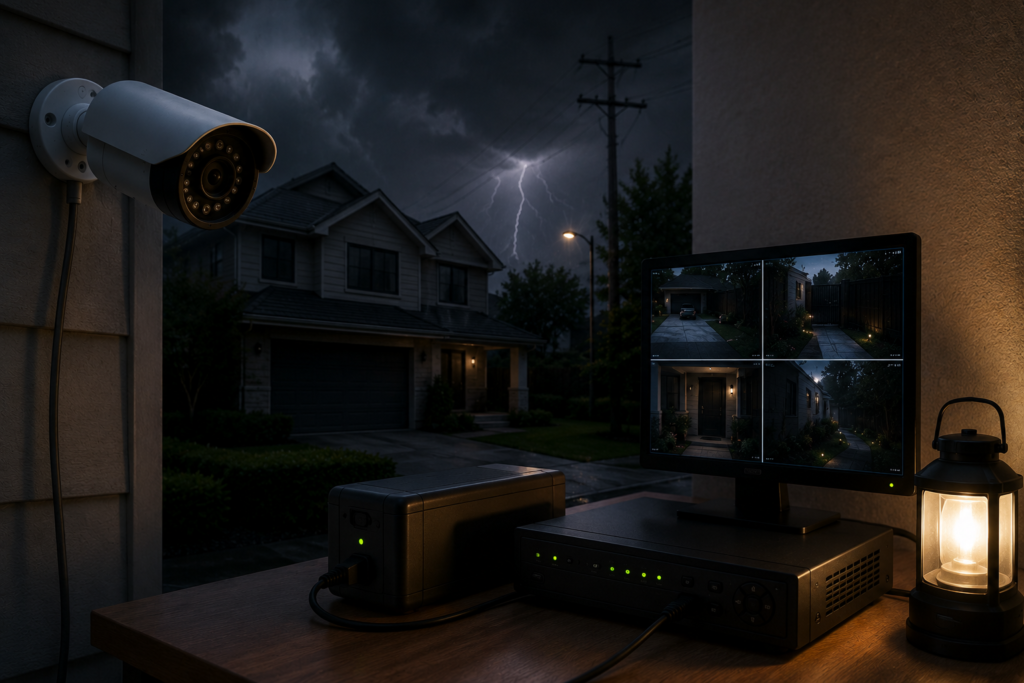
Power outage performance is a common point of confusion, since each system fails differently depending on backup preparation.
Wired systems connected to home electrical power will lose function during an outage unless backed up with an uninterruptible power supply, or UPS, which can maintain camera operation for several hours depending on battery capacity and how much additional equipment, like modems and routers, draws from that same backup power. For longer outages, this backup can be extended further with a generator.
Battery-powered wireless cameras have a natural advantage here, continuing to function during outages without needing any additional backup equipment, since they’re not drawing from home electrical power in the first place. It’s worth noting, though, that wireless cameras plugged into standard outlets rather than running on battery still lose power during an outage just like wired systems would, so it’s specifically the battery-powered wireless category that gains this resilience.
Video Quality: What You’re Actually Trading Off
Video quality differences between wired and wireless systems come down to fundamentally different technical constraints.
Wired connections support significantly higher resolutions, often 4K to 8K or beyond, without the bandwidth limitations that affect wireless transmission, since data travels through a dedicated physical connection rather than competing for wireless bandwidth. Wireless cameras are generally capped in the 720p to 2K range, and actual picture quality can vary noticeably based on your network’s current bandwidth and the physical distance and obstacles between camera and router.
For homeowners prioritizing genuinely sharp footage, particularly for identifying faces or license plates at a distance, wired systems generally offer a meaningful, consistent quality advantage.
Understanding the True Cost Comparison
Sticker price alone doesn’t tell the complete cost story for either system, and it’s worth looking at both upfront and ongoing expenses.
Wireless systems typically cost less initially due to simpler installation requirements, with materials for a professionally installed four-camera system often running around $800 to $1,200 including a storage device, though camera prices individually vary widely from roughly $100 to $950 depending on features. That said, wireless setups can carry ongoing costs through cloud storage subscriptions or cellular data plans, along with the recurring cost of battery replacement across multiple units over time.
Wired systems generally involve a higher upfront investment due to cabling, recorders, and often professional installation labor, but once installed, ongoing costs stay low, with no batteries to replace and typically no mandatory subscription fees if footage stores locally on an NVR or DVR. Over several years of ownership, this often makes wired systems the more cost-effective choice despite the higher starting price.
Installation Complexity: What to Actually Expect
Understanding the real installation process for each system helps set realistic expectations before you commit.
Wired camera installation involves running cables through walls, ceilings, or conduits, which can mean drilling holes, accessing crawl spaces, and potentially disrupting parts of your home during the process, generally making this a job best suited to professional installers rather than a weekend DIY project. This complexity is significantly reduced if wiring is planned during new construction rather than retrofitted into an existing home.
Wireless camera installation, by contrast, is often genuinely simple enough to complete as a DIY project, connecting to a central hub or network via radio waves without any cable-running required. Most wireless cameras still connect to a nearby electrical outlet for consistent power, since fully battery-powered operation, while possible, adds the ongoing burden of regular charging or battery replacement.
Choosing the Right System for Your Specific Situation
Matching camera type to your actual living situation and priorities matters more than following a general trend toward one technology.
Choose wired cameras if: You want the most reliable, continuous 24/7 recording, prioritize the highest video quality, are covering permanent, high-priority areas like main entry points, or are building a multi-camera system where minimal ongoing maintenance matters.
Choose wireless cameras if: You’re renting and can’t run permanent cabling, need fast deployment for temporary or urgent security needs, want the flexibility to reposition cameras as your needs change, or are covering hard-to-wire outdoor areas without nearby electrical access.
Consider a hybrid system if: You want dependable, high-quality coverage at your most critical entry points while still having the flexibility to add wireless cameras in spots where running cable isn’t practical, a combination that many security professionals consider the optimal overall approach.
Practical Buying Advice
A few specific considerations help you choose confidently regardless of which system type you lean toward.
- Assess your Wi-Fi coverage honestly before choosing wireless: If your home has notoriously weak Wi-Fi in certain areas, wireless cameras placed there will likely underperform regardless of the camera’s specifications.
- Factor in total cost of ownership, not just sticker price: Battery replacement, cloud storage subscriptions, and potential cellular data plans can add up significantly over a wireless system’s lifespan.
- Prioritize wired cameras for your most critical viewpoints: Front doors and main entry points benefit most from the consistent, high-quality recording wired systems provide.
- Plan for power outage backup regardless of system type: A UPS for wired systems, or confirming genuine battery backup for wireless cameras, ensures your security coverage doesn’t have a convenient blind spot during an outage.
- Check storage options carefully: Local NVR or DVR storage avoids ongoing subscription fees, while cloud-based storage, common with many wireless systems, often comes with a recurring monthly cost worth factoring into your long-term budget.
Match the System to Your Home, Not the Trend
Choosing between wired and wireless security cameras ultimately comes down to matching the system to your home’s specific layout, your internet reliability, and how much ongoing maintenance you’re willing to manage. Wired systems win decisively on reliability, video quality, and long-term maintenance simplicity, while wireless cameras win on installation ease, flexibility, and upfront affordability. For many homeowners, the smartest solution isn’t choosing one exclusively, but placing wired cameras at your most critical entry points and filling in flexible or hard-to-wire spots with wireless coverage, getting the genuine strengths of both systems working together.
Frequently Asked Questions
1- Are wireless security cameras less secure than wired ones?
Wireless cameras transmit over radio frequencies, which are technically more vulnerable to interception than a closed wired system, though strong network passwords and router security significantly reduce this risk in practice.
2- Do wireless cameras work during a power outage?
Fully battery-powered wireless cameras continue functioning during outages, while wireless cameras plugged into standard outlets lose power just like wired systems would without backup power.
3- Which system offers better video quality?
Wired cameras generally offer higher resolution and more consistent video quality, since they aren’t limited by wireless bandwidth constraints the way wireless cameras are.
4- How often do wireless camera batteries need replacing?
Battery-powered wireless cameras typically need charging or battery replacement every three to six months, depending on activity levels and how the camera’s motion settings are configured.
5- Is it cheaper to install wired or wireless cameras?
Wireless systems generally cost less upfront due to simpler installation, though wired systems often prove more cost-effective over several years due to lower ongoing maintenance and typically no subscription fees.
6- Can I mix wired and wireless cameras in the same system?
Yes, many homeowners and security professionals consider a hybrid approach, wired cameras at key entry points paired with wireless cameras in flexible or hard-to-wire locations, to be the optimal overall solution.