

If your energy bills feel high no matter the season, or some rooms in your house are noticeably colder or hotter than others, insulation is very often the reason. It’s one of the least visible parts of a home, which is exactly why it’s so easy to overlook,and so impactful once it’s actually addressed.
Insulation works by slowing the movement of heat in and out of your home, keeping it warmer in winter and cooler in summer. The right amount and type depend on your climate zone, with colder regions generally requiring insulation rated R-49 to R-60 in the attic, while warmer regions may only need R-30 to R-38. Common insulation types include fiberglass, cellulose, spray foam, and mineral wool each with different R-values, costs, and best-use areas.
This guide breaks down exactly how insulation works, the main types available, how much your home actually needs, and where to prioritize if you’re planning an upgrade.
How Insulation Actually Works
Heat naturally moves from warmer areas to cooler ones, through three basic mechanisms: conduction (through solid materials like walls), convection (through moving air), and radiation (through electromagnetic waves, like heat from sunlight). Insulation’s job is to slow down conductive and convective heat transfer, which keeps warm air inside during winter and outside during summer.
Heating and cooling typically account for a significant share often estimated at roughly half to two-thirds of total energy use in an average American home. That’s why insulation is widely considered one of the most cost-effective upgrades a homeowner can make, since it directly reduces how hard your HVAC system has to work year-round.
Understanding R-Value (The Number That Actually Matters)
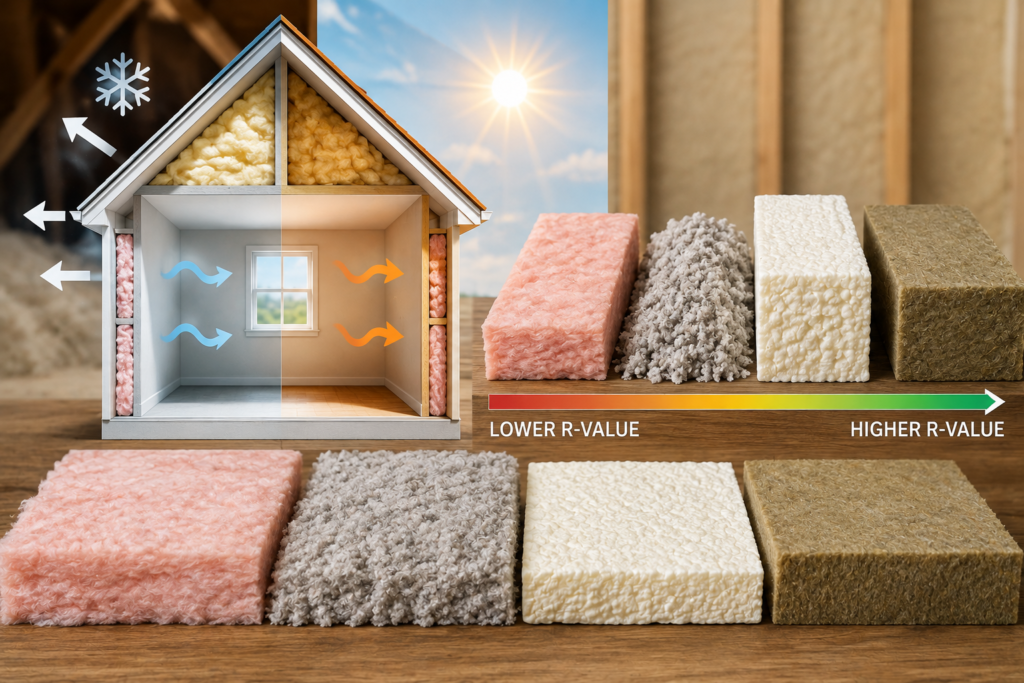
R-value measures a material’s resistance to heat flow the higher the number, the better it insulates. This is the single most important spec to understand when comparing insulation materials or options for your home.
A key detail: R-value is typically expressed per inch of material, since different insulation types achieve different performance levels at different thicknesses. This means comparing materials by R-value per inch is the fair way to judge their actual insulating power, not by thickness alone.
The Main Types of Home Insulation
Fiberglass
Fiberglass is the most widely installed insulation material in American homes, known for being affordable, non-combustible, and resistant to moisture damage.
- R-value: Roughly R-2.2 to R-4.3 per inch, depending on whether it’s batts or blown-in loose-fill
- Form: Available as pre-cut batts (blankets) or blown-in loose-fill
- Best for: New construction, open wall cavities, attic floors, and straightforward remodels
Note: Batts work well where wall cavities and joists are easily accessible, while blown-in fiberglass is often used for attic floors and retrofitting existing walls.
Cellulose
Cellulose is made primarily from recycled newspaper, treated with a fire retardant, and blown into place rather than installed as pre-cut pieces.
- R-value: Roughly R-3.2 to R-3.8 per inch
- Best for: Attic floors, retrofitting existing walls, and irregular cavities that batts don’t fill as completely
Trade-off to know: Cellulose can absorb moisture, which may cause it to settle and lose some of its R-value if it gets wet. Proper ventilation and vapor barriers matter more with cellulose than with fiberglass, especially in humid climates.
Spray Foam
Spray foam is applied as a liquid that expands to fill the cavity, creating both insulation and an air barrier in a single application. It’s installed by professionals using specialized equipment.
Open-cell spray foam:
- R-value: Roughly R-3.5 to R-3.7 per inch
- Softer, lighter, and less expensive than closed-cell
- Permeable to moisture, so it’s not recommended for below-grade or wet areas
Closed-cell spray foam:
- R-value: Roughly R-6.0 to R-7.0 per inch — the highest of any common insulation type
- Denser and more rigid, and acts as its own vapor barrier
- Well suited to basements, rim joists, and tight spaces where maximum performance per inch matters
Mineral Wool
Mineral wool (sometimes called rock wool) is made from spun mineral fibers and offers strong fire resistance and sound-dampening properties in addition to thermal performance.
- Best for: Areas where fire resistance or noise reduction is a priority, in addition to standard insulating performance
Rigid Foam Board
Rigid foam boards (including EPS, XPS, and polyiso varieties) are commonly used for basement walls, exterior continuous insulation, and areas where space is limited but strong performance is still needed.
- R-value: Roughly R-5.0 to R-6.5 per inch
- Best for: Basement walls, exterior wall sheathing, and situations where a thin but high-performing layer is needed
Insulation Types at a Glance
| Type | R-Value per Inch | Best For | Key Consideration |
| Fiberglass | R-2.2 to R-4.3 | Attics, walls, general use | Widely available, budget-friendly |
| Cellulose | R-3.2 to R-3.8 | Attics, wall retrofits | Moisture-sensitive |
| Open-cell spray foam | R-3.5 to R-3.7 | Cathedral ceilings, wall cavities | Not for below-grade use |
| Closed-cell spray foam | R-6.0 to R-7.0 | Basements, rim joists, tight spaces | Highest performance, higher cost |
| Mineral wool | Similar range to fiberglass | Fire-prone or noise-sensitive areas | Added fire resistance and soundproofing |
| Rigid foam board | R-5.0 to R-6.5 | Basement walls, exterior sheathing | Good for space-limited applications |
How Much Insulation Does Your Home Actually Need?
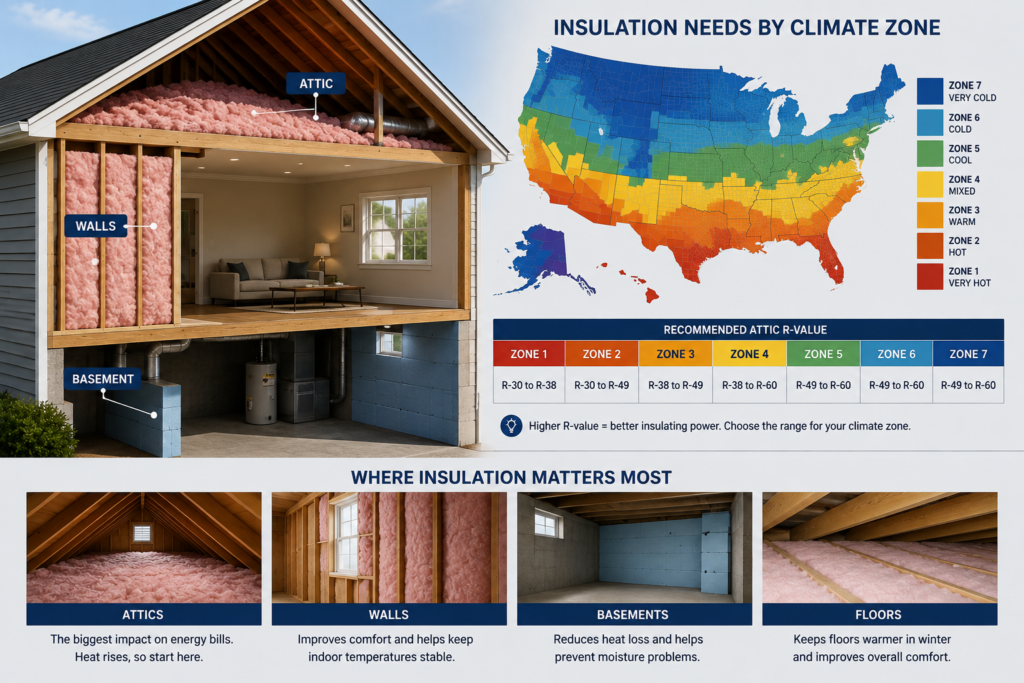
The right amount of insulation depends heavily on your climate zone. Homes in colder regions need significantly higher R-values than homes in warmer regions to maintain comparable energy efficiency.
General Attic R-Value Guidelines by Region
| Climate Zone Type | Recommended Attic R-Value |
| Warmer regions (e.g., southern states) | R-30 to R-38 |
| Moderate regions | R-38 to R-49 |
| Colder regions (e.g., northern states) | R-49 to R-60 |
How to check your specific requirement: Building energy codes set minimum insulation levels by climate zone, and your local building department or a licensed contractor can confirm the exact R-value recommended for your specific location and home assembly.
A Simple Way to Estimate Existing Attic Insulation
If you can see the attic floor joists clearly, insulation is likely too thin. If the insulation is level with or above the joists, you likely have a more substantial amount already in place — though checking the material type and measuring the actual depth is the more accurate approach, since different materials achieve different R-values at the same thickness.
Where to Prioritize Insulation in Your Home
Not every area of the house needs (or benefits from) the same type or amount of insulation. Here’s a general breakdown of typical priorities.
Attic
Often the highest-priority area, since heat naturally rises and escapes through an under-insulated attic. Blown-in cellulose or fiberglass is commonly used here for straightforward, cost-effective coverage.
Exterior Walls
For existing homes, blown-in cellulose or dense-pack fiberglass injected through small holes is a minimally invasive way to add insulation without major wall reconstruction. New construction typically uses fiberglass batts or spray foam installed in open cavities before drywall goes up.
Basement Walls
Because basement walls are exposed to ground moisture, closed-cell spray foam or rigid foam board is generally recommended over standard fiberglass batts, since these materials handle moisture exposure better.
Crawl Spaces
Ventilated crawl spaces typically use fiberglass batts in the floor joists above, while conditioned (sealed) crawl spaces often use closed-cell spray foam directly on the walls.
Rim Joists
The rim joist area — where the foundation meets the floor framing — is a common and often overlooked source of air leakage. Closed-cell spray foam is frequently used here since it insulates and air-seals in one step.
Cathedral or Vaulted Ceilings
These are among the more difficult areas to insulate well, since there’s no accessible attic space above and rafter depth is limited. Spray foam applied directly to the roof deck is a common solution, since it fills the available depth more completely than batts while also air-sealing the space.
Signs Your Home Is Under-Insulated
- Noticeably higher or lower temperatures in certain rooms compared to others
- Ice dams forming on the roof edge in winter, which can indicate heat escaping through the attic
- High heating or cooling bills relative to your home’s size
- Drafts near windows, doors, or electrical outlets
- Visible attic floor joists with little to no insulation covering them
- Rooms that feel uncomfortable shortly after the HVAC system shuts off, suggesting poor heat retention
DIY vs. Professional Insulation Installation
What Homeowners Can Often Handle
- Fiberglass batts in easily accessible, unfinished areas like attics with open joists
- Basic attic floor insulation top-offs, where you’re simply adding more material over existing insulation
What Generally Requires a Professional
- Spray foam installation, which requires specialized equipment to mix and apply the two-part chemical foam correctly
- Dense-pack cellulose in existing walls, which requires drilling and specific equipment to achieve proper density
- Any insulation work involving electrical, moisture, or structural considerations, where mistakes could create safety or performance issues
Practical Buying and Planning Advice
- Start with an energy assessment or attic inspection to understand your home’s current insulation levels before choosing a new material.
- Match the material to the location, not just the R-value. Moisture-prone areas like basements need different materials than dry, accessible attic spaces.
- Prioritize the attic first in most cases, since it’s typically the area with the most significant impact on overall energy efficiency for the investment.
- Don’t ignore air sealing. Insulation reduces heat transfer, but sealing air leaks (around windows, doors, and penetrations) addresses a different — and equally important — source of energy loss.
- Get a professional evaluation for spray foam or wall retrofits, since these installations are harder to do correctly without specialized tools and experience.
- Check your local building code’s minimum R-value requirements before starting any insulation project, since these vary by region and by which part of the home you’re insulating.
Insulation Is a Foundation, Not an Afterthought
Insulation might be invisible once it’s installed, but its impact on comfort and energy costs is anything but small. Understanding R-value, knowing which material fits which part of your home, and matching your insulation level to your climate zone are the fundamentals that separate a genuinely efficient home from one that’s fighting an uphill battle against the weather year-round.
If you’re noticing uneven temperatures, high energy bills, or visible gaps in your attic insulation, it’s worth getting a proper assessment before deciding on a fix. Getting the right material, in the right place, at the right R-value, is what actually turns insulation from a hidden expense into one of the most cost-effective upgrades your home can have.
Common Questions About Home Insulation
1- What R-value do I actually need for my attic?
It depends on your climate zone — generally R-30 to R-38 for warmer regions, R-38 to R-49 for moderate regions, and R-49 to R-60 for colder regions. Checking your local building code or consulting a contractor will give you the exact recommendation for your specific location.
2- Is spray foam worth the extra cost compared to fiberglass?
Spray foam offers the highest R-value per inch of any common insulation type and also acts as an air barrier, which can be valuable in tight or hard-to-insulate spaces. However, it costs significantly more than fiberglass or cellulose, so it’s often reserved for areas where its added performance and air-sealing properties are most valuable, like rim joists or basements.
3- Can I add new insulation over old insulation?
In many cases, yes — particularly in attics, where new insulation can often be added on top of existing material to boost the overall R-value. However, if the existing insulation is wet, damaged, or compressed, it’s generally best to address that first rather than simply insulating over the problem.
4- How do I know if my home needs more insulation?
Signs include uneven room temperatures, high energy bills, drafts near windows and doors, ice dams on the roof in winter, and visible attic joists with minimal insulation covering them.
5- Is cellulose insulation as good as fiberglass?
Both offer similar R-value ranges and are widely used, but they have different trade-offs — cellulose fills irregular cavities more completely and offers some air-sealing benefit, while fiberglass is more moisture-resistant and doesn’t settle as significantly over time.
6- Do I need a professional for all insulation work?
Not necessarily. Basic fiberglass batt installation in accessible, unfinished areas is often manageable as a DIY project. However, spray foam, dense-pack cellulose in existing walls, and any work involving structural or moisture considerations generally require professional installation.