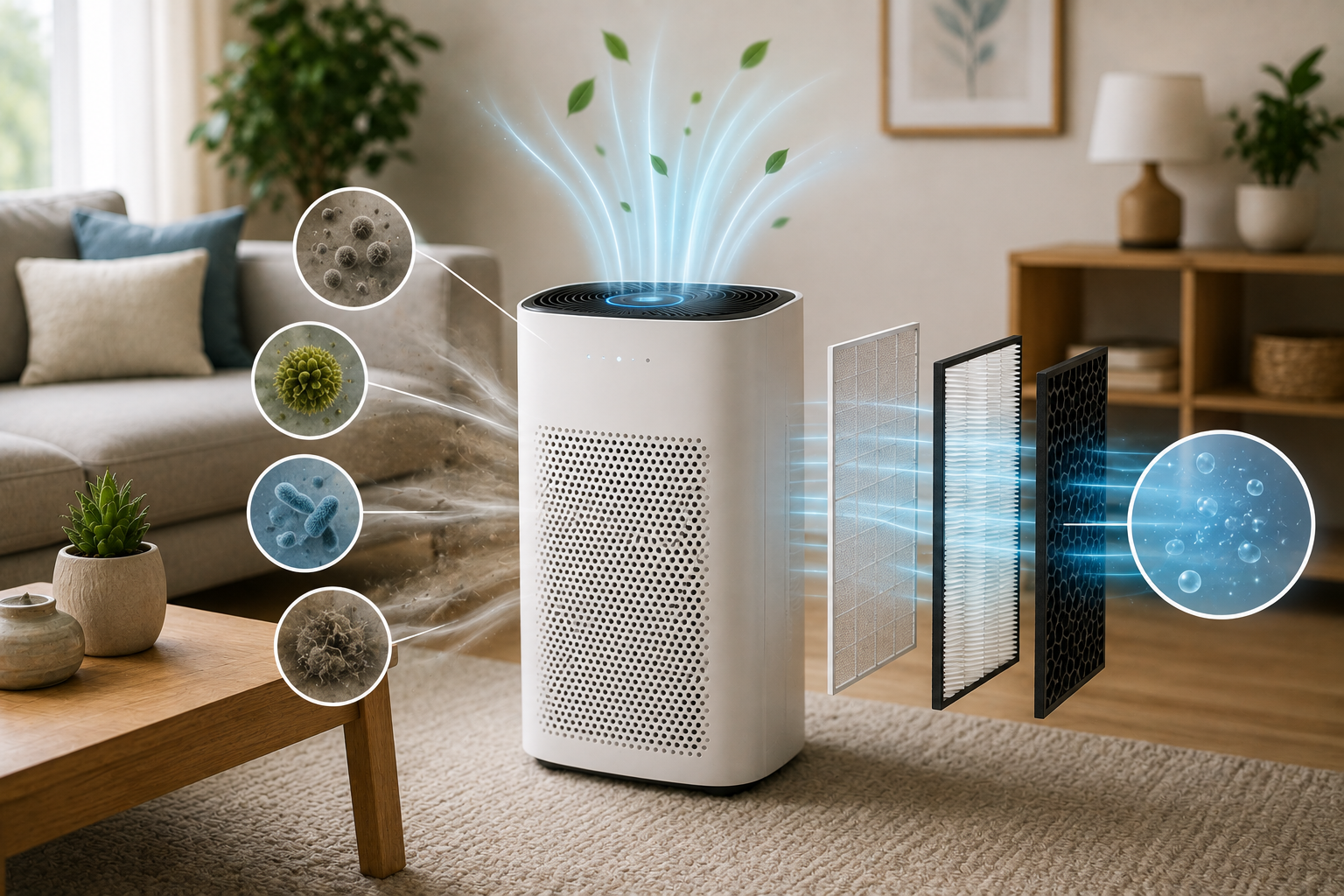
The single most important number on any air purifier’s spec sheet isn’t the HEPA rating, it’s the CADR, or Clean Air Delivery Rate, since this measures how much actual filtered air the unit delivers rather than just what filter technology it uses. A purifier with a CADR of 250 for dust reduces particle concentration to the equivalent of adding 250 cubic feet of clean air into the room every minute, and choosing a model with insufficient CADR for your room size means you’re paying for a purifier that simply can’t keep up.
This guide breaks down exactly how to choose an air purifier, covering CADR, HEPA filtration, room sizing math, and which “extra” features are worth paying for versus which ones to skip entirely. We’ll also cover ozone safety, ionizers, and practical buying advice for American homeowners trying to improve their indoor air quality without falling for marketing gimmicks.
By the end, you’ll know exactly which numbers to check on a spec sheet, and which flashy features consistently turn out to be more marketing than substance.
What Should You Actually Look For?
Start with the room, not the brand: choose a purifier with a smoke CADR equal to at least two-thirds of your room’s square footage, select genuine mechanical HEPA filtration rather than vague “HEPA-type” claims, and check the price and availability of replacement filters before you buy. Skip or specifically disable any ionizer, UV-C, or “activated oxygen” feature unless it’s independently certified for negligible ozone output, since these add-ons rarely deliver meaningful benefit and can introduce genuine health risks.
Everything else on a typical spec sheet, app connectivity, sleek design, voice assistant integration, matters far less than these three fundamentals for actually improving your indoor air quality.
Understanding CADR: The Number That Actually Matters
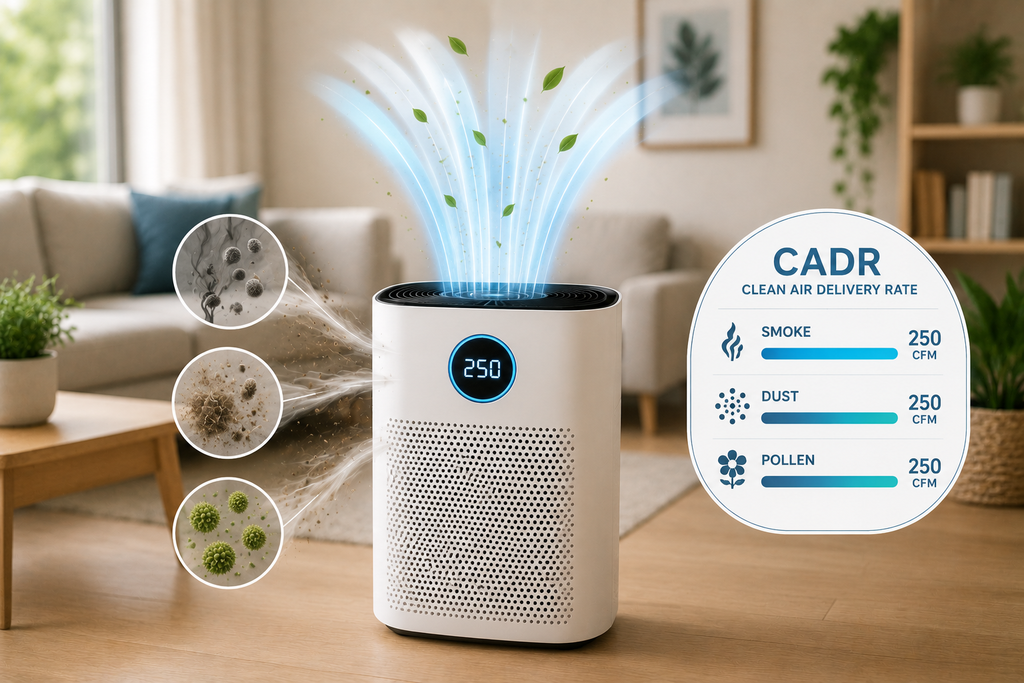
CADR is developed and tested by the Association of Home Appliance Manufacturers, and it measures how much filtered air a purifier delivers, expressed in cubic feet per minute. Crucially, CADR doesn’t care what specific filter technology is inside the unit, it simply tells you how effectively the whole system moves clean air into your room, which is why filtration experts consistently point to it as the metric to focus on above brand names or marketing claims.
The Three CADR Categories
CADR is tested and reported separately for three distinct pollutant types, each requiring different filtration performance:
- Tobacco smoke: The smallest particle size tested, generally 0.09 to 1.0 microns
- Dust: Medium-sized particles, generally 0.5 to 3 microns
- Pollen: The largest particle size tested, generally 5 to 11 microns
Focus specifically on the CADR number matching your primary concern. If pet dander or allergies are your main issue, prioritize the dust and pollen CADR figures; if odor or smoke is the bigger concern, the smoke CADR and the unit’s carbon filter capacity both matter more.
Look for AHAM Verifide Certification
Purifiers that have undergone AHAM’s voluntary certification program carry an AHAM Verifide seal specifying each model’s actual tested CADR values. This independent certification offers considerably more reliable assurance than a manufacturer’s own unverified performance claims.
Doing the Room-Size Math Correctly
Sizing a purifier correctly is arguably the single most consequential decision in this entire buying process, since an undersized unit simply can’t keep pace with your room’s actual air volume.
A practical rule of thumb: choose a purifier with a smoke CADR equal to at least two-thirds of your room’s square footage. Under this formula, a purifier with a CADR in the low-to-mid 200s would be considered effective for rooms up to roughly 330 to 375 square feet, while a compact unit with a CADR around 100 to 150 suits smaller spaces like a nursery, bedroom, or home office.
A practical sizing guide:
| Room Size | Recommended Minimum CADR (Smoke) |
| Small (nursery, small bedroom, ~100–200 sq ft) | 100–150 |
| Medium (bedroom, home office, ~200–300 sq ft) | 150–200 |
| Large (living room, open space, ~300–450 sq ft) | 200–300+ |
For bedrooms specifically, it’s genuinely worth buying slightly more capacity than the bare minimum calculation suggests, since extra headroom lets the unit run effectively at a quieter fan speed rather than needing to run at full, noisier power to keep up.
True HEPA vs “HEPA-Type”: Why the Wording Matters
Not every filter marketed with the word “HEPA” actually meets genuine HEPA performance standards, and this distinction is worth understanding before you buy.
While HEPA filters are effective and reliable, simply having some form of HEPA labeling doesn’t guarantee strong overall performance, since filtration is only one part of the full equation alongside adequate airflow and CADR. Terms like “HEPA-type” or “HEPA-like” generally indicate a filter that doesn’t meet the stricter true HEPA standard, and these should be treated with more skepticism than a purifier explicitly using “True HEPA” or citing a specific HEPA grade like H13 or H14.
The Truth About Ionizers, UV-C, and “Activated Oxygen” Features
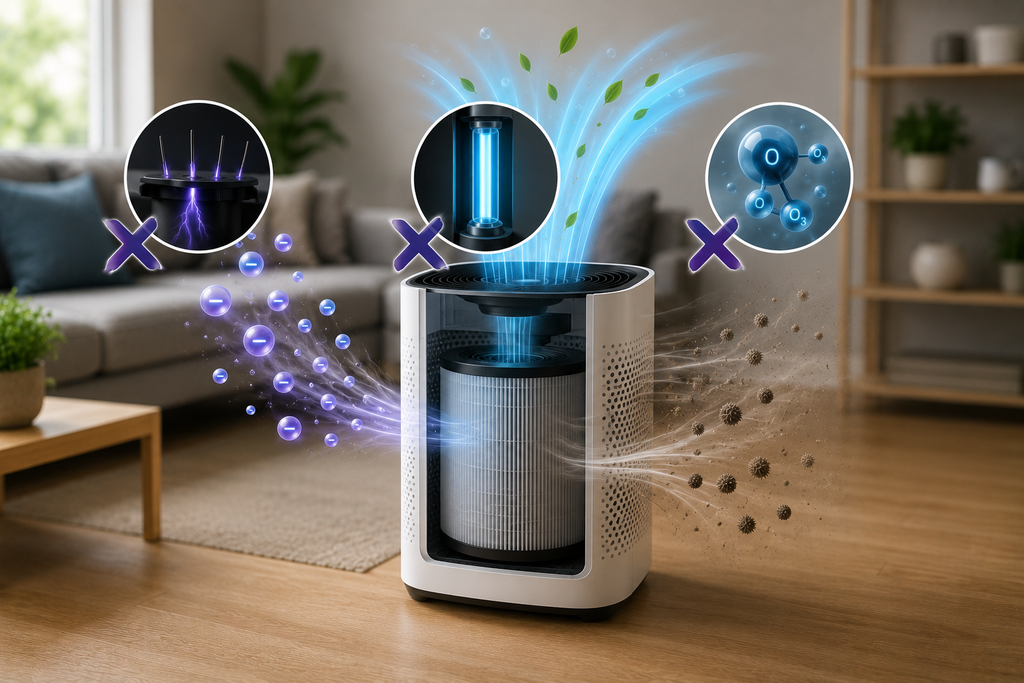
These add-on features are consistently marketed as bonus health benefits, but the actual evidence supporting most of them is considerably weaker than the marketing suggests.
Ionizers
Ionizers work by electrically charging particles so they settle onto surfaces rather than being trapped in a filter, meaning they technically remove particles from the air, but they redeposit that same debris onto your walls, furniture, and floors rather than genuinely eliminating it. Some ionizers also produce trace amounts of ozone, a genuine lung irritant, so if you’re considering a purifier with this feature, confirm it can be fully disabled and that the specific model carries independent low-ozone certification.
UV-C Light
UV-C is marketed as killing bacteria and viruses inside the unit, but the reality is that airflow typically moves far too quickly past the UV bulb for meaningful pathogen reduction, unless the purifier includes a dedicated germicidal chamber with extended exposure time, which most consumer units simply don’t have. The EPA has specifically stated that standalone UV-C air cleaners are generally not effective at the low exposure doses used in typical residential products.
Ozone Generators
This category deserves the strongest caution of all. Testing has found that even at low settings, some ozone generators can exceed the FDA’s 0.05 parts-per-million limit set for medical devices, and studies reviewed by the EPA have shown that low ozone levels don’t actually destroy indoor pollutants effectively in the first place. Ozone exposure has also been linked to decreased lung function, throat irritation, coughing, chest pain, and lung tissue inflammation, and can worsen asthma, emphysema, and bronchitis, making devices marketed primarily as ozone generators or “activated oxygen” units genuinely worth avoiding for occupied living spaces.
Comparing Purifier Add-On Features: Worth It or Skip It?
| Feature | Real Benefit | Verdict |
| True HEPA filtration | High, core function | Prioritize |
| High CADR relative to room size | High, core function | Prioritize |
| Activated carbon (for odors) | Moderate–high, for gas/odor removal | Worth it if odors are a concern |
| Ionizer | Low, redeposits particles, possible ozone | Skip or ensure it’s disableable |
| UV-C light | Low, insufficient exposure time in most units | Skip, don’t pay a premium |
| Ozone generator/”activated oxygen” | Negative, genuine health risk | Avoid entirely |
| App connectivity/smart features | Convenience only | Nice-to-have, not essential |
Particles vs Gases: Two Different Problems, Two Different Solutions
A purifier’s ability to handle particles and its ability to handle odors or gases are genuinely separate capabilities, and it’s worth understanding which one matters most for your specific situation.
Mechanical filters like HEPA capture particles as air physically passes through the filter media, making them effective against dust, pollen, and pet dander. Activated carbon or other sorbent materials, by contrast, can reduce certain gases and odors, though performance here depends heavily on the specific contaminant, the amount of carbon media, contact time, and how saturated the filter has become since its last replacement.
If odors are your primary concern, prioritize a purifier with a substantial carbon filter weight over CADR alone; if particles like allergens and dust are the bigger issue, HEPA filter size and CADR should take priority instead.
Washable Filters: A Real Trade-Off Worth Understanding
Some purifiers use washable pre-filters or even washable primary filters, and while the cost-saving appeal is obvious, there’s a genuine performance trade-off to weigh.
Washable HEPA-equivalent filters do exist, but they typically require careful, thorough washing and complete drying every few weeks to maintain their effectiveness. If you’re genuinely willing to commit to that maintenance routine, a washable filter system can save $60 to $100 annually in replacement filter costs. For most households, though, standard replaceable True HEPA filters remain the safer, more consistent choice, since they maintain reliable performance without depending on your own maintenance diligence.
Portable vs Whole-House Filtration
Beyond individual room units, it’s worth understanding how portable purifiers compare with whole-house filtration integrated into your HVAC system.
Whole-house filtration improves air quality throughout your home via your central HVAC system, but it only operates while air is actively circulating through that system. Portable purifiers, by contrast, provide targeted, continuous cleaning in specific occupied rooms like bedrooms and offices, and many households ultimately benefit from using both approaches together rather than relying on just one.
What Air Purifiers Can’t Fix
It’s worth being clear-eyed about the genuine limits of what any air purifier, regardless of quality, can actually accomplish.
If visible mold is linked to a plumbing leak or persistent dampness, an air purifier cannot remove the underlying moisture allowing that growth to continue, meaning the water issue itself needs repair and proper cleanup rather than relying on filtration to solve it. Similarly, if your concern involves carbon monoxide, fuel gas, radon, or another hazardous gas, an ordinary air purifier is not a detector or a corrective control, and you need the appropriate dedicated alarm, inspection, or mitigation system for that specific hazard instead.
Practical Buying Advice
A few final considerations help you shop confidently once you understand the core fundamentals.
- Check wattage at your actual expected fan speed: Energy use varies substantially depending on fan speed and unit size, so check the wattage specifically at the speed you expect to run most often, then estimate your real operating cost using your local electricity rate.
- Confirm replacement filter cost and availability before buying: A purifier that’s affordable upfront can become expensive over time if replacement filters are pricey or hard to find, so factor this into your total cost of ownership from the start.
- Verify the exact model number for any ozone certification: Visually similar regional product versions can differ in actual specifications, so confirm certification applies to the precise model you’re purchasing, not just the general product line.
- Prioritize your room over general brand reputation: The most expensive, well-reviewed purifier in the store can still be the wrong choice if its CADR doesn’t match your room’s actual square footage.
- Consider ENERGY STAR certification: This can help identify more efficient models among otherwise comparable options.
Size and Filtration First, Gimmicks Last
Choosing the right air purifier comes down to matching a genuine True HEPA filter and adequate CADR to your specific room size, rather than being drawn in by ionizers, UV-C lights, or other add-on features that promise more than they consistently deliver. Do the room-size math using the two-thirds CADR rule, prioritize activated carbon if odors are your main concern, and skip or disable any ozone-producing feature entirely. With these fundamentals in place, and a clear understanding of ongoing filter replacement costs, you’ll end up with an air purifier that genuinely improves your indoor air quality rather than one that simply looks impressive on a spec sheet.
Frequently Asked Questions
1- What’s the most important spec to check when buying an air purifier?
CADR, or Clean Air Delivery Rate, is the metric filtration experts consistently point to first, since it measures actual clean air output rather than relying on filter technology claims alone.
2- How do I know what size air purifier I need for my room?
Choose a purifier with a smoke CADR equal to at least two-thirds of your room’s square footage; for example, a CADR in the low-to-mid 200s generally suits rooms up to around 330 to 375 square feet.
3- Are ionizer air purifiers safe to use?
Some are, provided the ionization feature can be disabled and the specific model carries independent low-ozone certification from a source like CARB, but ionizers generally shouldn’t replace genuine mechanical HEPA filtration.
4- Do UV-C air purifiers actually kill germs effectively?
Generally not in typical consumer models, since airflow moves too quickly past the UV bulb for meaningful pathogen reduction without a dedicated germicidal chamber, which most residential units lack.
5- Should I avoid all air purifiers with ozone-related features?
Devices marketed primarily as ozone generators or “activated oxygen” units are genuinely worth avoiding for occupied spaces, given documented links to respiratory irritation and reduced lung function.
6- Is a washable filter air purifier a good long-term choice?
It can be if you’re committed to thorough, regular washing and drying every few weeks; otherwise, standard replaceable True HEPA filters offer more consistent, dependable performance.