
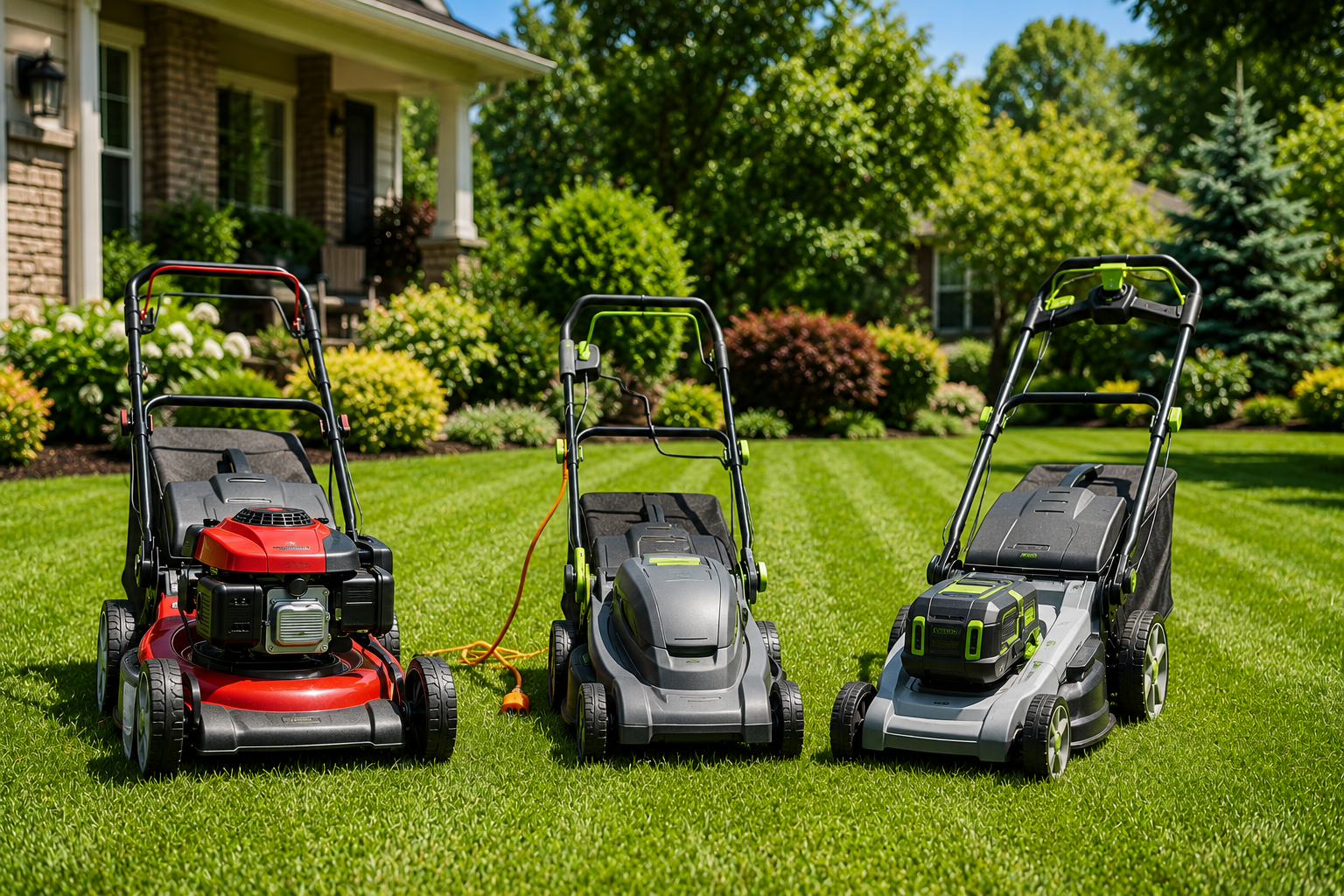
The gas vs electric lawn mower decision used to come down mostly to personal preference. In 2026, it’s shaped by three converging factors: rising fuel costs, meaningfully improved battery technology, and, in some states, genuine restrictions on what you’re even allowed to buy new. Understanding how these three power sources actually compare on cost, performance, and maintenance matters more now than it has in years.
This guide breaks down gas, corded electric, and battery-powered mowers side by side across the factors that actually affect your day-to-day mowing experience and long-term ownership costs, so you can choose confidently rather than by default.
Gas vs Electric vs Battery-Powered Lawn Mowers
Gas mowers still offer the most raw, sustained power for large or overgrown lawns, but they come with the highest ongoing maintenance and fuel costs, plus purchase restrictions in states like California. Battery-powered mowers have closed most of the performance gap for typical residential lawns, offering lower running costs, quieter operation, and minimal maintenance, at the trade-off of a higher upfront price and limited runtime per charge. Corded electric mowers offer the lowest cost and simplest maintenance of all three, but only suit smaller lawns within reach of a power outlet. For most standard suburban lawns under half an acre, battery-powered has become the most balanced overall choice in 2026; for larger properties or heavy-duty cutting needs, gas remains hard to fully replace where it’s still available to buy.
How Each Power Source Actually Works
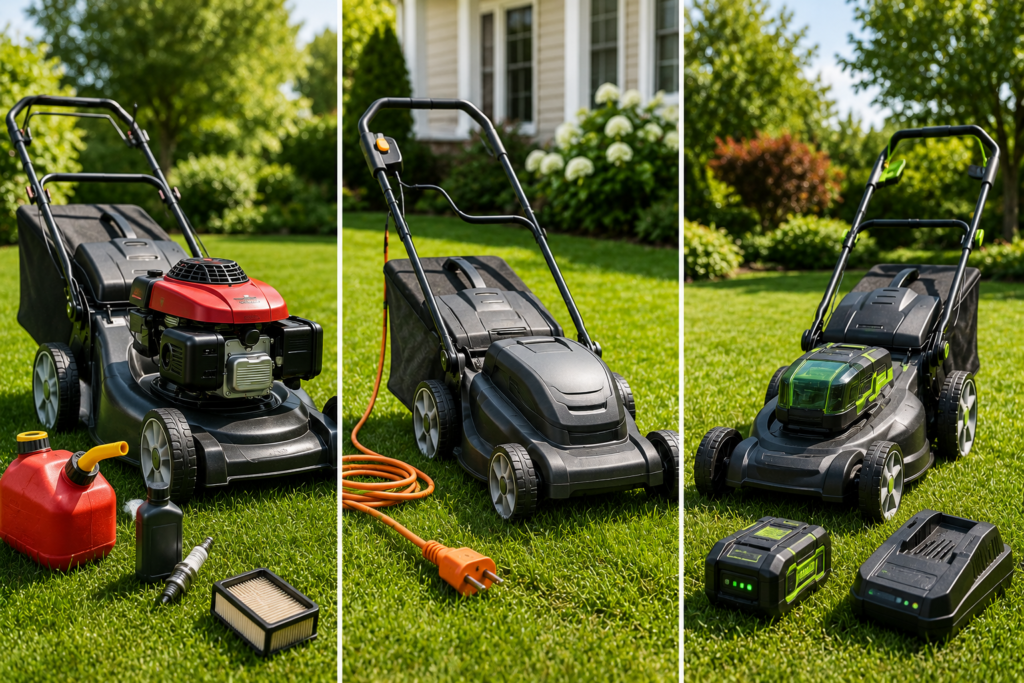
- Gas-Powered Mowers
Gas mowers use a small internal combustion engine, typically a spark-ignition small off-road engine (SORE) rated at or below 25 horsepower, to power the cutting blade. This is the traditional, long-established mower format most American homeowners grew up using.
- Corded Electric Mowers
Corded electric mowers plug directly into a household outlet via an extension cord, drawing continuous power without any battery involved. They produce zero direct emissions and never need recharging, but your mowing range is limited by cord length.
- 3- Battery-Powered (Cordless) Mowers
Battery-powered mowers run on rechargeable lithium-ion batteries, offering the mobility of a gas mower without a physical cord, but with a finite runtime before requiring a recharge. Battery voltage (commonly ranging from 40V to 80V or higher) is a useful general indicator of available power and runtime.
Side-by-Side Comparison
| Factor | Gas | Corded Electric | Battery-Powered |
| Upfront cost | Low to moderate | Low | Moderate to high |
| Ongoing fuel/energy cost | Higher (gasoline) | Lowest (electricity) | Low (electricity) |
| Maintenance | Oil changes, spark plugs, air filters | Minimal | Minimal |
| Power/cutting performance | Highest, sustained | Good for light-duty | Good, improving rapidly |
| Runtime limitation | None (refuel as needed) | None (corded) | Limited by battery charge |
| Mobility | Full freedom | Limited by cord length | Full freedom |
| Noise level | Loudest | Quiet | Quiet |
| Emissions | Direct emissions | None (at point of use) | None (at point of use) |
| Best for | Large lawns, heavy-duty cutting | Small lawns near outlets | Small to medium lawns |
| Purchase availability | Restricted in California | Widely available | Widely available |
1- Upfront Cost Comparison
Gas mowers have historically offered a lower entry price point for basic models, though this gap has narrowed as battery technology has become more mainstream and pricing has become more competitive. Corded electric mowers remain the most affordable option overall, since they don’t require a battery or the engineering complexity of a small combustion engine. Battery-powered mowers generally carry the highest upfront cost of the three, reflecting the price of the battery itself, though higher pricing often comes bundled with genuinely reduced long-term maintenance needs.
2- Ongoing Cost Comparison
- The Real Cost of Running a Gas Mower
Beyond the mower’s purchase price, gas mowers require regular purchases of gasoline, periodic oil changes, spark plug replacement, air filter changes, and occasional blade sharpening or engine tune-ups. With national average gas prices remaining well above $4 per gallon in many regions, and considerably higher in coastal states like California, the cumulative cost of keeping a gas mower fueled and maintained has become a more noticeable household expense than it once was.
- The Real Cost of Running an Electric Mower
Both corded and battery-powered mowers largely eliminate the ongoing maintenance gas mowers require, no oil changes, no spark plugs, no air filters. Electricity costs to charge a battery-powered mower or run a corded model are typically minimal, often just a few cents per mowing session, making the ongoing cost of ownership considerably lower than a comparable gas mower over several years of use.
- Battery Replacement Considerations
The one notable long-term cost specific to battery-powered mowers is eventual battery replacement, since lithium-ion batteries gradually lose capacity over years of charge cycles. This is worth factoring into total cost of ownership calculations, though it typically doesn’t happen for several years of normal use and is generally offset by the savings on fuel and maintenance in the meantime.
3- Performance Comparison
- Cutting Power
Gas mowers still generally offer the most consistent, sustained cutting power, particularly valuable for thick, tall, or overgrown grass, wet conditions, or large areas requiring continuous operation without interruption. Battery-powered mowers, particularly higher-voltage models (60V and above), have closed much of this performance gap for typical, regularly maintained residential lawns, though they can still struggle somewhat more than gas with genuinely overgrown or particularly thick grass.
- Runtime and Interruptions
Gas mowers have no runtime limitation beyond how much fuel is in the tank, refueling takes just a few minutes. Corded electric mowers similarly have no runtime limit, provided you stay within cord range. Battery-powered mowers are the one format with a genuine runtime constraint, requiring either a recharge break or a spare battery for larger lawns that exceed a single charge’s capacity.
- Noise and Comfort
Both corded and battery-powered electric mowers run considerably quieter than gas mowers, a meaningful factor for early morning mowing, noise-conscious neighborhoods, or simply personal comfort during use. Gas mowers also produce direct exhaust and vibration that electric alternatives eliminate.
4- Regulatory Landscape: What’s Actually Changed
- California’s Sales Restriction
California’s Assembly Bill 1346 prohibits the sale of new small off-road engines (25 horsepower or below) as of equipment manufactured after December 31, 2023, which covers the vast majority of residential gas lawn mowers. This means new gas mowers using these engines can no longer be sold as new in California, though existing gas mowers can continue to be owned and used. Some California cities have gone further, restricting actual use of gas equipment, not just its sale, with varying implementation timelines through 2026 and beyond.
- The Rest of the Country
Outside California, most states haven’t implemented similar sales bans, instead offering rebate programs and incentives to encourage voluntary adoption of electric lawn equipment. This means for the majority of American homeowners, gas mowers remain fully available to purchase, and the choice comes down to cost, performance, and personal preference rather than regulatory restriction.
- Checking Your Local Rules
Given how much this landscape varies by state and even by city, it’s worth checking your specific local regulations before assuming either gas or electric availability, particularly if you live in California or a state actively considering similar legislation.
5- Environmental Considerations
Gas mowers produce direct emissions during operation, and small engines like those used in lawn mowers are relatively less fuel-efficient and less emissions-controlled than modern automobile engines, making them a meaningful source of localized air pollution during use. Electric mowers, whether corded or battery-powered, produce no direct emissions at the point of use, though their overall environmental impact depends partly on how the electricity used to power or charge them is generated. Battery production and eventual disposal also carry their own environmental considerations, an active area of ongoing improvement in battery recycling infrastructure.
Which Should You Choose Based on Your Lawn?
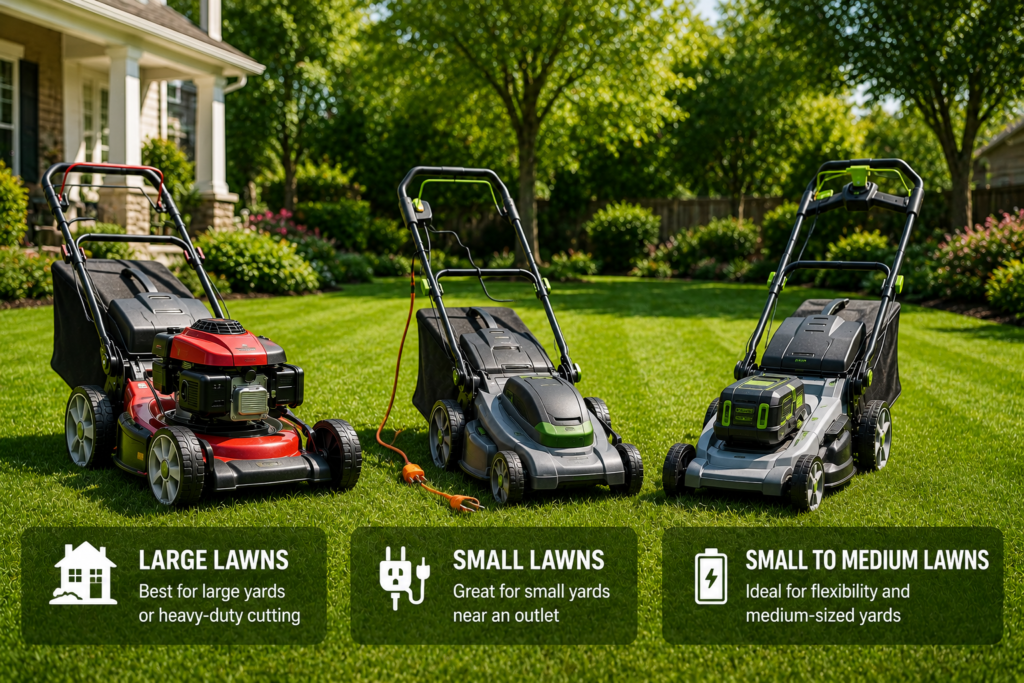
Small Lawns (Under 1/4 Acre)
A corded electric mower is often the most cost-effective, low-maintenance choice, provided your lawn stays within a reasonable cord range of an outdoor outlet.
Small to Medium Lawns (1/4 to 1/2 Acre)
A battery-powered mower in the 40V to 60V range typically provides enough runtime and power for a single mowing session without needing a recharge, combining mobility with low maintenance.
Medium to Large Lawns (1/2 to 1 Acre)
Here the decision becomes more genuinely close. A higher-voltage battery mower (60V-80V+) with a spare battery can handle this size, or a gas self-propelled mower offers uninterrupted power without battery management, particularly useful for thicker or more challenging grass conditions.
Large Properties (1+ Acres)
Gas riding mowers remain the most practical, cost-effective option for continuous, heavy-duty cutting across large areas, though electric riding mowers are becoming increasingly capable and are worth comparing directly for properties in this range.
Maintenance Comparison Over a Mower’s Lifespan
Gas mowers require the most ongoing, hands-on maintenance: regular oil changes, periodic spark plug and air filter replacement, fuel system care (particularly important if the mower sits unused over winter), and occasional carburetor or engine servicing. Corded electric mowers require essentially no engine maintenance at all, with occasional cord inspection for wear being the main upkeep task. Battery-powered mowers similarly require minimal maintenance, mainly proper battery storage and charging habits to maximize the battery’s usable lifespan over time.
Practical Buying Tips
- Check your state and city’s current regulations before assuming gas mower availability, particularly in California
- Calculate realistic total cost of ownership, purchase price plus several years of fuel or electricity and maintenance, rather than comparing upfront price alone
- Match battery voltage to your actual lawn size if going the battery-powered route, since underestimating runtime needs is a common frustration
- Consider noise tolerance in your neighborhood or household, particularly for early morning mowing schedules
- If choosing corded electric, measure your yard’s distance from available outdoor outlets before assuming a standard extension cord will comfortably cover your whole lawn
Common Mistakes to Avoid
- Assuming gas is always more powerful, when modern high-voltage battery mowers now handle most standard residential lawns comparably well
- Underestimating battery runtime needs for larger lawns, leading to frustrating mid-mow recharge breaks
- Ignoring total cost of ownership, focusing only on upfront price rather than several years of fuel, electricity, and maintenance costs combined
- Not checking local regulations, particularly for California residents assuming gas mowers remain freely available for new purchase
- Choosing corded electric without measuring cord range needs, resulting in a mower that can’t comfortably reach the entire lawn
Conclusion
The gas vs electric vs battery-powered lawn mower decision in 2026 comes down to matching power source to your specific lawn size, budget, and local regulatory environment, rather than defaulting to whatever your household has always used. Battery-powered mowers have genuinely closed the performance gap for most standard residential lawns while offering lower maintenance and running costs, making them the most balanced choice for many homeowners. Gas remains hard to fully replace for large properties or heavy-duty cutting needs where it’s still available to purchase, while corded electric continues to offer the simplest, most affordable option for smaller yards. Weighing your actual lawn size against these genuine trade-offs, rather than cost or tradition alone, will point you toward the mower that best fits how you’ll actually use it.
Frequently Asked Questions
1- Is a battery-powered lawn mower as good as a gas mower?
For most standard residential lawns, modern higher-voltage battery mowers now perform comparably to gas mowers. Gas still generally holds an edge for very large, thick, or overgrown grass requiring sustained heavy-duty cutting.
2- How much does it cost to run a gas mower versus an electric mower per year?
Gas mowers involve ongoing costs for fuel, oil changes, and periodic parts replacement, while electric mowers, corded or battery-powered, involve minimal electricity costs and little to no routine maintenance, generally making them meaningfully cheaper to run over several years.
3- Can I still buy a gas lawn mower in 2026?
In most states, yes. California specifically restricts the sale of new gas mowers using small off-road engines following Assembly Bill 1346, though existing gas mowers can continue to be used, and other states have generally taken an incentive-based rather than restrictive approach.
4- How long does a battery-powered mower run before needing a recharge?
This varies by battery voltage and mower model, but many mid-range battery mowers provide enough runtime for a standard quarter-to-half-acre lawn on a single charge, with larger lawns potentially requiring a spare battery.
5- Is a corded electric mower worth it for a small lawn?
Yes, for lawns within comfortable reach of an outdoor power outlet, corded electric mowers offer the lowest cost and simplest maintenance of any mower type, without any battery runtime concerns.
6- Do electric mowers require any maintenance at all?
Minimal maintenance is required, mainly keeping the blade sharp and clean, along with proper battery charging habits for cordless models, but neither type requires the oil changes, spark plugs, or fuel system care that gas mowers need.
7- Which mower type is quietest?
Both corded and battery-powered electric mowers run considerably quieter than gas mowers, which produce noticeably more noise and vibration from their internal combustion engine.