
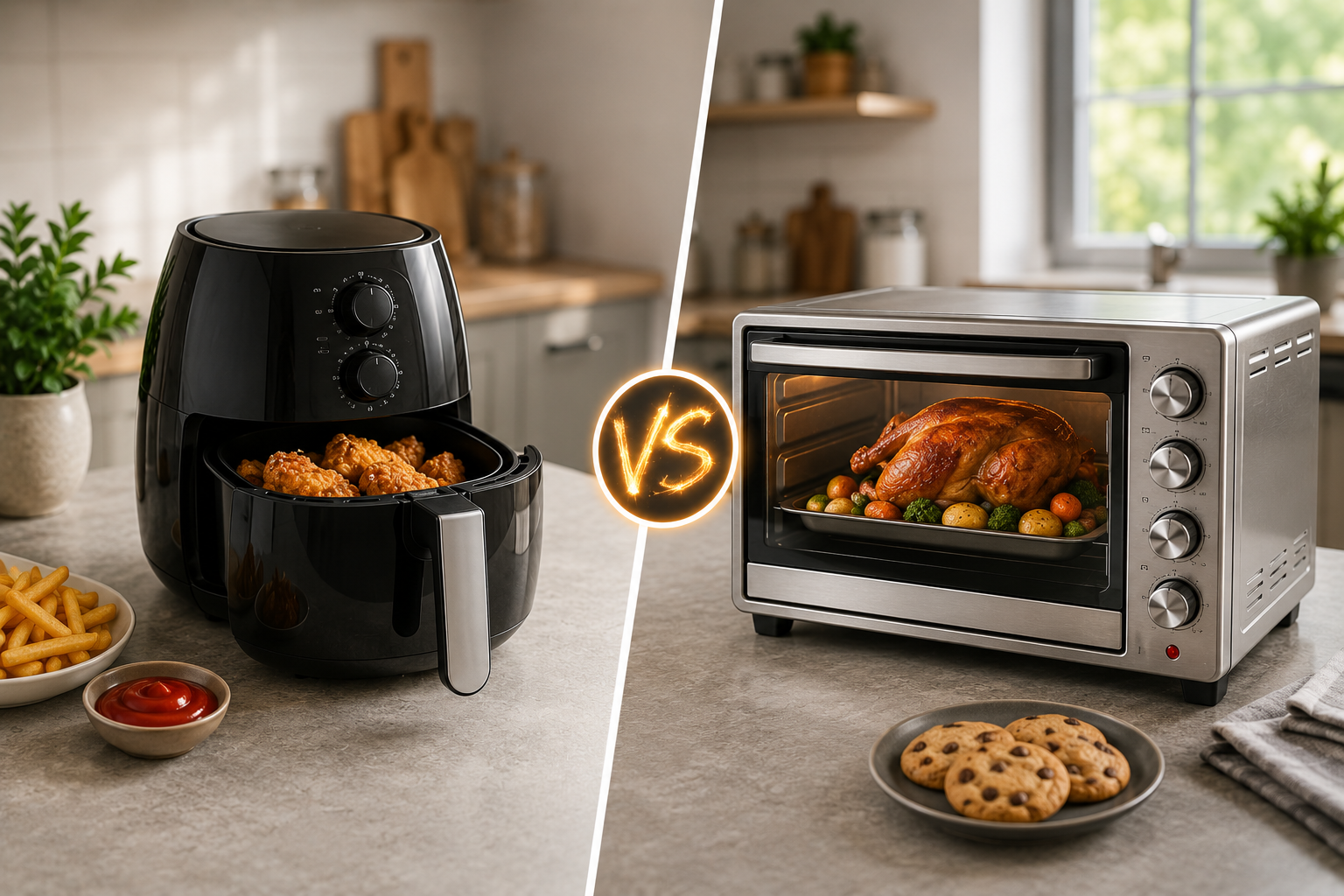
If you’ve been comparing kitchen appliances lately, you’ve likely run into the same recurring question: air fryer vs convection oven, and which one actually deserves counter space in your kitchen. Both use similar underlying technology, but they’re built for genuinely different purposes, and understanding that difference matters more than picking whichever one has better marketing.
This guide breaks down how each appliance works, where they overlap, where they differ, and which one, or both, makes the most sense for your household. Rather than declaring a single universal winner, we’ll walk through the practical trade-offs so you can make a decision based on your actual cooking habits.
Air Fryer vs Convection Oven: The Quick Overview
An air fryer and a convection oven both cook using rapidly circulated hot air, which is why they produce similarly crispy results. The real difference comes down to capacity and function: an air fryer is a compact, single-purpose countertop appliance built for fast, small-batch cooking, while a convection oven, whether a full-size wall oven or a larger countertop model, offers considerably more capacity and versatility for baking, roasting, and cooking larger meals. Many households genuinely benefit from having both, using the air fryer for quick, small portions and the convection oven for larger batches or dishes that need more space.
How Air Fryers Work
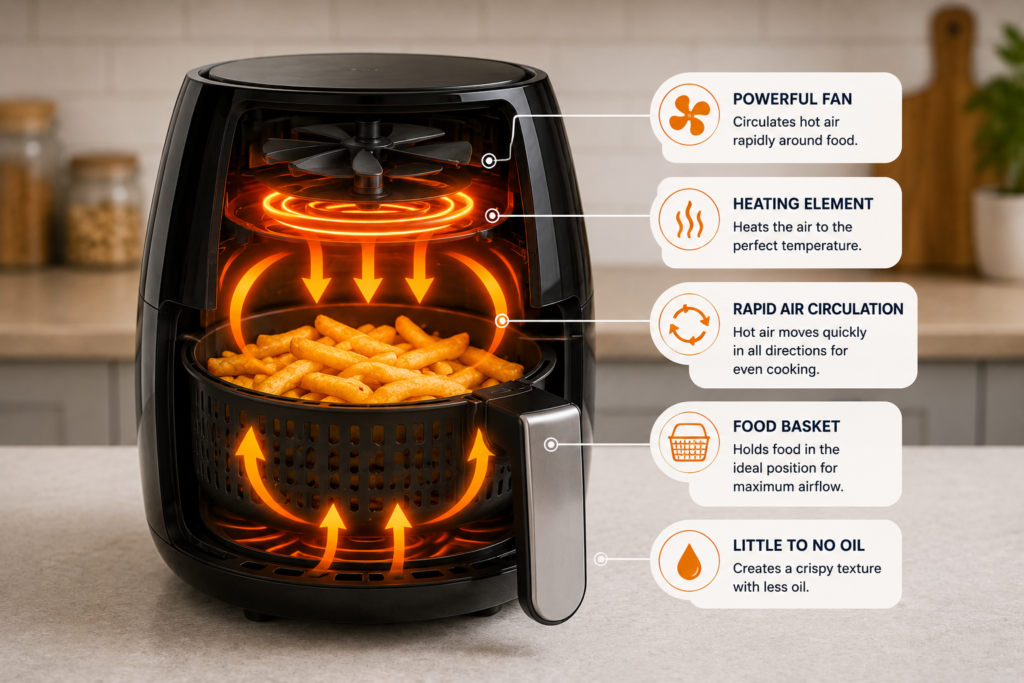
An air fryer uses a small, powerful fan positioned near a heating element to circulate hot air rapidly around food placed in a compact basket. This rapid air movement cooks food quickly while creating a crispy, browned exterior similar to deep frying, but using little to no added oil.
Because the cooking chamber is small, typically ranging from 2 to 10 quarts, air fryers heat up fast and cook food in a fraction of the time a full-size oven would need, making them especially popular for quick weeknight meals, reheating leftovers, and cooking frozen foods like fries or chicken nuggets.
How Convection Ovens Work
A convection oven uses the same basic principle: a fan circulating hot air, but within a much larger cooking chamber. This can be a full-size built-in wall oven with a convection setting, or a larger countertop convection oven that sits between a standard toaster oven and a full range oven in size.
The added airflow in a convection oven reduces cooking time compared to a standard (non-convection) oven and promotes more even browning, since hot air reaches all sides of the food rather than relying primarily on radiant heat from the top and bottom.
Air Fryer vs Convection Oven: Key Differences
| Feature | Air Fryer | Convection Oven |
| Typical Capacity | 2–10 quarts | 20+ quarts (countertop) or full oven size |
| Preheat Time | Minimal to none | Several minutes |
| Cooking Speed | Very fast for small portions | Fast, but scales with load size |
| Best For | Small batches, quick meals | Larger meals, baking, roasting |
| Counter Space | Compact | Larger footprint (countertop models) |
| Versatility | Limited to air frying function | Bake, roast, broil, and often air fry |
| Price Range | Lower to mid-range | Mid to higher range |
| Cleanup | Simple, removable basket | More surface area to clean |
1- Cooking Performance Compared
- Speed and Efficiency
Air fryers generally win on speed for small portions, since their compact cooking chamber heats up almost instantly and requires little to no preheating. For a quick batch of frozen fries or a few chicken tenders, an air fryer typically finishes noticeably faster than a convection oven would for the same task.
Convection ovens, while requiring more preheat time, make up for it with capacity. Cooking a larger batch of food in an air fryer often requires multiple rounds, since overcrowding the basket leads to uneven cooking, whereas a convection oven can handle a full sheet pan or multiple trays in a single cooking cycle.
- Crispiness and Texture
Both appliances produce similarly crispy results thanks to their shared rapid-air technology. In practice, the size of the batch matters more to the final texture than which appliance you use, since overcrowding either an air fryer basket or an oven tray can prevent food from crisping evenly on all sides.
- Versatility
This is where convection ovens generally pull ahead. A full-size or countertop convection oven can typically bake, roast, broil, toast, and often air fry within the same appliance, making it considerably more versatile for households that cook a wide variety of dishes. A standalone air fryer is generally limited to its core function, though many modern models do include secondary settings like roast, reheat, or dehydrate.
2- Capacity: A Major Practical Difference
Capacity is arguably the single biggest practical difference between these two appliances, and it has a direct impact on which one suits your household.
Air Fryer Capacity
Most home air fryers range from 2 to 10 quarts, suited to cooking for one to four people at a time, depending on the specific model and what you’re preparing. Larger households or those cooking bigger cuts of meat may find even a large air fryer basket limiting for a full meal.
Convection Oven Capacity
Full-size wall ovens with a convection setting offer significantly more capacity, easily handling a whole chicken, several sheet pans, or a large casserole dish. Countertop convection ovens, while smaller than a built-in wall oven, still typically offer considerably more interior space than even the largest air fryer models, making them a better fit for cooking multiple dishes or larger quantities at once.
3- Energy Efficiency Comparison
Energy efficiency is another area where these two appliances diverge meaningfully, largely due to the difference in size and cooking chamber volume.
Air Fryer Energy Use
Because air fryers have a small cooking chamber and don’t typically require preheating, they generally use less energy per cooking session than a full-size oven, particularly for small portions. Running an air fryer for a quick 15-minute cook is almost always more energy-efficient than heating an entire oven for the same task.
Convection Oven Energy Use
A full-size convection oven uses more energy to heat its larger interior, though it becomes more energy-efficient per item cooked when preparing larger batches, since you’re heating the space once for multiple servings rather than running several smaller cooking cycles. For households regularly cooking larger meals, a convection oven can end up being the more efficient choice overall, despite using more energy per individual cooking session.
4- Price Comparison
Price ranges for both appliances vary considerably based on size, brand, and features, though some general patterns hold across the market.
Basic air fryers tend to be the more affordable entry point among the two, particularly smaller basket-style models with manual controls. Larger air fryers, dual-basket models, or oven-style air fryers with more features can approach or match the price of a smaller countertop convection oven.
Countertop convection ovens generally start at a similar or slightly higher price point than a mid-range air fryer, with prices increasing alongside capacity and added features like multiple racks, rotisserie functions, or digital presets. Full-size wall ovens with convection settings represent a considerably larger investment, though this cost is typically part of a broader kitchen appliance package rather than a standalone purchase.
5- Cleanup and Maintenance
Cleanup requirements differ somewhat between the two, largely due to the difference in cooking chamber size and design.
Air fryers typically feature a removable, non-stick basket that’s simple to clean, often dishwasher-safe, making daily cleanup relatively quick and low-effort. Convection ovens, particularly full-size models, have more interior surface area to clean, including racks, walls, and sometimes a larger drip tray, which can make cleanup more time-consuming, especially after cooking greasy or messy dishes.
Which One Should You Buy?
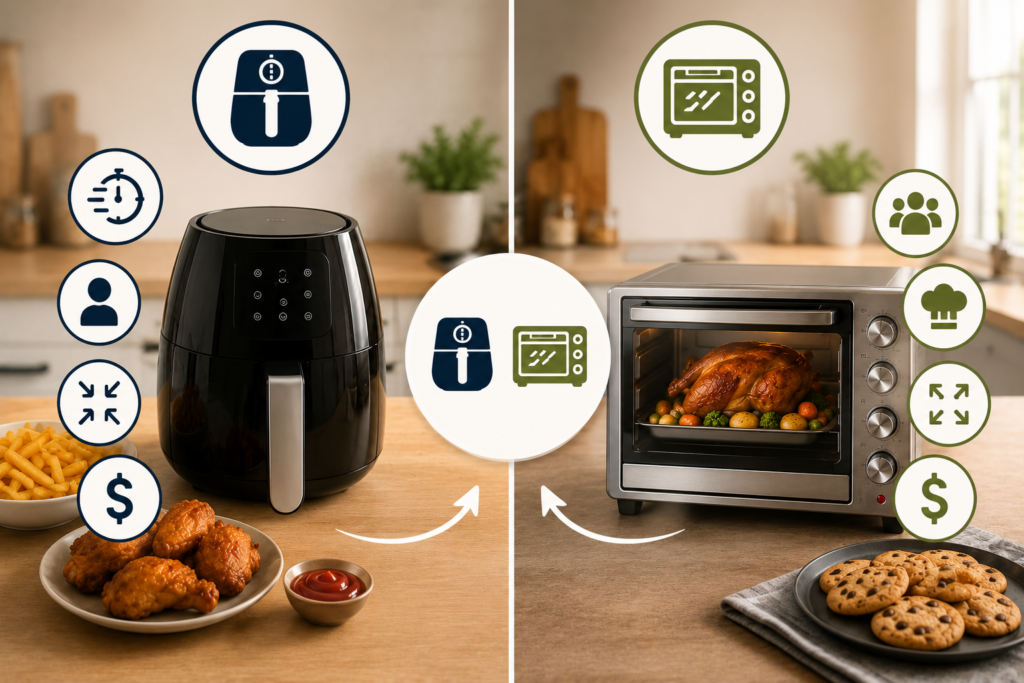
Choose an Air Fryer If:
- You primarily cook for one to three people
- You want fast, convenient meals with minimal preheating
- Counter space is limited
- You’re looking for a lower-cost entry point into rapid-air cooking
- You mainly cook items like frozen foods, small proteins, or vegetables
Choose a Convection Oven If:
- You regularly cook for a larger household or entertain guests
- You need to bake, roast, and broil in addition to air frying
- You want to cook larger cuts of meat or multiple dishes simultaneously
- You have adequate counter or built-in space for a larger appliance
- You value versatility over the fastest possible cooking time for small portions
Consider Both If:
Many households find genuine value in owning both appliances, using the air fryer for quick, everyday meals and small portions, while relying on a convection oven for larger family meals, baking projects, or entertaining. This combination covers both ends of the cooking spectrum without compromise, provided you have the kitchen space and budget to accommodate both.
Common Cooking Tasks: Which Appliance Wins?
| Task | Better Choice | Why |
| Reheating leftovers | Air fryer | Fast, no preheating needed |
| Cooking frozen fries or nuggets | Air fryer | Quick, crispy results in small batches |
| Roasting a whole chicken | Convection oven | Requires more interior space |
| Baking a sheet of cookies | Convection oven | Larger batch capacity |
| Quick weeknight side dish | Air fryer | Speed and convenience |
| Cooking for a large family meal | Convection oven | Handles multiple dishes at once |
| Dehydrating fruit or jerky | Either (model dependent) | Some air fryers include a dehydrate setting |
Practical Buying Tips
Regardless of which appliance you’re leaning toward, a few practical considerations can help guide your final decision:
- Think honestly about your typical portion sizes and household size before choosing capacity
- Measure your available counter space, particularly for larger convection oven models
- Consider how often you cook larger meals versus quick, small portions
- Factor in cleanup time, since larger appliances generally require more thorough cleaning
- If budget allows, evaluate whether owning both appliances would genuinely serve your household better than choosing just one
Common Mistakes to Avoid
- Choosing an air fryer for a large household, then struggling with multiple cooking batches for every meal
- Buying a large convection oven for infrequent, small-portion cooking, resulting in wasted energy and counter space
- Overlooking preheat time, particularly for households prioritizing quick weeknight meals
- Ignoring cleanup requirements, especially for larger convection ovens with more surface area
- Assuming both appliances perform identically, without considering how capacity affects real-world cooking results
Conclusion
The choice between an air fryer vs convection oven ultimately comes down to how much food you typically cook, how much counter space and budget you have available, and whether you value speed and simplicity over versatility and capacity. An air fryer suits smaller households and quick, everyday cooking, while a convection oven offers the space and flexibility needed for larger meals and a wider range of cooking tasks. For many American kitchens, the most practical solution isn’t choosing one over the other, but understanding how each appliance’s strengths complement different cooking needs throughout the week.
Frequently Asked Questions
1- Is an air fryer the same as a convection oven?
They use similar rapid-air cooking technology, but an air fryer is a smaller, single-purpose countertop appliance, while a convection oven offers significantly more capacity and versatility for baking, roasting, and cooking larger meals.
2- Can a convection oven do everything an air fryer can do?
In most cases, yes, particularly if the convection oven includes a dedicated air fry setting. However, an air fryer often cooks small portions faster due to its compact size and minimal preheat time.
3- Do I need both an air fryer and a convection oven?
Not necessarily, but many households find value in owning both, using the air fryer for quick, small-batch cooking and the convection oven for larger meals, baking, and entertaining.
4- Which is more energy efficient, an air fryer or a convection oven?
For small portions, an air fryer is generally more energy-efficient due to its smaller cooking chamber and minimal preheat time. For larger batches, a convection oven can be more efficient overall, since it cooks more food per heating cycle.
5- Is food cooked in an air fryer as healthy as food from a convection oven?
Both methods use significantly less oil than traditional deep frying, and neither is inherently healthier than the other, since the nutritional outcome depends more on the ingredients and oil used than on the specific appliance.