
Small kitchens present a real challenge: you need just as much storage as a larger kitchen, but with a fraction of the floor and wall space to work with. The right small kitchen storage cabinets can make a genuinely dramatic difference in how functional a tight kitchen feels day to day, turning a cramped, cluttered cooking space into one that actually works for you.
This guide covers the types of storage cabinets best suited to small kitchens, how to choose between them, and practical tips for making the most of every available inch. Rather than recommending specific products, we’ll focus on the categories and features that matter most, so you can shop confidently no matter which brand or retailer you choose.
Why Small Kitchens Need a Different Storage Approach
Standard kitchen storage advice doesn’t always translate well to compact spaces. In a small kitchen, every cabinet has to work harder, often serving more than one purpose, and wasted space an awkward corner, an unused gap above the fridge, a sliver of wall beside the cooker become a real missed opportunity rather than a minor inconvenience.
The goal isn’t necessarily buying more storage. It’s choosing storage that fits your specific layout efficiently and keeps frequently used items within easy reach. A kitchen with three well-chosen cabinets can easily outperform one with five poorly planned ones, simply because everything has a proper place and nothing gets buried at the back of a cupboard you can barely open.
It’s also worth thinking about how you actually move through your kitchen. Storage that looks great on paper but blocks a walkway or forces you to squeeze past an open door every time you cook isn’t really solving the problem; it’s just relocating it.
Types of Kitchen Storage Cabinets for Small Spaces
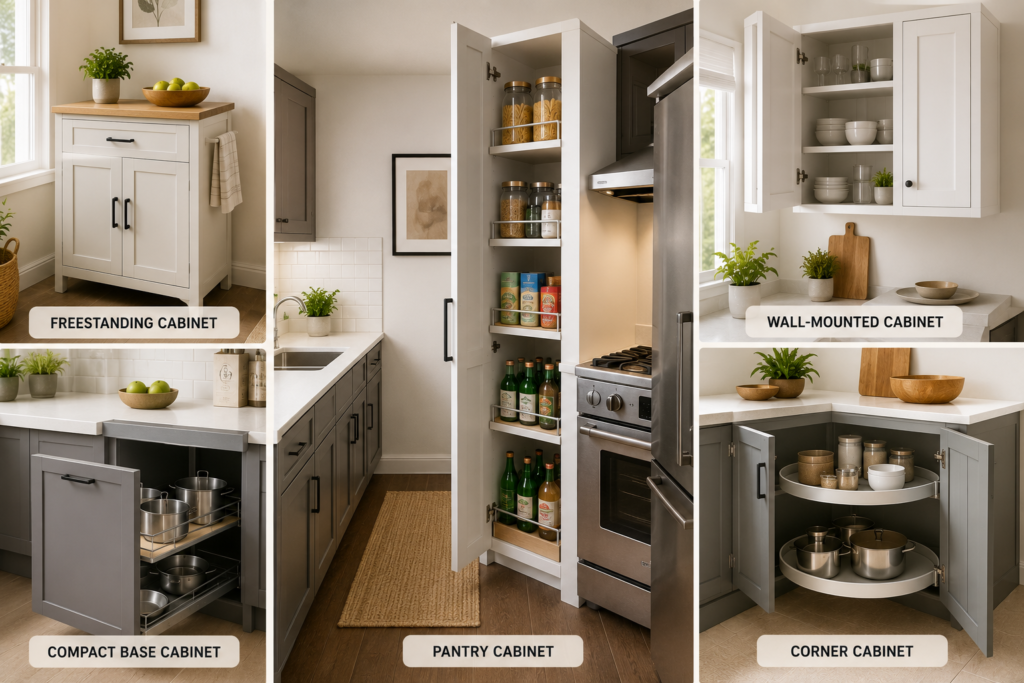
Freestanding Storage Cabinets
A freestanding kitchen storage cabinet offers one of the most flexible solutions for small kitchens, since it doesn’t require any installation and can be repositioned or removed if your needs change. These work particularly well in kitchens with an awkward layout that doesn’t leave room for built-in cabinetry, or in rented properties where permanent alterations aren’t an option.
Freestanding units come in a wide range of sizes, from narrow, slim cabinets that fit in tight gaps to larger hutch-style units offering significant storage in one footprint. Many double up as extra worktop space, which is often just as valuable as the storage itself in a small kitchen.
Pantry Cabinets
A pantry cabinet for small kitchen spaces solves one of the most common small-kitchen problems: nowhere to store bulk food items or small appliances. Slim pantry cabinets, often just 12 to 18 inches wide, fit into narrow gaps between appliances or at the end of a run of cabinetry without eating into your usable floor space.
Many compact pantry cabinets include pull-out shelving or wire baskets, making it far easier to see and reach items stored toward the back, rather than digging through tins and packets that have migrated to the shadows of a deep, fixed shelf.
Compact Base Cabinets
A compact kitchen storage cabinet designed specifically for smaller footprints typically ranges from 12 to 24 inches wide, compared to the standard 30 to 36-inch base cabinets found in larger kitchens. These narrower units fit into small kitchens without sacrificing much usable storage, and they’re often the easiest way to add a proper cabinet where a standard-width one simply wouldn’t fit.
Wall-Mounted Cabinets
Wall cabinets make use of vertical space that often goes underutilised in small kitchens. Extending cabinetry closer to the ceiling, rather than stopping short and leaving an awkward gap that just collects dust, adds meaningful extra storage without using any additional floor space at all arguably the best value-for-space option going.
Corner Cabinets
Corners are some of the most commonly wasted space in any kitchen. Specialised corner cabinets, including lazy Susan and pull-out designs, make awkward corner space genuinely usable rather than leaving it empty or nearly impossible to reach into.
Comparing Storage Cabinet Types
| Cabinet Type | Best For | Installation | Flexibility |
| Freestanding cabinet | Renters, flexible layouts | None required | High |
| Pantry cabinet | Bulk food storage | Minimal to none | Moderate |
| Compact base cabinet | Narrow gaps, tight kitchens | Usually built-in | Low |
| Wall-mounted cabinet | Maximising vertical space | Requires installation | Low |
| Corner cabinet | Awkward corner space | Usually built-in | Low |
What to Look for When Choosing a Storage Cabinet
Size and Fit
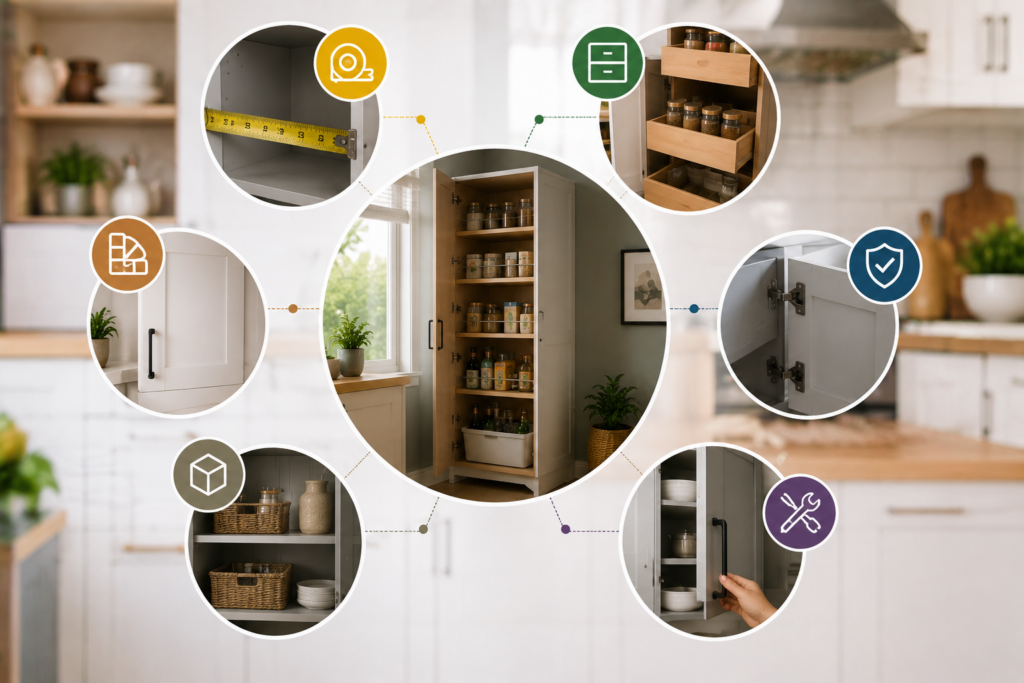
Measure the exact space available before shopping, including height, width, and depth. In small kitchens, even an inch or two of miscalculation can mean the difference between a cabinet that fits neatly and one that has to go straight back. It’s also worth checking door swing and drawer extension clearances, not just the cabinet’s static footprint.
Material Quality
Solid wood cabinets can offer good durability and can often be refinished, although they usually cost more upfront. Engineered wood, such as MDF or particleboard, offers a more budget-friendly option but is more vulnerable to moisture damage over time, which matters near sinks and hobs. Metal cabinets resist moisture well and suit modern kitchen styles, though they can show dents and scuffs more easily than wood.
Storage Configuration
Look for adjustable shelving, since fixed shelves often waste vertical space that could otherwise fit taller items like bottles or cereal boxes. Pull-out drawers and baskets make it easier to access items stored at the back of deeper cabinets, which matters considerably in space-constrained kitchens where every cabinet needs to be genuinely usable, not just technically available.
Door Style
In tight kitchens, door clearance matters more than it might seem. Sliding or bi-fold doors can be a smarter choice than traditional swinging doors in narrow walkways, since they don’t require extra floor space to open fully a small detail that makes a real difference if your kitchen doubles as a thoroughfare.
Pros and Cons of Small Kitchen Storage Cabinets
Pros
- Make efficient use of otherwise wasted space, especially corners and vertical gaps
- Freestanding options require no installation and suit renters
- Wide range of sizes means there’s almost always something that fits
- Pull-out and adjustable features improve accessibility in tight spaces
- Can double as worktop space in the case of freestanding units
Cons
- Compact cabinets naturally hold less than standard-sized ones
- Built-in options require professional installation and higher upfront cost
- Cheaper engineered wood options are more vulnerable to moisture over time
- Poorly measured cabinets can obstruct walkways or door swings
- Corner and pull-out mechanisms can wear out faster than simple fixed shelving
Maximising Vertical Space
Vertical space is one of the most overlooked storage opportunities in small kitchens. A few practical approaches:
- Extend wall cabinets to the ceiling rather than leaving a gap above
- Add stackable shelf organisers inside cabinets to use vertical space within each shelf
- Use the space above cabinets for rarely used items stored in labelled bins
- Install a slim rolling cabinet in narrow, unused gaps between appliances
- Fit a shallow shelf or rail on unused wall space for jars, spices, or utensils
Freestanding vs Built-In Storage: Which Is Better for Small Kitchens?
This depends largely on whether you’re renting or own your home, and how permanent you want the solution to be.
Freestanding cabinets offer flexibility and require no installation, making them ideal for renters or anyone who might rearrange their kitchen in the future. They’re also generally easier and cheaper to replace if your needs change, and you can take them with you when you move.
Built-in cabinets offer a more seamless, integrated look and can be custom-fitted to make the most of every available inch, which matters considerably in tight spaces. They cost more and typically require professional installation, but they make the most efficient use of oddly shaped or limited space, and tend to add more value if you own your property.
Common Mistakes to Avoid
- Buying oversized cabinets that technically fit but leave little room to move around the kitchen
- Ignoring vertical space, leaving the area above wall cabinets or the fridge unused
- Choosing swinging doors in tight walkways where they can’t open fully
- Overlooking corner space, one of the most commonly wasted areas in small kitchens
- Buying storage without a plan, resulting in cabinets that don’t actually solve your specific storage problems
- Forgetting to account for appliance doors, such as an oven or dishwasher, when measuring nearby cabinet clearance
How to Prioritise Storage in a Small Kitchen
Not every small kitchen has room for every type of storage cabinet, so it helps to prioritise based on your actual cooking habits.
If you cook frequently and use a lot of pantry staples, prioritise a slim pantry cabinet over additional wall cabinets. If counter space is your biggest complaint, a freestanding cabinet that also offers some countertop surface may solve two problems at once. If your kitchen has an awkward, unused corner, addressing that space specifically often yields more usable storage than adding a standard cabinet elsewhere.
It can help to live with your kitchen as it is for a week or two before buying anything, simply noting what you reach for daily versus what sits untouched. That habit alone often reveals exactly where your storage priorities should be.
Conclusion
There’s no single “best” storage cabinet for every small kitchen the right choice depends on your layout, whether you rent or own, and how you actually cook. That said, a combination approach tends to work best: a freestanding cabinet or slim pantry unit for flexibility, paired with wall-mounted storage extended to the ceiling to make full use of vertical space. Corner solutions are worth the investment if your kitchen has one, since that space is so often wasted otherwise. Measure carefully, prioritise based on your habits, and resist the urge to over-buy a few well-chosen cabinets will always outperform a kitchen crammed with too many.
Frequently Asked Questions
1- What is the best type of cabinet for a small kitchen?
This depends on your specific layout, but freestanding cabinets and slim pantry units tend to offer the most flexibility for genuinely small kitchens without requiring major installation.
2- How can I add storage to a small kitchen without renovating?
Freestanding cabinets, wall-mounted shelving, and stackable organisers inside existing cabinets all add meaningful storage without any structural changes.
3- Are freestanding kitchen cabinets a good long-term solution?
Yes, particularly for renters or households that may rearrange their kitchen in the future. They offer nearly the same functionality as built-in cabinets with far more flexibility.
4- What’s the best way to use corner space in a small kitchen?
A lazy Susan or pull-out corner cabinet system makes the most of typically wasted corner space, turning it into genuinely accessible storage.
5- Should I choose wood or metal cabinets for a small kitchen?
Wood offers a warmer look and can be refinished over time, while metal resists moisture better and suits more modern kitchen styles. The right choice depends on your kitchen’s overall design and how much moisture exposure the cabinet will face.
6- How deep should a small kitchen cabinet be?
Standard base cabinets are usually around 24 inches deep, but slimmer versions at 12 to 18 inches are widely available and often better suited to tight kitchens where every inch of walking space counts.