
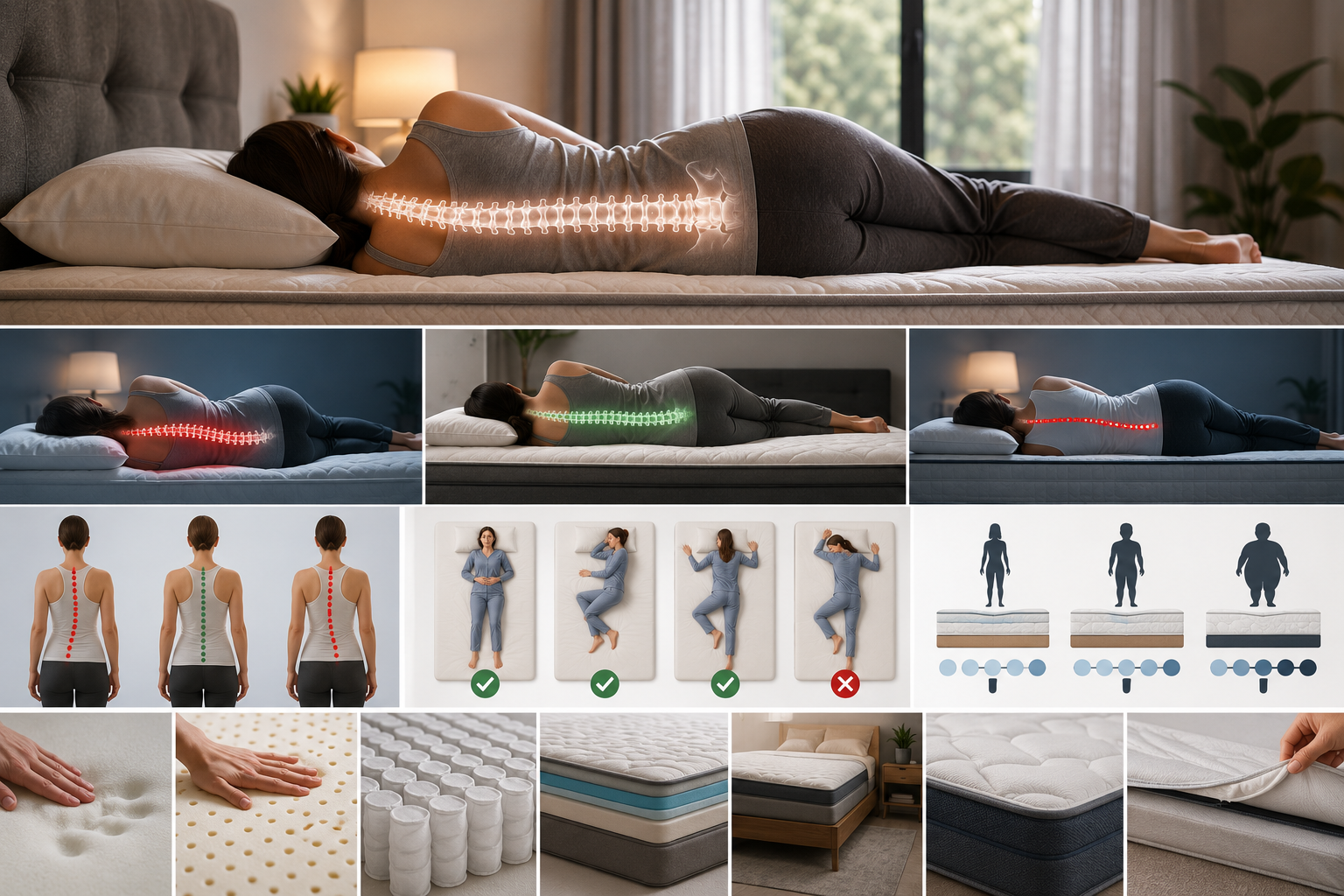
If you’ve ever rolled out of bed stiffer than when you laid down, your mattress might genuinely be the culprit, not just age or a long day. Finding the best mattress for back pain isn’t about grabbing the firmest bed on the showroom floor, despite the old advice most of us grew up hearing, it’s about understanding what actually keeps your spine in its natural alignment through a full night of sleep.
This guide breaks down what the evidence actually says about firmness and back pain, how your sleep position and body weight should shape your choice, which materials genuinely help, and the warning signs that mean it’s time to look beyond a new mattress entirely.
What Actually Helps Back Pain
Despite the long-standing myth that a hard mattress is best for a bad back, the evidence points the other way: a medium-firm mattress, generally landing around 5 to 7 on a 10-point firmness scale, does more to reduce back pain than either a very soft or a very firm surface. The goal is a mattress firm enough to prevent your hips and torso from sinking into a “hammock” shape, but soft enough to cushion your shoulders and hips so your spine can rest in its natural curve. Your ideal spot within that medium-firm range still depends on your sleep position, body weight, and hip width, which is exactly what the rest of this guide walks through.
Why “Firmer Is Always Better” Is Outdated Advice
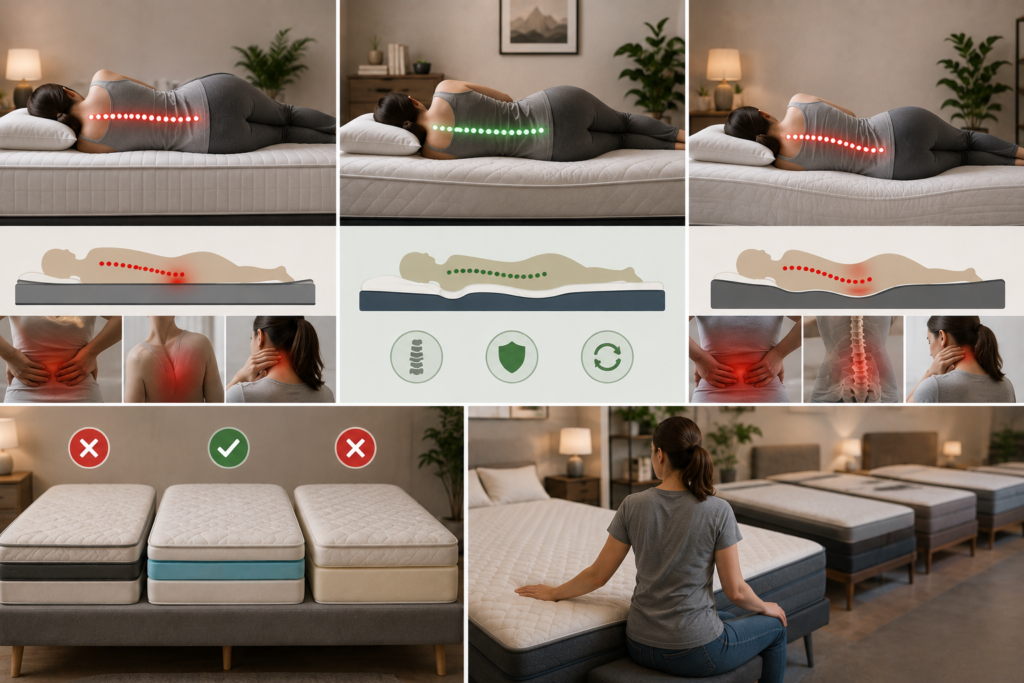
The Old Belief vs What Actually Works
For decades, doctors and mattress salespeople alike recommended the firmest possible mattress for anyone with back pain, the logic being that firm support prevents the spine from sinking or curving unnaturally. More recent research has walked that advice back considerably, showing that medium-firm surfaces actually outperform very firm ones for both sleep quality and reported back pain relief.
The Real Problem With Extremely Firm Mattresses
A mattress that’s too hard doesn’t let your shoulders and hips sink in at all, which means those pressure points bear the full brunt of your body weight without any cushioning. This creates uncomfortable pressure buildup at the joints and actually prevents your spine from settling into its natural curve, the opposite of the support a firm mattress is supposed to provide.
The Real Problem With Overly Soft Mattresses
At the other extreme, a mattress that’s too soft lets the heaviest part of your body, your torso and hips, sink too deeply into the surface, creating what’s often called the “hammock effect.” Once your midsection drops lower than the rest of your body, your lumbar spine gets pulled out of its neutral alignment, and that misalignment is a well-documented contributor to morning stiffness and lower back pain.
The Firmness Sweet Spot, Explained
Where the Evidence Actually Points
Multiple mattress and spine-focused sources converge on a similar range: medium-firm, roughly 5 to 7 on a standard 10-point scale, as the firmness level most strongly associated with reduced back pain and better sleep quality. This isn’t a single fixed number, though, your ideal spot within that range shifts based on a few personal factors.
How Sleep Position Shifts Your Ideal Firmness
| Sleep Position | Recommended Firmness | Why |
| Back sleepers | Medium-firm (5–7) | Needs lumbar support without letting hips sink too far |
| Side sleepers | Softer medium (5–6) | Needs enough give for shoulder and hip sinkage to keep spine level |
| Stomach sleepers | Firm (7–8) | Needs firmness to prevent hips sinking into an unnatural arch |
| Combination sleepers | Medium-firm hybrid (5–6) | Needs enough versatility to support multiple positions through the night |
How Body Weight Shifts Your Ideal Firmness
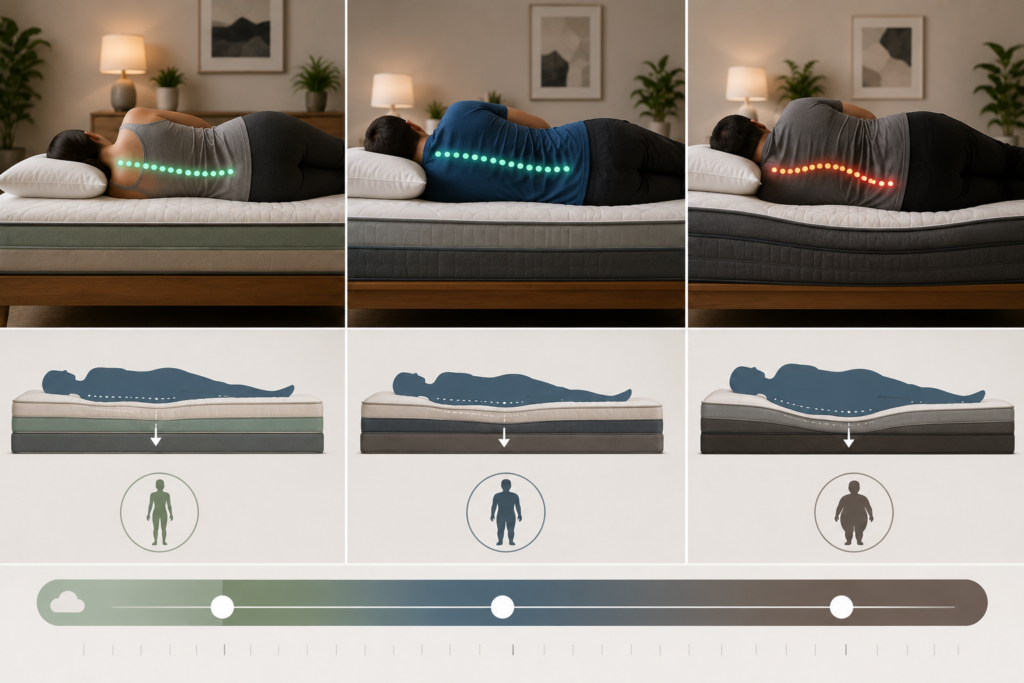
Body weight changes how firm a given mattress actually feels underneath you, which matters just as much as the number on the label.
- Under 150 lbs: You’ll feel a given mattress as firmer than its stated rating suggests, since your weight isn’t compressing the material as much. Consider going one step softer than the standard medium-firm recommendation.
- 150–230 lbs: This is the range where the standard medium-firm (5–7) recommendation applies most directly and predictably.
- Over 230 lbs: You’ll sink deeper into any given mattress, and may need a firmer build than standard medium-firm to maintain neutral spinal alignment. Always check a mattress’s stated weight limit before buying.
Why Hip Width Matters More Than People Expect
If you have wider hips, you may actually need a mattress with more give, a slightly softer surface, to keep your spine properly aligned, since narrower support under wide hips can push your pelvis out of neutral position. Conversely, narrower hips may benefit from a firmer surface, since there’s less mass needing to sink in to reach proper alignment.
Best Mattress Materials for Back Pain Relief
Hybrid: The Most Frequently Recommended Option
Hybrid mattresses, combining supportive coils with a contouring foam or latex comfort layer, come up repeatedly as the strongest overall choice for back pain sufferers. The coil base provides responsive, targeted support beneath the lumbar spine, while the foam layer cushions the hips and shoulders, giving you both structural support and pressure relief in one mattress rather than having to choose between them.
Zoned Support: Precision Where You Actually Need It
Many higher-performing back-pain mattresses use zoned support systems, dividing the mattress into different firmness sections rather than applying uniform firmness throughout. A typical zoned layout reinforces the torso and lower back with firmer material to prevent sagging, while softer material under the shoulders and hips provides the cushioning those pressure points need.
Latex: A Responsive, Naturally Supportive Alternative
Latex mattresses offer a more buoyant, responsive feel than memory foam while still providing genuine contouring support, a combination that works particularly well for back pain sufferers who want pressure relief without the slower, deeper sink of pure memory foam.
Memory Foam: Good for Pressure, Less Ideal Alone for Structure
Memory foam alone offers excellent pressure relief but generally lacks the structural, zoned support a hybrid or latex construction provides, which is why it’s more often recommended for back pain specifically when paired with a supportive base layer rather than used as an all-foam mattress on its own.
Special Considerations for Sciatica
For sleepers dealing with sciatica specifically, the ideal mattress firmness generally falls in the same medium to medium-firm range as general back pain relief, providing enough cushioning around the hips and lower back to keep the spine neutral without the pressure buildup a firmer surface can create along the compressed nerve pathway.
What About Adjustable Bases?
Adjustable foundations, which let you raise or angle the head and foot of the bed, are increasingly paired with mattresses marketed for back pain relief. By encouraging a sleep position that reduces stress on the lower back, elevating the knees slightly, for example, an adjustable base can further support proper spinal alignment beyond what the mattress alone provides, particularly useful for those managing chronic lower back discomfort alongside other pain points like the neck or shoulders.
Warning Signs Your Current Mattress Is the Problem
New or Worsening Pain Is a Red Flag
If you’re waking up with aches you didn’t have before, particularly in your neck, shoulders, or lower back, that’s a genuine signal your current mattress isn’t supporting you properly, not just something to push through.
The “Sinking” vs “Board” Test
Pay attention to how your body actually feels on the mattress. If you feel like you’re sinking too far in, your midsection dropping below the rest of your body, that’s the hammock effect at work. If you feel like you’re sleeping on a rigid board with no give at your shoulders or hips, that’s the opposite problem, both are signs the firmness isn’t right for you.
Visible Sagging or Body Impressions
Check your mattress for visible indentations where you regularly sleep. A well-constructed mattress shouldn’t develop body impressions deeper than about 1.5 inches, even after months of consistent use, deeper sagging than that is a sign the mattress itself has broken down structurally, not just a firmness mismatch.
Use Your Sleep Trial Fully
Most mattress brands offer a trial period specifically because a bed can feel wonderful after five minutes in a showroom and completely different after a month of actual sleep. Give a new mattress genuine time, generally several weeks, before deciding whether it’s actually working, and don’t hesitate to return it if it isn’t.
When a Mattress Isn’t Enough
If you’ve already changed your mattress to a properly fitted, medium-firm option and you’re still consistently waking up with stiffness or pain, that persistent pattern can be a sign of an underlying issue, like degenerative disc disease or another spinal condition, that a mattress alone won’t resolve. In that case, it’s worth having a conversation with a doctor or spine specialist rather than continuing to cycle through mattresses hoping for a fix.
Practical Buying Tips
- Start with medium-firm (5–7) as your baseline, then adjust based on your sleep position, body weight, and hip width
- Prioritize hybrid or zoned-support constructions over uniform-firmness options if back pain is a primary concern
- Check the mattress’s stated weight limit if you’re on the heavier end, and lean firmer than standard recommendations if you weigh over roughly 230 pounds
- Use the full sleep trial period before making a final judgment, since a mattress’s true performance shows up over weeks, not one night
- Watch for visible sagging or body impressions deeper than 1.5 inches as a sign the mattress itself needs replacing, not just repositioning
Common Mistakes to Avoid
- Assuming the firmest mattress is automatically best for back pain, when medium-firm surfaces actually show stronger results
- Ignoring your sleep position when choosing firmness, applying the same recommendation regardless of whether you sleep on your back, side, or stomach
- Overlooking body weight’s effect on how firm a mattress actually feels, leading to a mismatch even when the labeled firmness seems “correct”
- Judging a mattress after just one night, rather than giving it several weeks within a proper sleep trial period
- Continuing to cycle through mattresses despite persistent pain, without considering that an underlying spinal condition may need professional evaluation
Conclusion
Finding the best mattress for back pain comes down to abandoning the old “firmer is always better” myth and focusing instead on medium-firm support, roughly 5 to 7 on the standard scale, adjusted for your specific sleep position, body weight, and hip width. A hybrid mattress with zoned support generally offers the most balanced combination of structural alignment and pressure relief, but the real test happens over weeks of actual sleep, not a five-minute showroom lie-down. Use your sleep trial fully, watch for genuine warning signs like new pain or visible sagging, and if the ache persists even after a proper mattress change, that’s your cue to talk to a professional rather than keep guessing.
Frequently Asked Questions
1- What firmness mattress is best for back pain?
A medium-firm mattress, generally in the 5 to 7 range on a 10-point scale, is most strongly associated with reduced back pain, offering enough support to prevent sagging while still cushioning pressure points.
2- Is a firm mattress better for back pain than a soft one?
Not necessarily. While firm mattresses were long assumed to be best, research shows medium-firm surfaces outperform very firm ones for both back pain relief and overall sleep quality.
3- What mattress type is best for lower back pain specifically?
Hybrid mattresses with zoned support are frequently recommended, since they combine firm, structural support under the torso and lower back with softer cushioning at the shoulders and hips.
4- How does body weight affect mattress firmness for back pain?
Heavier individuals sink deeper into any given mattress and often need a firmer build than standard recommendations, while lighter individuals feel a mattress as firmer than its rating suggests and may benefit from going slightly softer.
5- Is memory foam good for back pain?
It can be, particularly for pressure relief, but memory foam alone often lacks the structural, zoned support a hybrid or latex mattress provides, making combination constructions generally more effective for back pain specifically.
6- How long should I try a new mattress before deciding if it helps my back pain?
Give it several weeks within your mattress’s sleep trial period rather than judging after just one or two nights, since a mattress’s true impact on pain and alignment shows up over consistent, extended use.
7- When should I see a doctor instead of just buying a new mattress?
If you’ve switched to a properly fitted, medium-firm mattress and you’re still experiencing persistent stiffness or pain, that pattern may indicate an underlying spinal condition worth having evaluated by a doctor or specialist.