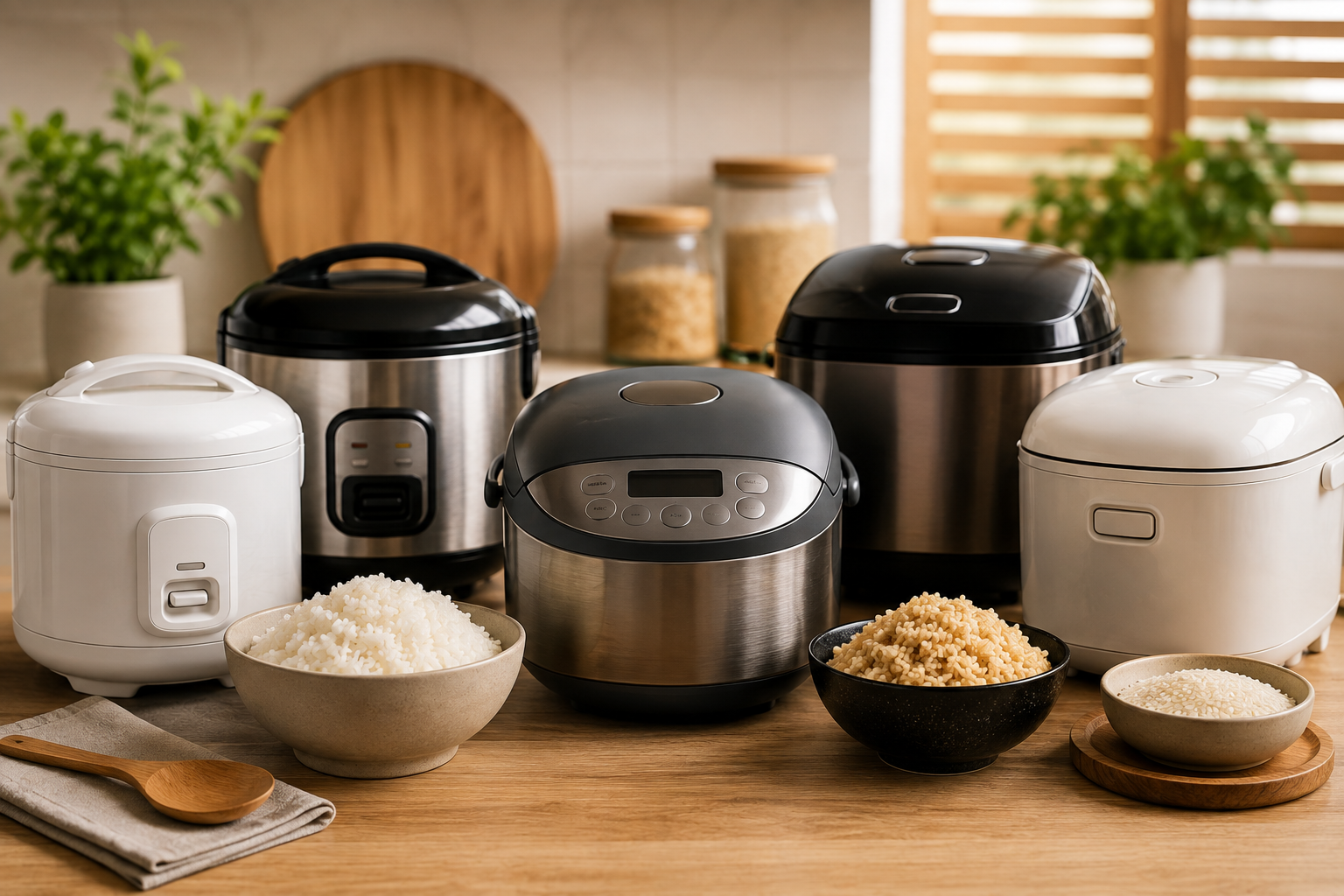
If your rice regularly comes out mushy, dry, or unevenly cooked, the problem usually isn’t your technique. It’s your equipment. A quality rice cooker takes the guesswork out of getting consistently fluffy results, regardless of which rice variety you’re cooking.
This guide explains what actually separates a basic rice cooker from one that delivers perfect rice every time, how different heating technologies work, and which features are genuinely worth paying for. We’ll also cover fuzzy logic rice cookers, capacity sizing, and practical buying advice.
By the end, you’ll understand exactly what to look for, so you can choose a rice cooker that matches your household’s needs without overspending on features you won’t use.
What Makes a Rice Cooker Great?
Heating technology, not brand reputation alone, is what actually separates mediocre rice from consistently great rice. The type of heating system inside your cooker determines how evenly it cooks and how well it adjusts to different rice types and water ratios.
Basic cookers rely on a single thermostat that simply shuts off once the water boils away, with no ability to adjust mid-cycle. More advanced machines use a microcomputer chip, often called Micom, that reads the amount of rice and water inside and adjusts time and temperature as cooking progresses.
Understanding these heating tiers is the single most useful thing you can do before buying, since it explains most of the price difference between a $25 cooker and a $300 one.
Understanding Rice Cooker Heating Technology
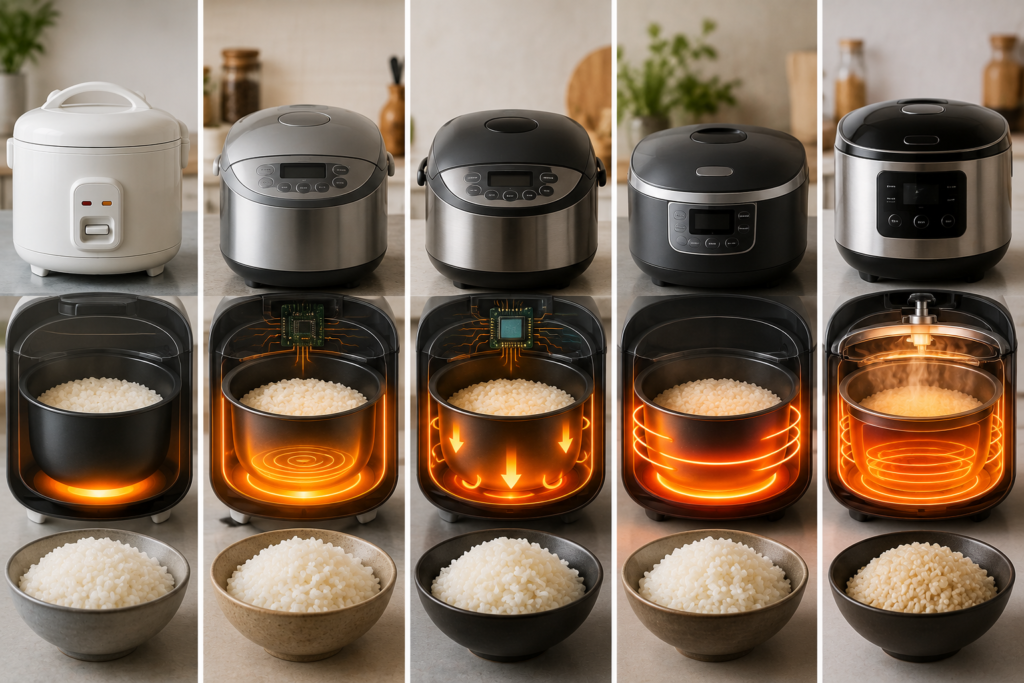
Not all rice cookers work the same way internally, and this is where most of the real quality differences come from.
Basic Thermostat Cookers
These entry-level models use a simple on/off thermostat that heats until the water boils away, then shuts off or switches to a basic keep-warm setting. They work adequately for simple white rice but struggle with consistency across different rice types or slightly imprecise water measurements.
Micom (Microcomputer) Cookers
Micom rice cookers use a microcomputer chip that reads conditions inside the pot and adjusts cooking time and temperature accordingly. This produces noticeably more consistent results than basic thermostat models, especially with varying rice types.
Fuzzy Logic Cookers
Fuzzy logic technology builds on Micom systems, using a mathematical approach that lets the cooker fine-tune cooking time or heat level based on real-time conditions inside the bowl. Fuzzy logic uses microcomputer adjustments to standard bottom heating, automatically handling different rice types without requiring manual adjustments from the user.
Not every fuzzy logic cooker produces excellent rice automatically, but independent testing has consistently found that models producing excellent rice tend to include fuzzy logic technology as a common factor.
Induction Heating (IH)
Induction Heating (IH) makes the entire inner pot a heat source using magnetic induction, rather than heating only from the bottom. This produces more precise and uniform temperature control throughout the rice, since heat surrounds the pot rather than concentrating at the base.
Pressure Induction Heating
The most advanced cookers combine pressure cooking with induction heating, allowing for higher, more consistent temperatures throughout the cooking cycle. This tier is generally reserved for premium models and offers the most precise results, though the improvement over standard IH can have diminishing returns for casual home cooking.
| Technology | How It Works | Best For |
| Basic thermostat | Single on/off heat cycle | Occasional, simple white rice |
| Micom | Microcomputer adjusts time/temp | Everyday consistent cooking |
| Fuzzy logic | Real-time adaptive adjustments | Multiple rice types, hands-off cooking |
| Induction (IH) | Heats entire pot evenly | Precise, uniform texture |
| Pressure IH | Combines pressure + induction | Premium results, largest investment |
Does More Advanced Technology Always Mean Better Rice?
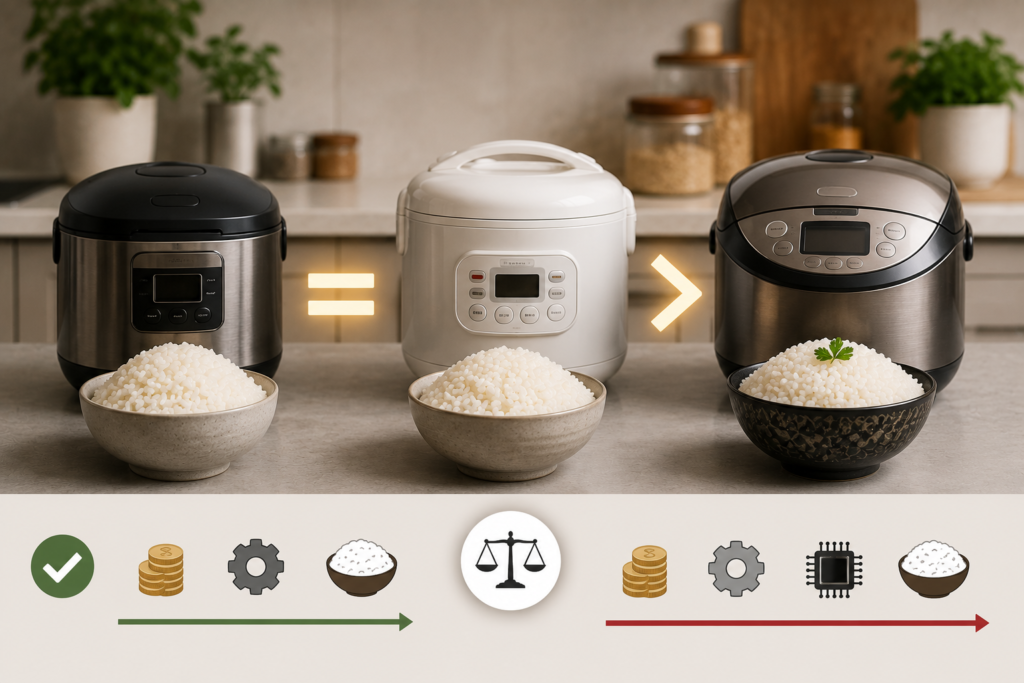
Not necessarily, and this is worth understanding before you overspend. Some testing has found that pricier induction models didn’t produce noticeably better rice than a well-regarded fuzzy logic cooker at a lower price point, suggesting spending more can have diminishing returns past a certain point.
A reasonably priced rice cooker with digital controls and a computer chip is often described as the practical sweet spot for most households, delivering consistently fluffy rice along with genuinely useful extra features, without paying premium prices for marginal improvements.
Practical takeaway: Fuzzy logic sits at a strong value point for most home cooks. Induction and pressure models are worth considering only if you cook rice very frequently or want the most precise results possible.
Trusted Rice Cooker Brands to Know
Several brands consistently appear in independent testing and comparison coverage, each with a slightly different reputation and price positioning.
- Zojirushi is widely considered the premium leader in rice cooker technology, with a long history specifically focused on rice cooking engineering. Zojirushi’s fuzzy logic and induction models remain among the most consistently recommended picks in independent testing.
- Tiger is known for durability and offers strong performance at accessible price points, frequently praised in comparison testing for solid, dependable results.
- Cuckoo brings a distinct approach shaped by Korean rice-cooking traditions, with pressure induction heating technology developed to replicate the texture associated with traditional clay-pot cooking methods.
- Toshiba offers strong value with advanced features, often positioned as a more affordable alternative to premium Japanese brands while still including fuzzy logic or induction technology on select models.
- Panasonic also produces induction rice cookers, though testing has found its higher-priced induction models don’t necessarily outperform well-regarded fuzzy logic alternatives at lower price points.
- Budget-friendly brands like Aroma and COMFEE offer accessible entry points with basic digital controls, useful for households wanting dependable results without a large upfront investment.
Choosing the Right Capacity for Your Household
Rice cooker capacity is measured in cups, though it’s worth noting that this typically refers to uncooked rice measured with the cooker’s included cup, which is usually smaller than a standard US measuring cup.
| Household Size | Recommended Capacity |
| 1–2 people | 3–5 cups |
| 3–4 people | 5–6 cups |
| 5+ people or frequent entertaining | 8–10 cups |
Buying a cooker with too little capacity means running multiple batches for larger meals, while an oversized cooker can occasionally affect texture consistency when cooking very small portions. Match capacity to your typical, everyday cooking needs rather than the largest gathering you host occasionally.
Key Features Worth Considering
Beyond core heating technology and capacity, a few additional features genuinely improve everyday usability.
Keep-Warm Function
Nearly all modern rice cookers include an automatic keep-warm setting that maintains temperature after cooking finishes. This is particularly useful for households with staggered mealtimes.
Delay Timer
A delay timer lets you set the cooker in advance, so rice finishes cooking exactly when you need it, such as right when you get home from work. This is a genuinely convenient feature for busy households.
Multiple Rice Settings
Many mid-range and premium cookers include dedicated settings for white rice, brown rice, sushi rice, and porridge, each adjusting time and temperature automatically for that specific type.
Non-Stick Inner Pot
A non-stick coated bowl makes cleaning significantly easier and helps prevent rice from sticking to the sides during cooking. It’s worth noting that non-stick coatings on inner pots may need replacing after roughly three to five years, depending on usage frequency.
Steamer Basket
Some rice cookers include a steamer basket accessory, allowing you to steam vegetables or proteins simultaneously above the cooking rice, adding practical versatility to the appliance.
How Long Do Rice Cookers Typically Last?
Lifespan varies significantly by build quality and technology tier. Quality fuzzy logic rice cookers typically last eight to twelve years with proper care, while premium Japanese brands with advanced technology have reported lifespans exceeding fifteen years in some cases.
Budget basic-thermostat cookers generally have shorter lifespans, though they’re also considerably cheaper to replace if needed. Factoring in expected lifespan alongside upfront cost gives a clearer picture of long-term value than price alone.
Comparing Rice Cookers by Price Tier
| Price Range | What You Typically Get |
| Under $40 | Basic thermostat or entry Micom controls, simple presets |
| $40–$100 | Fuzzy logic or advanced Micom, delay timer, multiple settings |
| $100–$200 | Induction heating, precise temperature control, sturdier build |
| $200+ | Premium fuzzy logic or pressure IH, platinum-infused pots, AI-adjusted learning features |
Rice Cooker Buying Checklist
Before buying, run through this checklist to confirm you’re prioritising the right specs for your household.
- Match capacity to typical household size, not occasional large gatherings
- Choose fuzzy logic or Micom over basic thermostat models if consistency matters
- Consider induction heating only if you cook rice very frequently or want maximum precision
- Check for a delay timer if your schedule benefits from set-and-forget cooking
- Confirm non-stick pot quality and understand it may need replacing after several years
- Factor in brand reputation and expected lifespan, not just upfront price
Common Mistakes to Avoid
- Assuming all rice cookers work the same way: Heating technology varies significantly, and this is genuinely the biggest factor in rice quality and consistency.
- Overpaying for induction without needing it: Testing has found diminishing returns from higher-end induction models compared with well-regarded fuzzy logic alternatives at lower prices.
- Buying based on capacity alone: A larger cooker doesn’t necessarily produce better rice, and mismatched capacity can occasionally affect texture for smaller portions.
- Ignoring water ratio guidelines: Even the best rice cooker can’t fully compensate for consistently incorrect rice-to-water ratios, though fuzzy logic models handle minor variations better than basic ones.
- Skipping brand research: Established rice-cooking specialists like Zojirushi, Tiger, and Cuckoo have built a specific reputation around rice cooking performance that’s worth considering over general kitchen appliance brands.
Conclusion
The path to consistently perfect rice comes down to understanding heating technology first, then matching capacity and features to your household’s actual habits. Fuzzy logic rice cookers offer the strongest balance of consistency and value for most home cooks, while induction and pressure models suit buyers wanting maximum precision and are willing to pay a premium for it. Established brands like Zojirushi, Tiger, and Cuckoo bring genuine rice-cooking expertise to the table, but the right choice ultimately depends on how often you cook rice and how much control you want over the process. Focus on heating technology and capacity first, and you’ll end up with a rice cooker that delivers reliably good results for years to come.
Frequently Asked Questions
1- What is the difference between fuzzy logic and induction heating?
Fuzzy logic uses a microcomputer to adjust cooking time and temperature automatically, while induction heating warms the entire inner pot for more even temperature distribution. Many premium models combine both technologies.
2- Is a more expensive rice cooker always better?
Not necessarily. Testing has found that some pricier induction models don’t outperform well-regarded fuzzy logic cookers at lower price points, suggesting a practical middle ground often delivers the best value.
3- How long do rice cookers typically last?
Quality fuzzy logic models typically last eight to twelve years, with some premium brands reporting lifespans of fifteen years or more with proper care.
4- Do I need a rice cooker with multiple settings?
If you regularly cook different rice types, such as brown rice, sushi rice, or porridge, dedicated settings genuinely improve consistency. If you mainly cook one type of rice, this feature matters less.
5- What size rice cooker do I need for a family of four?
A 5 to 6 cup capacity generally suits a household of three to four people for everyday meals.
6- Does the inner pot need to be replaced over time?
Yes, non-stick coatings on inner pots may need replacing after roughly three to five years, depending on usage frequency and care.