
A good stand mixer genuinely changes what’s practical to cook at home. Bread dough that would take significant hand-kneading comes together in minutes, meringues whip up reliably, and a full batch of cookie dough gets mixed in one pass instead of several tiring rounds by hand. Choosing among the best stand mixers for home bakers, though, means understanding that not every mixer is built the same way, and the “best” one depends heavily on what you actually bake.
This guide covers the leading stand mixer options across budget levels and mixing styles, along with a complete buying guide covering motor power, mixing action, capacity, and which features genuinely matter for different types of baking.
Planetary vs Spiral Action: The Most Important Distinction
Before comparing specific models, it’s worth understanding the two main types of mixing action, since this affects performance more than almost any other spec.
Planetary Mixers
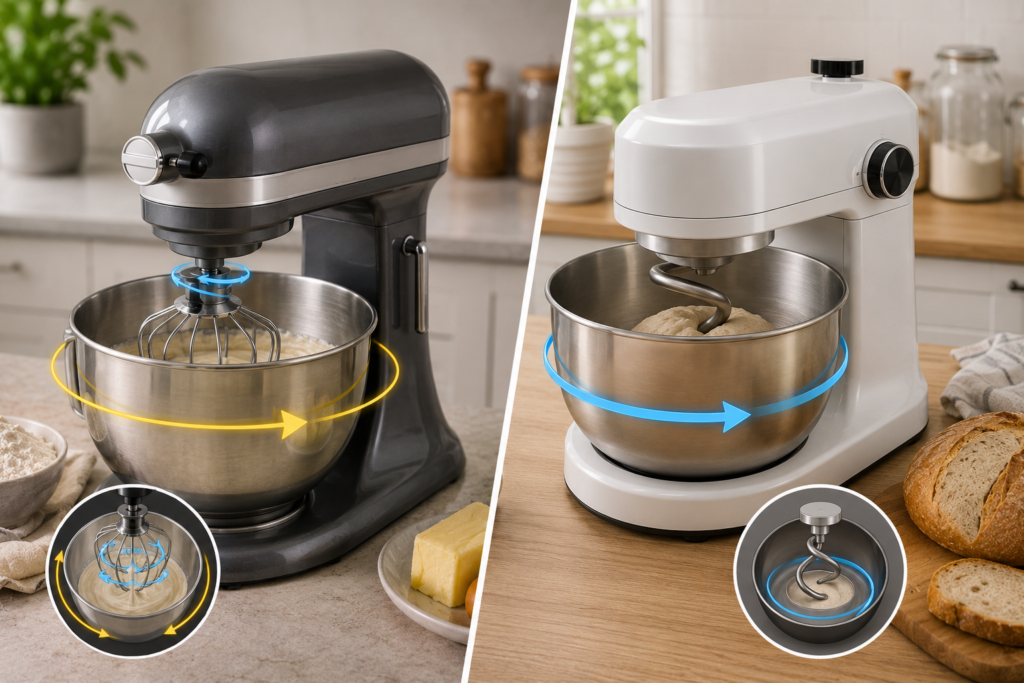
Most home stand mixers, including the popular KitchenAid Artisan line, use planetary mixing action, where the beater spins on its own axis while also moving around the bowl, similar to how a planet orbits while rotating. This design works well for a wide range of tasks: creaming butter and sugar, whipping cream, mixing cake batter, and handling light-to-moderate bread doughs.
Spiral and Center-Drive Mixers
Mixers like the Bosch Universal Plus and Ankarsrum use a different mechanism, where the bowl itself rotates around a stationary or center-mounted mixing tool. This design tends to produce a more thorough, even mix with dense, heavy dough, and bread bakers working with stiff whole-grain or enriched doughs often find these mixers handle that specific task with less strain on the motor than a comparable planetary design.
For most general home baking, a planetary mixer is more than sufficient. For households that bake bread frequently, particularly heavier whole-grain loaves, a spiral-action mixer is worth serious consideration.
A Quick Comparison Table
| Stand Mixer | Mixing Action | Bowl Capacity | Motor Power | Best For |
| KitchenAid Artisan Series 5-Quart | Planetary | 5 quarts | 325W | Most home bakers, largest accessory ecosystem |
| Cuisinart SM-50 | Planetary | 5.5 quarts | 500W | Budget-conscious buyers wanting strong specs |
| Bosch Universal Plus | Center-drive/spiral | 6.5 quarts | 500W | Frequent bread bakers, heavy dough |
| Pioneer Woman 5-Quart | Planetary | 5 quarts | 600W | Budget-friendly, occasional baking |
| Hamilton Beach Stand Mixer | Planetary | Varies | Lower | Light, infrequent use |
| GE Profile Smart Mixer | Planetary | 7 quarts | Higher | Largest capacity, smart features |
| Ankarsrum Original | Spiral/roller | Large | Motor-focused | Serious bread bakers, long-term durability |
| Breville Bakery Chef | Planetary | Large | High | Powerful all-around performance |
Top Stand Mixer Picks for Home Bakers
1- KitchenAid Artisan Series 5-Quart
The KitchenAid Artisan has held its position as one of the most recommended stand mixers for over a decade, known for its 325-watt direct-drive motor, 10 speed settings, and iconic 5-quart stainless steel bowl. Its biggest advantage beyond core mixing performance is its accessory ecosystem, KitchenAid’s hub attachment system supports everything from pasta rollers to meat grinders, making it a genuinely versatile long-term kitchen investment for bakers who might expand into other food prep tasks over time.
2- Cuisinart SM-50
Often recommended as the strongest budget alternative to KitchenAid, the Cuisinart SM-50 offers a 500-watt motor and a slightly larger 5.5-quart bowl, technically outspeccing the KitchenAid Artisan on paper at a notably lower price point. It’s a solid choice for first-time stand mixer buyers, occasional bakers, or anyone not yet certain they’ll use a stand mixer often enough to justify KitchenAid’s higher price, though it has a smaller attachment ecosystem and less established long-term reliability track record.
3- Bosch Universal Plus
This is a consistent favorite among high-volume home bread bakers, thanks to its center-drive mixing action, where the bowl rotates around a central hub while the mixing tool works from below. This produces a thorough, even mix with dense dough that traditional planetary mixers can struggle to match at a similar bowl size. Its 500-watt motor and 6.5-quart capacity make it well suited to bakers regularly working with stiff, whole-grain, or enriched bread doughs.
4- Pioneer Woman 5-Quart
Recognized by Consumer Reports as a recommended performer, this budget-friendly option offers a 600-watt motor in a more affordable package than premium alternatives. It suits bakers wanting solid everyday performance without the higher price tag of KitchenAid or Bosch.
5- Hamilton Beach Stand Mixer
This is one of the most affordable stand mixer options on the market, lightweight and easy to use for lighter, infrequent baking tasks. Its lower weight means it’s more prone to “walking” across the counter during heavier mixing tasks like bread dough, and its components are generally less durable than pricier alternatives, but it remains a reasonable entry point for occasional bakers on a tight budget.
6- GE Profile Smart Mixer
Offering the largest bowl capacity in most comparisons at 7 quarts, this model suits bakers who regularly need to mix large batches, whether for big families or frequent baking projects. It’s currently available in just one capacity size, so buyers wanting smart features in a more compact mixer won’t find a smaller option within this specific line.
7- Ankarsrum Original
Known for a distinctive roller and scraper mixing system rather than a traditional beater, the Ankarsrum is favored by serious bread bakers for its ability to handle large batches of dough with minimal heat buildup, a factor that can affect gluten development in more traditional mixers. It typically carries one of the longest motor warranties in the category, reflecting strong long-term durability expectations.
8- Breville Bakery Chef
This mixer delivers notably powerful performance, particularly for heavier mixing tasks, though it tends to work somewhat slower than comparable models like the KitchenAid Artisan for certain tasks, and its control dial has a bit of a learning curve for new users.
Weight and Stability Considerations
Stand mixer weight affects how stable the machine stays during heavy mixing tasks like kneading bread dough. Lighter mixers, generally under 15 pounds, are easier to move and store but can shift or “walk” across the counter when kneading dense dough. Heavier mixers, often 20 pounds or more, stay firmly in place during tough mixing tasks but are correspondingly harder to lift, move, or store away between uses.
If counter space is limited and you plan to store your mixer between uses, weight is worth factoring in alongside raw mixing power.
Warranty Considerations
Warranty length varies considerably across brands and often reflects a manufacturer’s confidence in long-term durability.
| Brand | Typical Warranty |
| Ankarsrum | Around 7 years on the motor |
| KitchenAid | Hassle-free 1-year full replacement (motor coverage varies) |
| Bosch | Around 3 years |
| Cuisinart | Around 3-year limited |
| Hamilton Beach | Around 3-year limited |
A longer motor warranty generally suggests a manufacturer expects the mixer to perform reliably for a longer stretch of regular use, which is worth weighing against upfront price, particularly for a household that plans to bake frequently for many years.
Matching a Stand Mixer to Your Baking Habits
Occasional Bakers
If you bake cookies or cakes a few times a month, a budget-friendly planetary mixer like the Pioneer Woman 5-Quart or Cuisinart SM-50 likely offers more than enough capability without unnecessary expense.
Frequent All-Around Bakers
For bakers who regularly make cookies, cakes, frostings, and the occasional loaf of bread, the KitchenAid Artisan remains a strong, versatile default choice, particularly given its extensive accessory ecosystem for future expansion into other food prep tasks.
Serious Bread Bakers
If bread, particularly dense whole-grain or enriched dough, is a regular part of your baking routine, a spiral or center-drive mixer like the Bosch Universal Plus or Ankarsrum Original is worth the additional investment, since these designs handle heavy dough with less strain and more even mixing than most planetary designs.
Large Households or Bulk Bakers
If you regularly bake large batches, whether for a big family or for gifting and events, a larger-capacity mixer like the GE Profile Smart Mixer’s 7-quart bowl reduces how often you need to mix in multiple smaller batches.
Key Features to Consider
Bowl Capacity
Match bowl size to your typical batch size. A 5-quart bowl suits most everyday home baking, while larger 6-to-7-quart bowls benefit households regularly mixing large batches of dough or batter.
Attachment Compatibility
If you anticipate wanting to expand into pasta making, meat grinding, or other food prep tasks down the line, prioritize a mixer with a well-established attachment ecosystem, since this can significantly extend the appliance’s usefulness beyond basic mixing.
Speed Settings
More speed settings offer finer control, useful for tasks ranging from slow folding to high-speed whipping, though most home bakers find 8 to 10 well-spaced speed settings sufficient for the vast majority of recipes.
Bowl Material
Stainless steel bowls are the most common and durable option, resistant to scratching and staining. Some premium models offer glass or ceramic bowl options, which can add aesthetic appeal but may be more prone to chipping.
Budget Planning
Stand mixer prices span a wide range depending on brand, motor power, and mixing action. Budget models, generally under $200, suit occasional bakers wanting basic functionality without a large investment. Mid-range options, often in the $300 to $450 range, include well-regarded choices like the KitchenAid Artisan and Cuisinart SM-50, balancing solid performance with reasonable pricing. Premium spiral-action and high-capacity models, often $400 and above, suit serious or frequent bakers prioritizing long-term durability and heavy-dough performance.
Common Mistakes to Avoid
- Buying based on brand recognition alone, without considering whether a planetary or spiral-action design better suits your actual baking habits
- Underestimating bowl capacity needs, ending up mixing in multiple smaller batches for larger recipes
- Overlooking mixer weight, resulting in a lighter mixer that shifts around during heavy dough kneading
- Ignoring warranty length, particularly for a higher-cost investment meant to last many years
- Choosing a mixer without considering the attachment ecosystem, limiting future versatility for tasks beyond basic mixing
Conclusion
Finding the best stand mixers for home bakers comes down to matching mixing action, capacity, and motor power to how you actually bake, not simply choosing the most expensive or popular name. Occasional bakers can do well with an affordable planetary mixer, while frequent bread bakers will likely see real benefits from investing in a spiral or center-drive design built specifically to handle dense dough. Consider your typical batch sizes, how often you bake, and whether future attachment versatility matters to you, and you’ll land on a stand mixer that genuinely earns its place on your counter for years to come.
Frequently Asked Questions
1- Which is better, KitchenAid or Bosch, for a stand mixer?
Neither is universally better; it depends on your baking habits. KitchenAid’s planetary mixer suits most general home baking with the largest attachment ecosystem, while Bosch’s center-drive design is particularly favored by frequent bread bakers working with dense, heavy dough.
2- What is the best stand mixer for baking bread specifically?
Spiral or center-drive mixers like the Bosch Universal Plus or Ankarsrum Original are generally recommended for frequent bread bakers, since their mixing action handles dense dough more evenly with less motor strain than typical planetary designs.
3- Is a budget stand mixer good enough for occasional baking?
Yes, for occasional bakers making cookies, cakes, or light dough, a budget-friendly option like the Cuisinart SM-50 or Pioneer Woman 5-Quart generally provides sufficient performance without the higher cost of premium models.
4- How much bowl capacity do I need for a stand mixer?
A 5-quart bowl suits most everyday home baking needs, while larger households or frequent bulk bakers may benefit from a 6-to-7-quart capacity to reduce mixing multiple smaller batches.
5- Do more expensive stand mixers actually perform better?
Generally, yes, particularly for heavy dough and frequent use, where stronger motors, more durable construction, and specialized mixing actions like spiral or center-drive designs produce noticeably better results and longer-term reliability.
6- How long should a good stand mixer last?
This varies by brand and usage, but well-maintained mixers from established brands can last well over a decade of regular use, reflected in their warranty lengths, which range from around 1 year of full replacement coverage up to 7 years of motor coverage depending on the manufacturer.
7- Is it worth buying a stand mixer with a large attachment ecosystem?
If you anticipate expanding into other food prep tasks, like pasta making or meat grinding, a mixer with a well-established attachment system, such as the KitchenAid Artisan, can significantly extend its usefulness over time compared to a mixer with limited or no attachment options.