Standing in the small appliance aisle, it’s easy to assume a blender and a food processor do roughly the same job. Both have a base, a motor, and a set of blades, and both promise to make food prep faster. But the blender vs food processor question actually comes down to two genuinely different tools built for different textures and tasks.
This guide breaks down the real differences between these two appliances, covering how they work, what each one does best, and whether your kitchen actually needs one, the other, or both. By the end, you’ll know exactly which appliance solves the specific food prep problems you run into most often.
Blender vs Food Processor: The Quick Overview
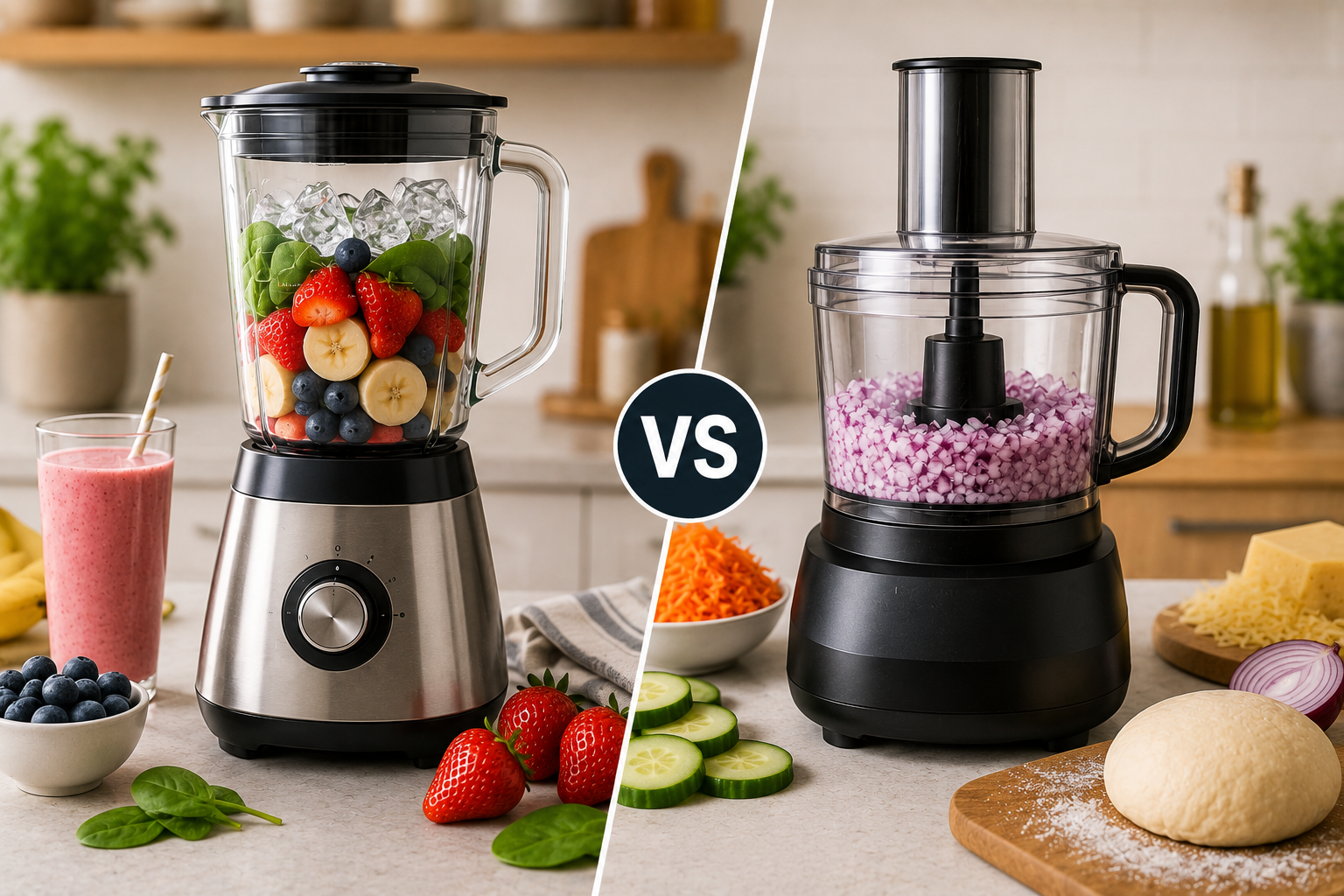
A blender is built for liquids, purées, and smooth textures, think smoothies, soups, and sauces, using a tall, narrow jar and blades designed to pull ingredients downward into a vortex. A food processor is built for solid or semi-solid food prep, think chopping vegetables, shredding cheese, making dough, or pulsing ingredients into a coarse texture, using a wide, shallow bowl and interchangeable blades or discs. If your cooking regularly involves both liquid blending and solid food prep, many households genuinely benefit from owning both rather than trying to make one appliance do the other’s job.
How Blenders Work
A blender uses a tall, narrow jar with fixed blades at the bottom, spinning at high speed to create a vortex that continuously pulls ingredients down toward the blades. This design is specifically suited to processing liquids and semi-liquids, since the vortex keeps ingredients moving and blending evenly, even as the mixture becomes smoother and more liquid over time.
This makes blenders the clear choice for smoothies, soups, sauces, and any task where the end goal is a smooth, pourable, or drinkable consistency.
How Food Processors Work
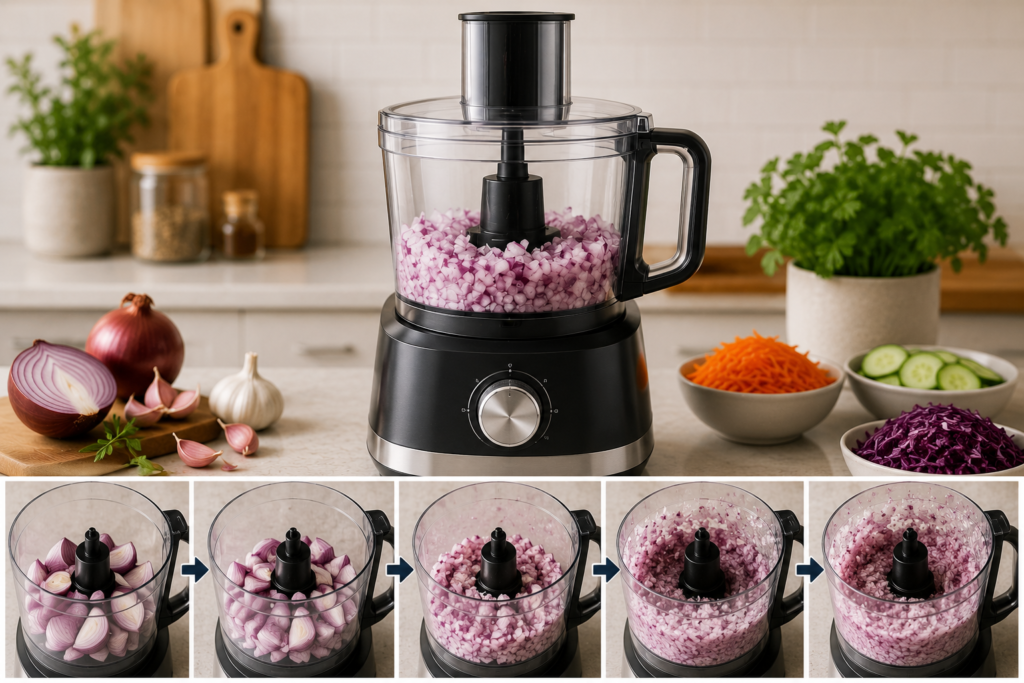
A food processor uses a wide, shallow bowl paired with a flat, spinning blade positioned near the bottom, along with a range of interchangeable attachments like shredding discs, slicing discs, and dough blades. Rather than relying on a liquid vortex, a food processor works by repeatedly cutting, chopping, or shredding food as it falls back down into the blade’s path.
This design suits solid and semi-solid foods far better than a blender’s vortex-based approach, since food processors can handle drier mixtures, larger chunks, and tasks that don’t involve much liquid at all.
Blender vs Food Processor: Key Differences
| Feature | Blender | Food Processor |
| Jar/Bowl Shape | Tall, narrow | Wide, shallow |
| Blade Design | Fixed blades at bottom | Interchangeable blades and discs |
| Best For | Liquids, purées, smoothies | Chopping, shredding, dough, solids |
| Liquid Requirement | Requires liquid to blend properly | Works well with little to no liquid |
| Texture Result | Smooth, pourable | Chopped, shredded, coarse, or crumbly |
| Common Attachments | Tamper, travel cups | Shredding disc, slicing disc, dough blade |
| Typical Capacity | 40–90 oz jar | 7–14 cup bowl |
| Price Range | Lower to high, based on power | Lower to high, based on capacity/features |
What a Blender Does Best
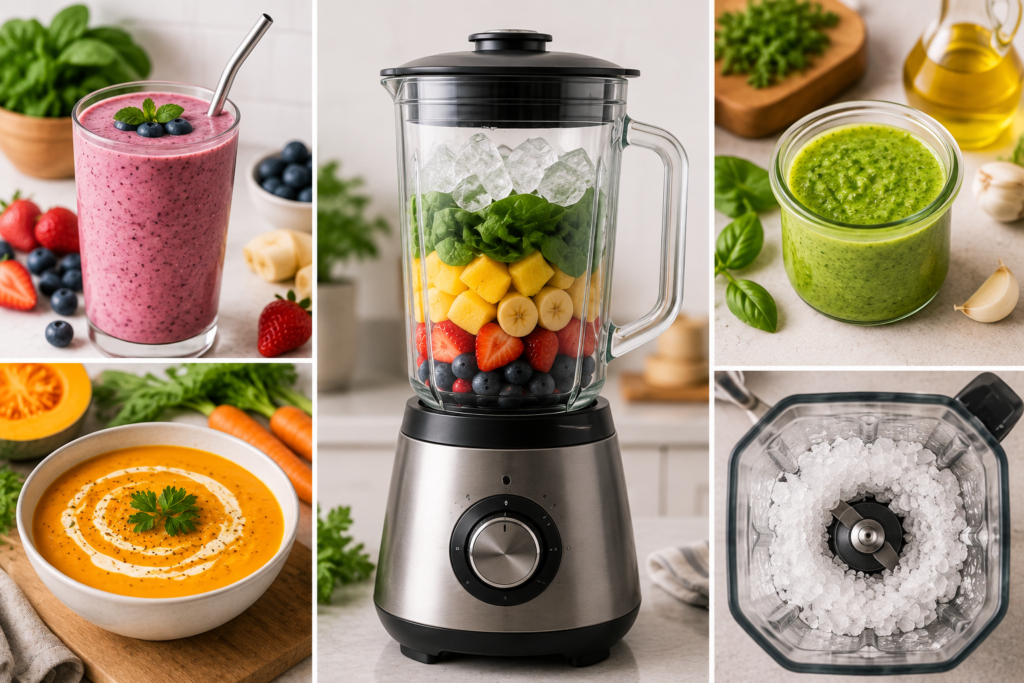
Smoothies and Shakes
Blenders excel at breaking down frozen fruit, ice, and liquid ingredients into a smooth, drinkable consistency, which is precisely what their vortex-style blending motion was designed to achieve.
Soups and Purées
Blending cooked vegetables, broths, and seasonings into a smooth soup is one of the most common blender tasks, and many higher-end models even include a dedicated soup setting that heats the mixture through blending friction alone.
Sauces and Dressings
Blenders handle thinner sauces, dressings, and dips well, particularly those with a liquid base like oil, vinegar, or broth, producing a smooth, well-emulsified result.
Frozen Drinks and Desserts
The powerful, continuous blending action makes blenders well suited to crushing ice for frozen drinks or blending frozen fruit into a sorbet-like consistency.
What a Food Processor Does Best
Chopping Vegetables
A food processor’s flat blade and wide bowl make quick work of chopping onions, garlic, peppers, and other vegetables into consistent, small pieces, far faster than doing it by hand.
Shredding and Slicing
Interchangeable discs allow a food processor to shred cheese, slice potatoes, or grate carrots quickly and uniformly, a task blenders simply aren’t designed to handle.
Making Dough
The wide bowl and powerful motor allow a food processor to mix and knead pizza dough, pie crust, or pastry dough far faster than mixing by hand, and more effectively than a blender’s narrow jar would allow.
Making Nut Butter, Hummus, and Dips
Thicker mixtures with less liquid content, like hummus, pesto, or homemade nut butter, tend to process more evenly in a food processor’s wide bowl than in a blender’s narrow jar, where thick mixtures can get stuck around the blades.
Pulsing for Coarse Textures
The pulse function on a food processor allows precise control over texture, useful for tasks like making breadcrumbs, chopping nuts, or achieving a specific coarse chop rather than a fully smooth purée.
Can You Use a Blender as a Food Processor (or Vice Versa)?
This is one of the most common practical questions homeowners ask, and the honest answer is: partially, but with real limitations.
Using a Blender for Food Processor Tasks
A blender can handle some lighter chopping tasks in a pinch, particularly with the pulse function and a bit of added liquid. However, it struggles with drier mixtures, larger batches of solid food, and tasks like shredding or slicing that require a completely different blade mechanism than what a blender jar offers.
Using a Food Processor for Blender Tasks
A food processor can blend some smoother mixtures, particularly thicker dips or sauces with more body, but it generally struggles with fully liquid mixtures like smoothies or thin soups, since its wide, shallow bowl doesn’t create the same continuous vortex a blender jar does. The result is often less smooth and more prone to uneven blending near the edges of the bowl.
In short, each appliance can occasionally substitute for the other in a pinch, but neither does the other’s core job particularly well regularly.
Do You Need Both a Blender and a Food Processor?
For many households, the honest answer is yes, particularly if you cook regularly and your meals involve both solid food prep and liquid blending tasks.
Signs You Need a Blender
- You regularly make smoothies, shakes, or protein drinks
- You often blend soups or sauces to a smooth consistency
- You make frozen drinks or crushed-ice beverages
- Your cooking involves a lot of liquid-based purées
Signs You Need a Food Processor
- You frequently chop vegetables in larger quantities
- You bake regularly and need to make pie crust or dough
- You shred cheese or vegetables often
- You make dips, hummus, or nut butter regularly
- You want more control over coarse versus fine textures
Signs You Might Only Need One
If your cooking leans heavily toward one category- frequent smoothies and soups but rarely chopping large quantities of vegetables, for example- you may be able to get by with just a blender for now, and vice versa for food processor-heavy cooking. Starting with the appliance that matches your most frequent kitchen task is a reasonable way to prioritize if budget or counter space is limited.
Combination Appliances: Do They Work?
Some manufacturers offer combination blender-food processor units, typically a base motor with interchangeable jar and bowl attachments for different tasks. These can be a practical space-saving solution for smaller kitchens or households with lighter usage needs, though they generally involve some compromise, often a less powerful motor shared across both functions compared to two dedicated, specialized appliances.
For households that use both functions frequently and want the best possible performance in each, two separate appliances typically outperform a combination unit. For those with lighter, occasional needs and limited kitchen space, a combination unit can be a reasonable middle ground.
Choosing the Best Food Processor for Home Use
If you’ve decided a food processor is the right addition to your kitchen, a few features are worth prioritizing.
Bowl Capacity
Food processors typically range from small 3-to-4-cup models suited to individual tasks, up to larger 12-to-14-cup models better suited to bigger batches or larger households.
Included Attachments
Look for a model that includes the specific attachments you’ll actually use, such as a dough blade for baking, a shredding disc for cheese, or a slicing disc for consistent vegetable prep.
Motor Power
A stronger motor handles denser doughs and larger batches more effectively, which matters more for households doing frequent baking or processing large quantities of vegetables at once.
Pulse Control
Precise pulse control allows better management over texture, letting you stop exactly when you reach the desired chop size rather than over-processing food into a purée.
Choosing the Best Blender for Home Use
If a blender is the higher priority for your kitchen, focus on these factors:
Motor Power
Higher wattage generally improves performance with tough ingredients like ice and frozen fruit, though blade design and jar shape also play a meaningful role in actual blending results.
Jar Capacity and Material
Consider how many servings you typically blend at once, and whether you prefer a durable plastic jar or a glass jar that resists scratching and retains fewer odors over time.
Preset Programs
Programs for smoothies, soups, or frozen desserts can simplify blending by automatically adjusting speed and time for consistent results.
Practical Buying Tips
A few practical tips can help guide your decision regardless of which appliance you’re prioritizing:
- Think honestly about your most frequent cooking tasks before choosing which appliance to prioritize first
- Consider your available counter and storage space, particularly if you’re considering owning both
- Look at included attachments closely, since these often determine real-world versatility more than raw power
- Factor in cleanup effort, since food processors with multiple attachments can take longer to clean than a simple blender jar
- If budget allows, prioritize both appliances over a combination unit for the best performance in each specific task
Common Mistakes to Avoid
- Trying to force a blender to handle food processor tasks regularly, leading to uneven results and unnecessary strain on the motor
- Buying a food processor expecting smoothie-level smoothness, which its wide, shallow bowl generally can’t achieve
- Choosing a combination unit without understanding the performance trade-offs, expecting equal performance to two dedicated appliances
- Overlooking attachment quality, ending up with a food processor that lacks the specific disc or blade you actually need
- Ignoring capacity needs, buying a small processor or blender that can’t handle your typical batch sizes
Conclusion
The blender vs food processor question isn’t really about which appliance is better, it’s about which specific kitchen tasks you do most often. Blenders excel at liquids, purées, and smooth textures, while food processors handle chopping, shredding, and solid food prep far more effectively. Rather than trying to force one appliance into the other’s role, think honestly about your regular cooking habits and consider whether your kitchen would genuinely benefit from having both dedicated tools on hand.
Frequently Asked Questions
1- Can I make a smoothie in a food processor?
You can, but results are generally less smooth than a blender, since a food processor’s wide, shallow bowl doesn’t create the same continuous vortex needed to fully blend liquids and ice evenly.
2- Can I chop vegetables in a blender?
To a limited extent, using the pulse function, but blenders generally struggle with drier chopping tasks and tend to produce uneven results compared to a food processor’s flat blade and wide bowl.
3- Which is better for making hummus, a blender or a food processor?
A food processor generally performs better for hummus, since its wide bowl handles the thicker, less liquid mixture more evenly than a blender’s narrow jar, where thick ingredients can get stuck around the blades.
4- Do I need both a blender and a food processor?
Many households benefit from owning both, since they serve genuinely different purposes. If your cooking leans heavily toward one type of task, starting with just one appliance is a reasonable way to prioritize.
5- What is the main difference between a blender and a food processor?
A blender is designed for liquids and smooth purées using a tall, narrow jar and a vortex-style blending motion, while a food processor is designed for chopping, shredding, and solid food prep using a wide, shallow bowl and interchangeable blades.
6- Is a food processor good for making dough?
Yes, food processors are commonly used for pie crust, pizza dough, and pastry dough, since their powerful motor and wide bowl handle mixing and light kneading more effectively than a blender.
7- Can a combination blender-food processor replace both appliances?
It can work reasonably well for lighter, occasional use, though dedicated separate appliances generally offer better performance for households using both functions frequently.