
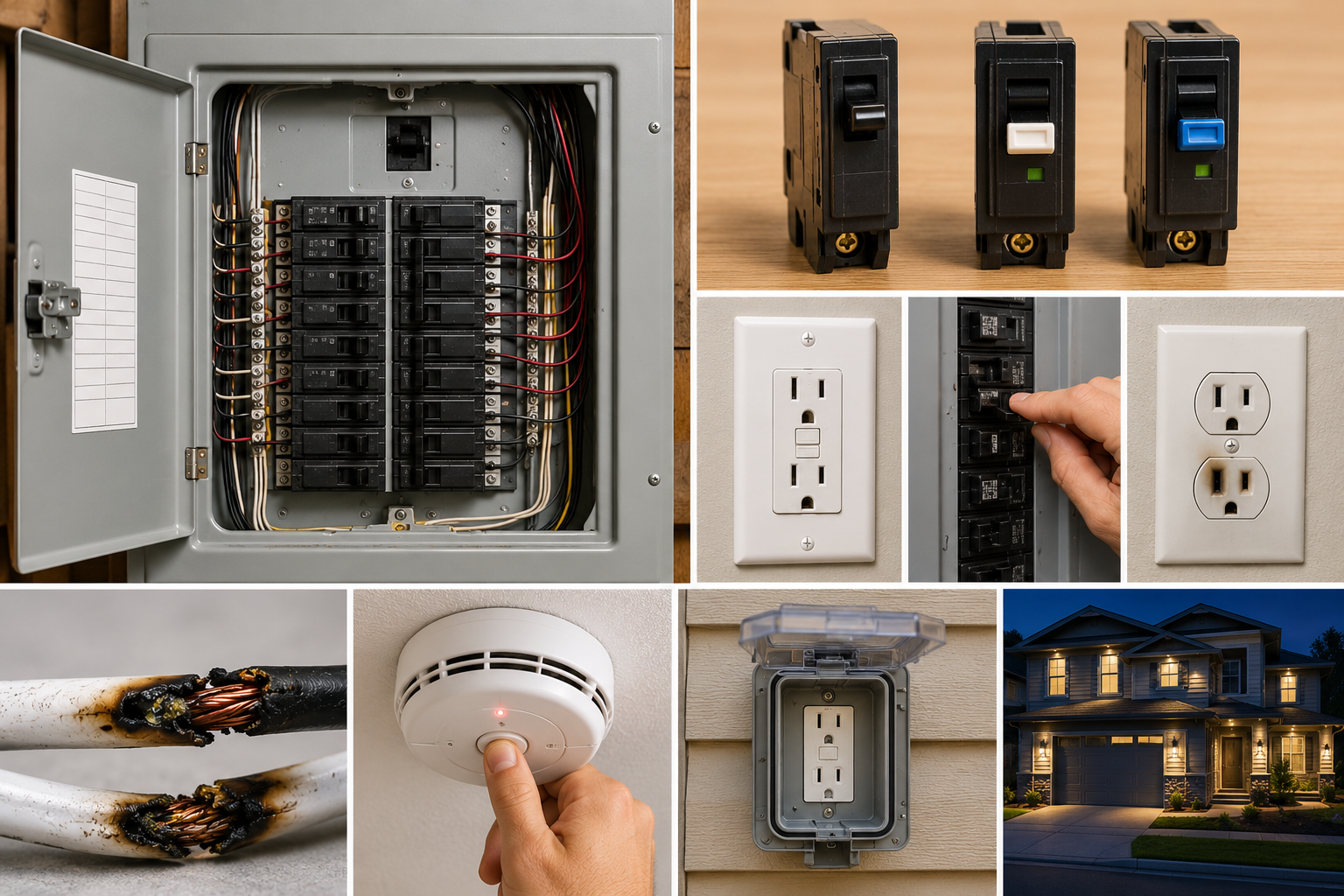
Most homeowners only think about their breaker panel the moment something stops working, a tripped switch, a dead outlet, a flickering light. But circuit breakers explained in plain terms is really just understanding a handful of switches designed specifically to protect your home from overheating, shock, and fire, and knowing which type does what removes a lot of the mystery from that gray metal box in your garage or basement.
This guide walks through exactly how circuit breakers work, the real differences between standard, GFCI, and AFCI breakers, why yours might keep tripping, and when a tripped breaker is a simple reset versus a sign you need an electrician.
Circuit Breakers
A circuit breaker is a safety switch that automatically shuts off electrical flow to a circuit when it detects a dangerous condition, an overload, a short circuit, a ground fault, or a dangerous arc, protecting your home’s wiring from overheating or catching fire. Standard breakers protect against basic overloads and short circuits. GFCI (Ground Fault Circuit Interrupter) breakers specifically protect people from electric shock in wet or damp locations, tripping within roughly 1/40th of a second when they detect current leaking to ground. AFCI (Arc Fault Circuit Interrupter) breakers specifically protect against electrical fires by detecting dangerous arcing inside walls or cords. Current electrical code requires both types in overlapping areas of most homes, which is why dual-function GFCI/AFCI breakers have become increasingly common.
What a Circuit Breaker Actually Does
The Basic Mechanism
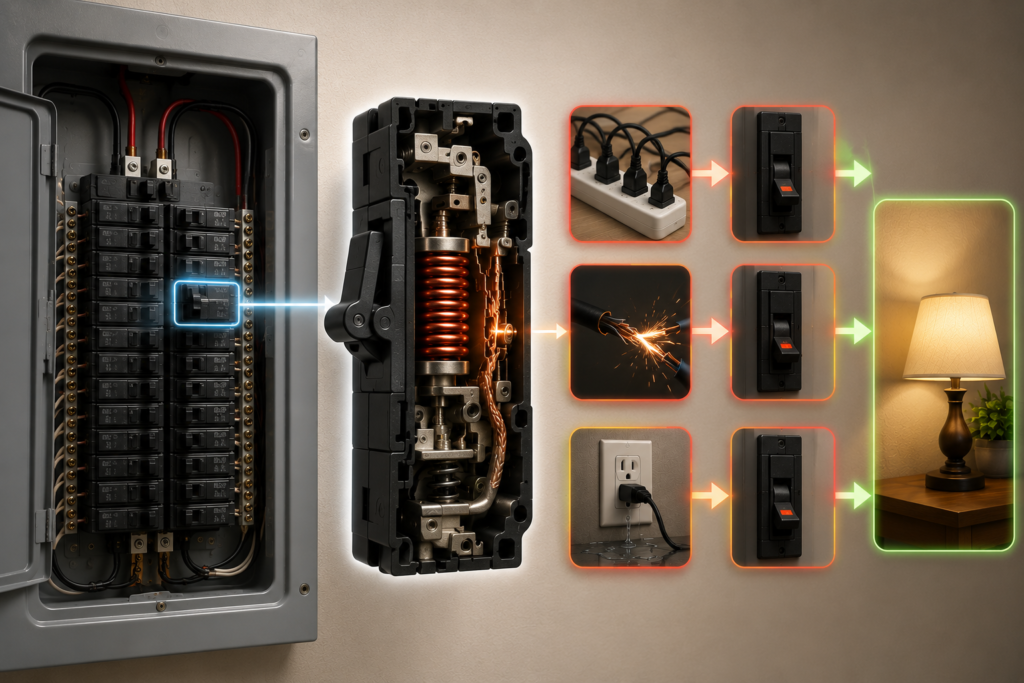
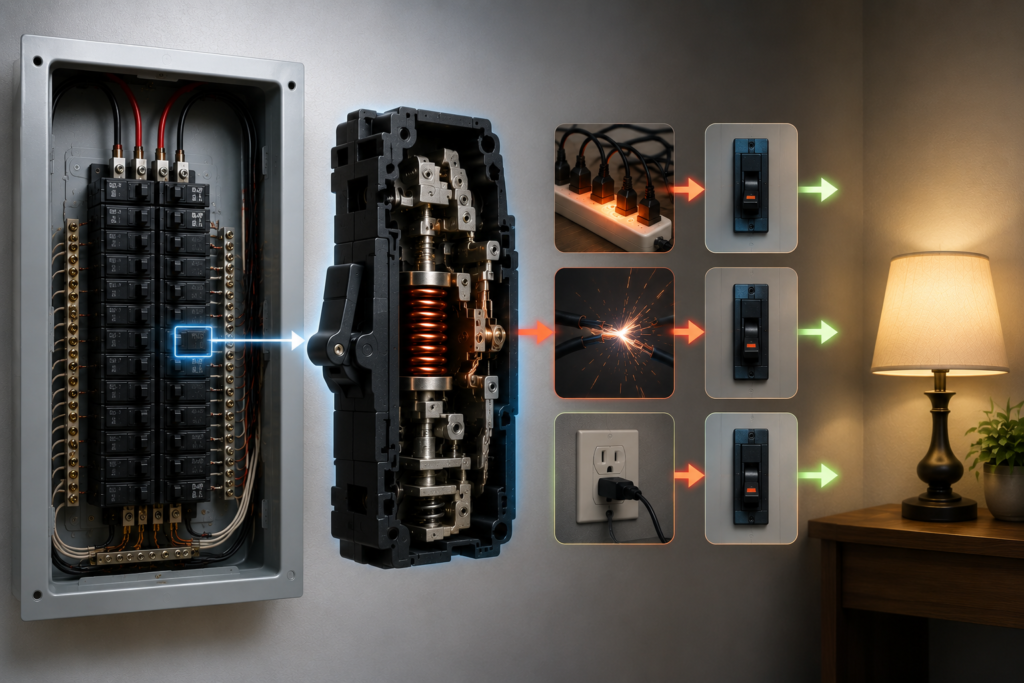
A circuit breaker continuously monitors the electrical current flowing through its circuit. When it detects an abnormal condition, current exceeding the circuit’s safe capacity, a sudden short circuit, or another dangerous condition specific to the breaker type, it automatically “trips,” physically interrupting the flow of electricity before that abnormal condition can cause overheating, damage, or fire.
Why Breakers Replaced Fuses
Older homes sometimes still use fuse boxes rather than circuit breaker panels. A fuse contains a metal strip that melts and permanently breaks the circuit when it detects excess current, requiring physical replacement after every trip. A circuit breaker, by contrast, can simply be reset once the underlying problem is resolved, making it more convenient and cost-effective for long-term, repeated use.
Circuit Breakers Are Built to Last, But Not Forever
Circuit breakers are generally built to last for decades under normal use, but they aren’t indefinite. Burn marks around a breaker, a burning smell near your panel, or a breaker that repeatedly fails to stay reset are all warning signs that a specific breaker, or potentially your panel itself, needs professional attention rather than continued use.
The Three Main Types of Circuit Breakers
- Standard Breakers (Single-Pole and Double-Pole)
Standard breakers protect against basic overcurrent situations, an overload (too many devices drawing power on one circuit) or a short circuit (a direct, unintended connection between wires). Single-pole breakers handle standard 120-volt circuits, common for lighting and general outlets. Double-pole breakers supply the higher 240-volt power needed for larger appliances like electric dryers, ranges, and central air conditioning units. Importantly, standard breakers only respond to excess heat and current, they won’t detect an electrical arc or a ground fault the way GFCI and AFCI breakers specifically will.
- GFCI Breakers (Ground Fault Circuit Interrupters)
A GFCI breaker monitors for current “leaking” to ground, which happens when electricity takes an unintended path, often through a person’s body, rather than flowing normally through the circuit. GFCI breakers are engineered to detect this leakage at extremely low levels, often as little as 4 to 6 milliamps, and trip within about 1/40th of a second, fast enough to prevent a serious shock in most situations. This is why GFCI protection is specifically required in wet or damp locations, bathrooms, kitchens, garages, laundry areas, and outdoor receptacles, where water and electricity are more likely to come into unsafe contact.
- AFCI Breakers (Arc Fault Circuit Interrupters)
An AFCI breaker is built to detect dangerous electrical arcing, small, often invisible sparks that can occur between damaged, pinched, or deteriorating wires, a leading cause of electrical fires that start inside walls where they can smolder unnoticed for extended periods. AFCI breakers use microprocessor-based technology to distinguish this dangerous arcing from the normal, harmless arcing that occurs when you switch a light on or off, then trip the circuit before a dangerous arc can ignite surrounding material. AFCI protection is required by code in most living areas of newer homes, bedrooms, living rooms, family rooms, and similar spaces.
Residential circuit breaker panel with a detailed breaker mechanism, electrical fault scenarios, automatic tripping, and a safely powered household lamp.
Different Hazards, Different Jobs
This is the single most important distinction to understand, and it’s a common point of confusion: GFCI protects people from shock, while AFCI protects property from fire. They detect entirely different electrical conditions, and neither one is a substitute for the other.
Why You Might Need Both in the Same Circuit
Because current electrical code requires GFCI protection in wet locations and AFCI protection in living-area circuits, and because some spaces (like a laundry area or a finished basement) can fall under both requirements simultaneously, dual-function GFCI/AFCI breakers have become an increasingly common, cost-effective way to satisfy both protection requirements with a single device rather than installing two separate breakers.
GFCI vs AFCI Comparison
| Factor | GFCI Breaker | AFCI Breaker |
| Protects against | Electric shock (ground faults) | Electrical fire (dangerous arcing) |
| Detection method | Monitors current leakage to ground | Monitors for abnormal arcing patterns |
| Typical trip speed | Extremely fast (around 1/40th of a second) | Varies, uses microprocessor analysis |
| Required locations | Bathrooms, kitchens, garages, outdoors, laundry | Bedrooms, living rooms, family rooms, similar living spaces |
| Can substitute for the other? | No | No |
Where Each Type Is Required in Your Home
GFCI-Required Areas
Current electrical code (NEC 210.8) requires GFCI protection in wet and damp locations throughout a home: bathroom receptacles, kitchen countertop outlets, garage circuits, outdoor receptacles, laundry areas, and, since more recent code updates, certain 240-volt receptacles as well, including specific appliance circuits like dishwashers and refrigerators in some jurisdictions. Most residential codes now require GFCI protection in somewhere around 8 to 10 distinct areas throughout a typical home.
AFCI-Required Areas
Current code (NEC 210.12) requires AFCI protection on nearly all 120-volt living-area circuits: kitchens, family rooms, dining rooms, living rooms, bedrooms, sunrooms, recreation rooms, closets, hallways, and laundry areas. In practice, this reaches the vast majority of a home’s standard living-space circuits.
Older Homes and Updated Requirements
These specific code requirements have expanded significantly over time, meaning an older home built before certain code updates may not currently have GFCI or AFCI protection in areas that would require it under current standards. While existing homes generally aren’t required to retrofit to meet updated codes retroactively, updating older wiring to include this protection, particularly in bathrooms, kitchens, and bedrooms, is a genuinely worthwhile safety upgrade many electricians recommend even when it’s not strictly mandated.
Why Does My Breaker Keep Tripping?
Overloaded Circuit
The most common, and most benign, cause: too many devices or appliances drawing power on a single circuit at once. This typically happens with standard breakers and is usually resolved by redistributing devices across different circuits or reducing simultaneous use.
Short Circuit
A short circuit occurs when a “hot” wire touches a neutral or ground wire unintentionally, creating a sudden surge of current. This often trips the breaker immediately and repeatedly, and while sometimes caused by a damaged appliance cord, a genuinely persistent short circuit warrants electrical inspection rather than repeated resetting.
Ground Fault (GFCI Tripping)
If a GFCI breaker specifically keeps tripping, it’s detecting current leaking to ground, potentially from a damaged appliance, exposed wiring, or moisture intrusion into an outlet or device. This should be treated as a genuine warning sign rather than simply reset repeatedly without investigation.
Arc Fault (AFCI Tripping)
AFCI breakers tripping can indicate a genuine developing wiring hazard, but they can also occasionally trip from certain electronics or wiring configurations that create signals resembling dangerous arcing (sometimes called “nuisance tripping”), though this has become considerably less common with newer combination-type AFCI breaker technology.
A Failing Breaker Itself
Occasionally, the breaker itself is the problem rather than the circuit it protects, particularly for older breakers. A breaker that trips with no apparent cause, or one that won’t reliably stay reset, may simply need replacement.
Troubleshooting a Tripped Breaker
| Situation | Likely Cause | What to Do |
| Trips only under heavy device use | Circuit overload | Redistribute devices across circuits |
| Trips immediately on reset | Short circuit or faulty device | Unplug devices on that circuit, test individually |
| GFCI trips repeatedly | Ground fault, possible moisture or damaged device | Inspect connected devices; call an electrician if unresolved |
| AFCI trips with no clear cause | Possible arcing hazard or nuisance trip | Note frequency; call an electrician if it recurs |
| Won’t stay reset at all | Failing breaker | Replace the breaker; consult an electrician |
Testing GFCI and AFCI Devices
Why Monthly Testing Matters
Both GFCI and AFCI devices include a built-in test button specifically for verifying they’re functioning correctly. Testing these monthly is considered important precisely because these devices can fail silently, continuing to supply power normally while no longer providing the actual protection they’re designed for.
How to Test
Press the “test” button on the device, it should trip and cut power immediately. Press “reset” to restore power. If a device fails to trip during testing, or won’t reset properly afterward, it should be replaced.
When to Replace GFCI/AFCI Devices Regardless of Testing
Devices over roughly 10 to 15 years old are generally worth replacing proactively, even if they currently pass testing, since their internal components can degrade with age in ways that aren’t always immediately apparent through a simple test.
When to Call an Electrician
Genuine Warning Signs
Burn marks or discoloration around your breaker panel, a persistent burning smell, breakers that won’t stay reset, or GFCI/AFCI breakers tripping repeatedly without an obvious cause all warrant a licensed electrician’s assessment rather than continued DIY troubleshooting.
Panel Age and Capacity Concerns
If your home’s electrical panel is decades old, or if you’re planning to add significant new electrical load (like an EV charger or major appliance upgrade), an electrician can assess whether your panel’s overall capacity and breaker types are adequate for current needs and code requirements.
Anything Involving the Panel Itself
While resetting a tripped breaker is safe for any homeowner, working inside the panel itself, replacing breakers, adding circuits, or diagnosing panel-level issues, should be left to a licensed electrician, both for safety and because this work typically requires permits and inspection in most jurisdictions.
Common Mistakes to Avoid
- Repeatedly resetting a breaker that keeps tripping without investigating why, potentially masking a genuine developing hazard
- Assuming GFCI and AFCI protection are interchangeable, when they protect against entirely different electrical dangers
- Skipping monthly testing of GFCI and AFCI devices, missing silent failures that leave you without actual protection
- Ignoring burn marks or a burning smell near your panel, signs that warrant immediate professional attention
- Attempting to work inside the breaker panel yourself, a task that should be left to a licensed electrician
Conclusion
Understanding circuit breakers explained in practical terms comes down to recognizing that standard, GFCI, and AFCI breakers each protect against a genuinely different electrical hazard, overload, shock, and fire respectively, and that your home likely needs all three types working together in the right locations. Testing your GFCI and AFCI devices monthly, paying attention to why a breaker actually trips rather than just resetting it automatically, and knowing when a warning sign means it’s time to call an electrician will keep your home’s electrical system working the way it’s genuinely designed to, quietly protecting you until the moment it actually needs to.
Frequently Asked Questions
1- What’s the difference between GFCI and AFCI breakers?
GFCI breakers protect people from electric shock by detecting current leaking to ground, while AFCI breakers protect against electrical fires by detecting dangerous arcing in wiring or cords, they serve genuinely different safety purposes.
2- Why does my breaker keep tripping?
This depends on the type. Standard breakers usually trip from circuit overload or a short circuit, GFCI breakers trip from a detected ground fault, and AFCI breakers trip from detected arcing, each pointing to a different underlying cause worth investigating.
3- Do I need both GFCI and AFCI protection in my home?
Yes, in most homes, since current code requires GFCI protection in wet locations and AFCI protection in most living-area circuits, with some areas requiring both, which is why dual-function breakers have become increasingly common.
4- How often should I test my GFCI and AFCI breakers?
Monthly testing is generally recommended, since these devices can fail silently while still appearing to supply power normally, leaving you without the protection they’re designed to provide.
5- Is it safe to just reset a tripped breaker myself?
Yes, resetting a tripped breaker is a normal, safe homeowner task. However, if a breaker trips repeatedly or won’t stay reset, that pattern warrants investigation rather than continued resetting.
6- How do I know if my home has enough GFCI and AFCI protection?
Older homes built before certain code updates may lack this protection in areas that would currently require it. A licensed electrician can assess your panel and wiring against current code requirements and recommend updates where appropriate.
7- When should I replace a circuit breaker?
Replace a breaker if it shows burn marks or discoloration, produces a burning smell, fails to stay reset reliably, or if it’s a GFCI or AFCI device over roughly 10 to 15 years old, even if it currently passes testing.