Cookware shopping seems simple until you’re standing in front of a wall of pots and pans, all claiming to be the best option for your kitchen. Material, construction, coating, and now, increasingly, chemical composition all factor into a genuinely informed decision, one that affects not just how your food cooks, but how long your cookware actually lasts.
This cookware buying guide walks through every major material option, how to decide between a full set and individual pieces, what’s changing with nonstick regulations across different states, and practical buying advice to help you build a kitchen cookware collection that actually fits how you cook.
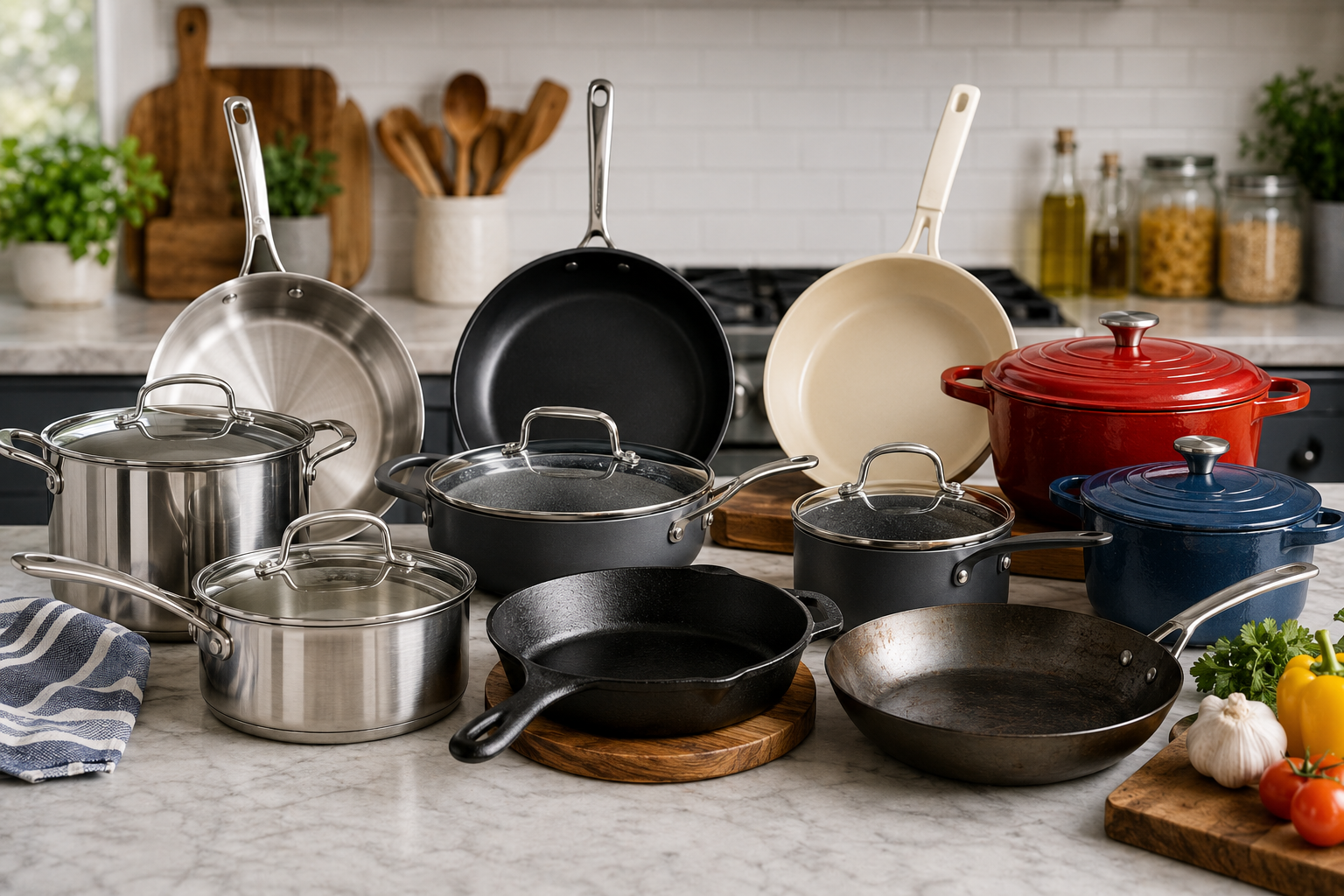
Understanding Cookware Materials
1- Stainless Steel
Stainless steel is prized for its durability, resistance to rust and staining, and versatility across nearly every cooking technique, from searing to simmering. It doesn’t react with acidic foods the way some other materials can, and quality stainless steel releases no coating or PFAS into food, since there’s no coating involved at all. The trade-off is that stainless steel isn’t naturally nonstick, requiring proper preheating and adequate fat to prevent food from sticking, a matter of technique rather than the material itself.
2- Nonstick (Traditional PTFE Coating)
Traditional nonstick cookware uses a PTFE-based coating, commonly known by the brand name Teflon, that provides excellent food release with minimal oil. It’s ideal for delicate foods like eggs and fish, and it’s generally the most budget-friendly nonstick option available. The coating can degrade over time, particularly with high heat, metal utensils, or physical damage like scratching, and this has become the center of increasing regulatory attention in several states.
3- Ceramic and Ceramic-Coated Nonstick
Ceramic-coated cookware offers a nonstick cooking surface without PTFE or traditional PFAS coatings, appealing to buyers specifically seeking a PFAS-free alternative. It performs well for everyday cooking with easy release and simple cleanup, though most ceramic nonstick surfaces gradually lose some of their nonstick performance over time and generally aren’t considered a lifetime purchase the way stainless steel or cast iron can be.
4- Cast Iron
Cast iron offers exceptional heat retention, genuine durability that can last generations with proper care, and a naturally developing nonstick quality through seasoning over time. It requires more maintenance than other materials, regular seasoning and careful drying to prevent rust, and its significant weight can be a real consideration for some cooks.
5- Carbon Steel
Carbon steel shares many of cast iron’s benefits, excellent heat retention and durability, while being notably lighter and often more responsive to temperature changes. Like cast iron, it requires seasoning and similar care to prevent rust, appealing particularly to cooks who want cast iron’s performance in a more manageable weight.
6- Enameled Cast Iron
Enameled cast iron combines cast iron’s heat retention with a glass-like enamel coating, eliminating the need for seasoning while adding resistance to acidic foods. It comes at a higher price point than bare cast iron and remains quite heavy, but offers a durable, low-maintenance alternative for those wanting cast iron’s cooking performance without ongoing seasoning upkeep.
Cookware Material Comparison
| Material | Nonstick Performance | Durability | Maintenance | Best For |
| Stainless steel | Low (technique-dependent) | Very high | Low | Searing, sauces, everyday versatility |
| Traditional nonstick (PTFE) | Excellent | Moderate | Low | Eggs, delicate fish, low-oil cooking |
| Ceramic/ceramic nonstick | Good | Moderate | Low | PFAS-free nonstick cooking |
| Cast iron | Good (once seasoned) | Very high | Higher | Searing, baking, long-term durability |
| Carbon steel | Good (once seasoned) | Very high | Higher | Similar to cast iron, lighter weight |
| Enameled cast iron | Moderate | Very high | Low | Braising, acidic dishes, low-maintenance durability |
Understanding PFAS and Nonstick Cookware Regulations
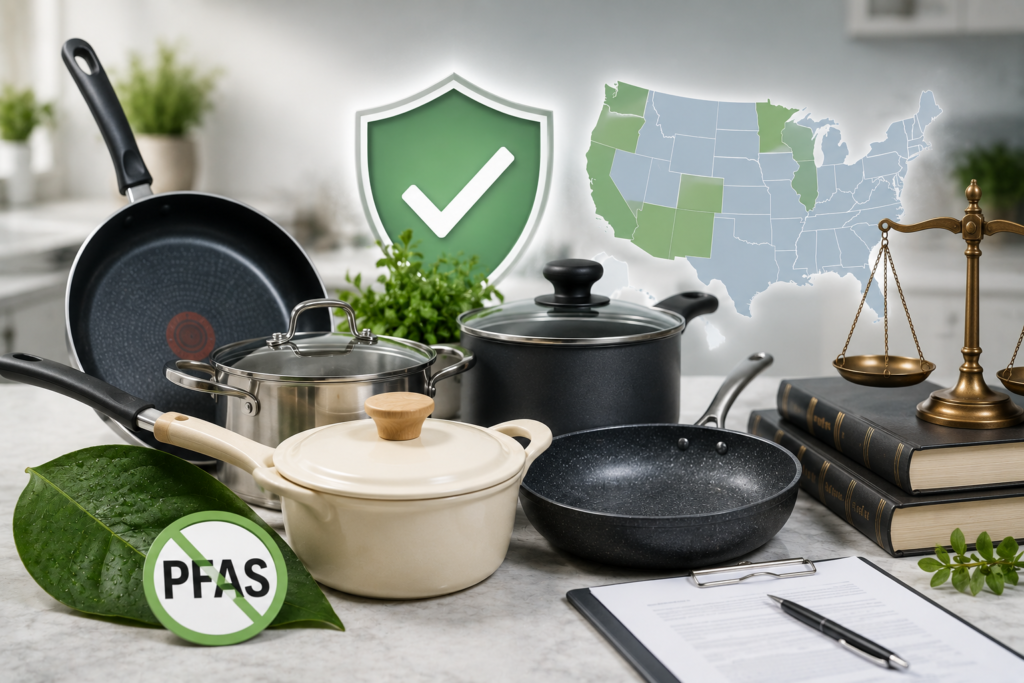
This has become a genuinely important consideration for cookware shoppers in recent years, and regulations are actively evolving at the state level rather than through a single unified federal rule.
What PFAS Actually Means
PFAS refers to a broad family of “forever chemicals” used in various nonstick coatings, valued for their durability and heat resistance but increasingly scrutinized for potential health and environmental concerns, particularly when cookware coatings become damaged, scratched, or worn down over time.
State-by-State Regulation Status
Regulation of PFAS in cookware currently varies considerably by state rather than existing as a single national standard. Minnesota became the first state to prohibit the sale of new PFAS-containing cookware, effective January 2025. Maine’s restrictions took effect in January 2026, and Colorado implemented a similar ban on products containing intentionally added PFAS, including cookware, also effective January 2026. Vermont, Connecticut, and Rhode Island are moving forward with their own bans or restrictions, with enforcement dates ranging from 2026 to 2028.
Outside these specific states, federal regulation of PFAS specifically in cookware remains a longer-term prospect rather than a current requirement, meaning the practical effect of these rules depends significantly on where you live.
What This Means for Your Purchase
If you live in a state with active or upcoming PFAS cookware restrictions, retailers in that state are increasingly limited in what they can sell going forward. Regardless of your state’s specific regulatory status, checking a product’s material composition and any manufacturer disclosures remains the most reliable way to understand exactly what you’re buying, rather than assuming regulatory status alone guarantees a particular outcome.
Practical Safety Advice Regardless of Regulation
If you continue using traditional nonstick cookware, avoid using it once the surface becomes visibly scratched, flaking, or worn down, since damage to the coating increases the risk of the coating material leaching into food during cooking. Avoiding metal utensils, extreme high heat, and abrasive cleaning tools all help extend a nonstick coating’s usable lifespan before this becomes a concern.
Set vs Individual Pieces: Which Should You Buy?
The Case for a Cookware Set
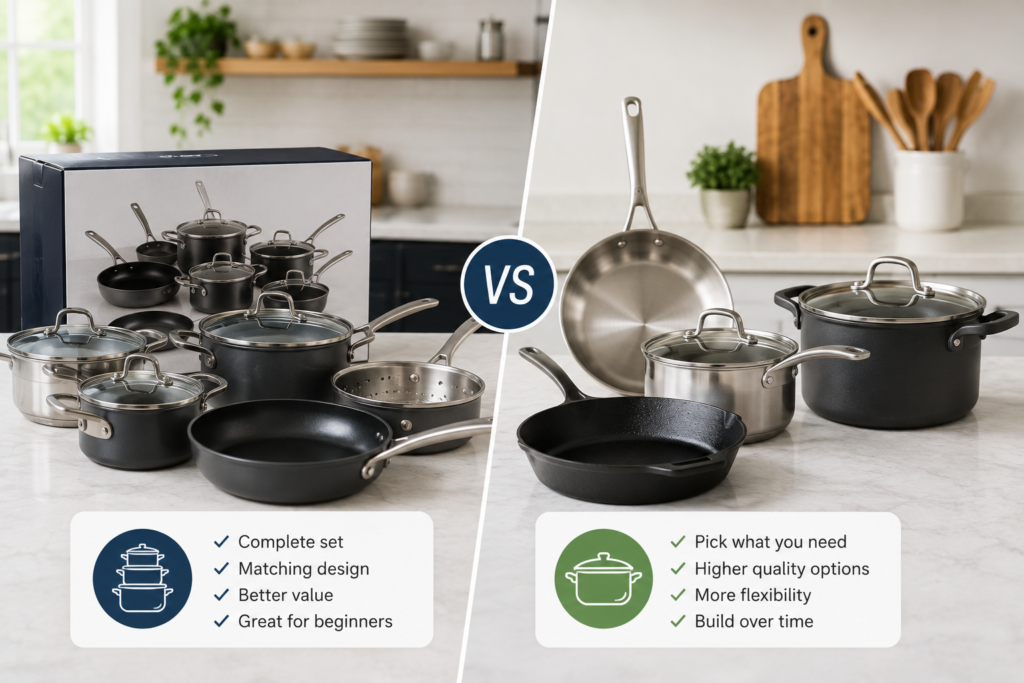
A complete set offers convenience, coordinated design, and often better overall value per piece compared to buying everything individually. This works particularly well for first-time kitchen buyers or anyone wanting a comprehensive, ready-to-cook collection without researching each piece separately.
The Case for Individual Pieces
Buying individual pieces lets you match the material to the specific cooking task, choosing cast iron for searing, stainless steel for sauces, and a nonstick pan specifically for eggs, rather than accepting whatever material a set happens to include across all its pieces. This approach often costs more overall but avoids paying for pieces you won’t actually use regularly.
A Practical Middle Ground
Many experienced home cooks build their collection gradually: starting with a small set or a few essential individual pieces, then adding specialized items, a dedicated cast iron skillet, a stockpot, a nonstick pan for eggs, as specific cooking needs become clear over time.
Essential Pieces for Most Home Kitchens
Regardless of whether you buy a set or individual pieces, most households genuinely use a fairly consistent core lineup:
- A large skillet or frying pan (10–12 inches) for everyday sautéing and searing
- A saucepan (2–3 quart) for sauces, grains, and small-batch cooking
- A stockpot (6–8 quart) for soups, pasta, and larger-batch cooking
- A Dutch oven or braiser for slow-cooked dishes, braises, and stovetop-to-oven cooking
- A small nonstick pan for eggs and delicate foods
Additional specialized pieces, a wok, a griddle, a roasting pan, are worth adding based on your specific cooking habits rather than purchasing upfront as part of an oversized starter set.
Cookware Construction Quality
Base and Layer Construction
Multi-clad or tri-ply construction, where layers of different metals (often stainless steel around an aluminum or copper core) are bonded together, generally offers better heat distribution than single-layer stainless steel, reducing hot spots during cooking.
Handle Attachment
Riveted handles tend to be more durable long-term than welded or screwed handles, since rivets distribute stress across a wider area of the pan’s body rather than a single attachment point.
Weight as a Quality Indicator
Heavier cookware, within reason, often indicates thicker, more substantial construction, which generally improves heat retention and reduces warping over time, though this needs to be balanced against practical considerations like ease of lifting and handling during regular use.
Matching Cookware to Your Stovetop
Gas Stovetops
Gas stoves work well with nearly all cookware materials, since the open flame provides flexible, even heat regardless of the pan’s base material.
Electric Coil or Radiant Stovetops
These generally perform best with flat-bottomed cookware that maintains full contact with the heating surface, since warped or uneven pan bottoms can create inconsistent heating.
Induction Cooktops
Induction requires cookware with magnetic properties, meaning materials like aluminum, copper, and glass generally won’t work at all unless specifically layered with a magnetic base. Stainless steel and cast iron are typically induction-compatible, though it’s worth confirming compatibility with a specific product before purchasing if you cook on an induction cooktop.
Budget Planning
Cookware prices span an enormous range depending on material, construction quality, and brand. Budget-friendly options, generally basic stainless steel or traditional nonstick pieces, offer solid everyday performance without a large investment. Mid-range cookware, including quality tri-ply stainless steel or ceramic nonstick sets, balances durability and price for most households. Premium cookware, particularly high-end cast iron, carbon steel, or fully-clad stainless steel collections from established brands, represents a longer-term investment that can genuinely last decades with proper care.
Common Mistakes to Avoid
- Buying an oversized set with pieces you’ll never use, rather than a smaller, more intentional collection
- Ignoring stovetop compatibility, particularly for induction cooktops requiring magnetic cookware
- Continuing to use visibly damaged nonstick cookware, increasing the risk of coating material leaching into food
- Choosing purely by price, without considering construction quality or how the cookware will hold up to your actual cooking frequency
- Overlooking maintenance requirements, particularly for cast iron and carbon steel, which need regular seasoning and care to perform and last well
Conclusion
Choosing the right cookware comes down to matching material to how you actually cook, understanding the genuine trade-offs between nonstick convenience and long-term durability, and staying informed about evolving PFAS regulations that vary by state. Whether you build your collection through a coordinated set or by adding individual pieces over time, prioritizing solid construction and materials suited to your specific stovetop and cooking style will serve you far better than choosing based on price or packaging alone. With the right foundation in place, quality cookware is one of the few kitchen investments that can genuinely last decades rather than needing regular replacement.
Frequently Asked Questions
1- What is the best cookware material overall?
There isn’t one universal answer, since the best material depends on your cooking style. Stainless steel offers the most versatility and durability without any coating concerns, while cast iron and carbon steel offer excellent long-term performance for searing and high-heat cooking.
2- Is nonstick cookware safe to use?
Traditional nonstick cookware is generally considered safe under normal use, but damaged, scratched, or heavily worn coatings increase the risk of material leaching into food, so replacing significantly worn nonstick pans is a reasonable precaution.
3- What is PFAS-free cookware?
PFAS-free cookware avoids the “forever chemical” coatings used in some traditional nonstick products, typically using ceramic coatings, stainless steel, or cast iron instead, which don’t rely on PTFE-based nonstick technology.
4- Do I need a full cookware set, or can I buy individual pieces?
Both approaches work well. A set offers convenience and coordinated design, while individual pieces let you match material to specific cooking tasks, often at a higher total cost but with less unused capacity.
5- Is cast iron better than stainless steel?
Neither is universally better, they serve different purposes. Cast iron excels at heat retention and searing, while stainless steel offers more everyday versatility and doesn’t require seasoning or the same level of ongoing maintenance.
6- Can I use any cookware on an induction cooktop?
No. Induction cooktops require cookware with magnetic properties, meaning materials like pure aluminum, copper, and glass generally won’t work unless specifically constructed with a magnetic base layer.
7- Are PFAS restrictions on cookware the same across the whole country?
No, currently regulation varies significantly by state. Minnesota, Maine, and Colorado have implemented specific restrictions on PFAS-containing cookware, with other states moving toward similar rules on different timelines, while broader federal regulation remains a longer-term prospect.