Walk into any appliance showroom, and you’ll see dishwashers loaded with features you’ve never heard of, from soil sensors to steam-assisted cycles. Not all of them are worth paying extra for.
This guide cuts through the marketing language and explains which features genuinely affect your day-to-day experience, and which ones you can safely skip. We’ll cover dishwasher features, how to compare models, and practical buying advice that applies regardless of your budget.
By the end, you’ll know exactly what to prioritise when comparing dishwashers, so you can buy with confidence rather than guessing based on spec sheets alone.
So, What Matters Most
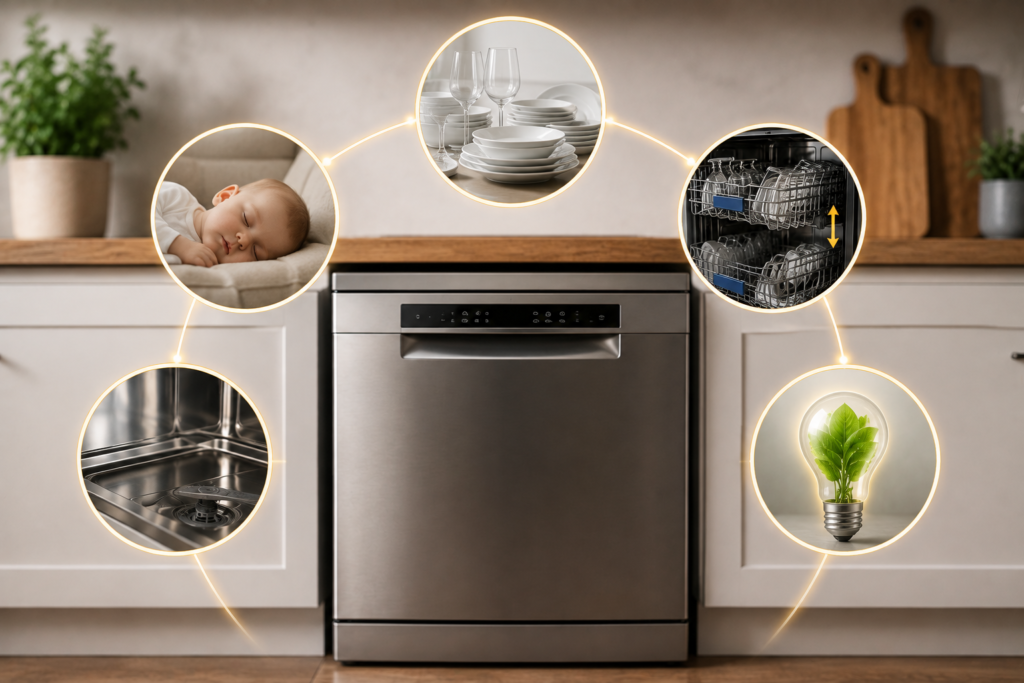
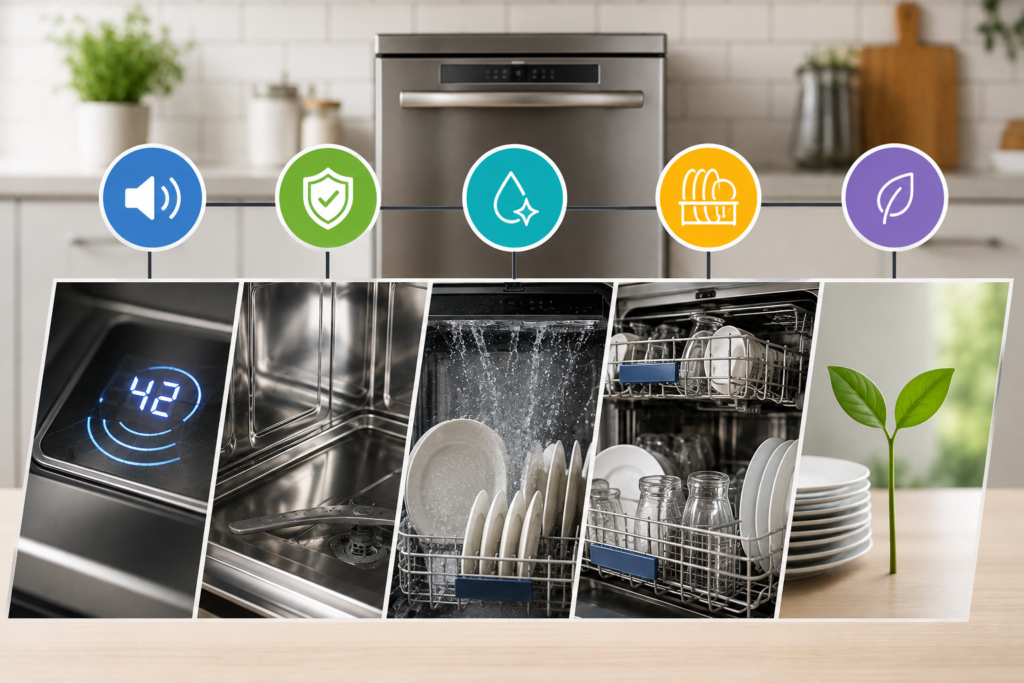
If you only remember a handful of things before buying, focus on these
- Noise level
- Tub material
- Drying performance
- Rack flexibility
- Energy efficiency
Everything else is a nice-to-have rather than a genuine necessity for most households.
These five factors influence your daily experience far more than flashier extras like smart app controls or interior lighting. We’ll explain each one in detail below, along with how to weigh them against your budget and household needs.
1- Noise Level: Why Decibels Matter More Than You’d Think
Dishwasher noise is measured in decibels (dB), and this single number affects your daily life more than almost any other spec. Lower numbers mean quieter operation.
Budget models often run in the mid-to-high 50 decibel range, loud enough to compete with nearby conversation. Mid-range models typically sit around 44–50 decibels, noticeably quieter and less intrusive. Premium models can drop into the low 40s or even high 30s, quiet enough that you may forget the dishwasher is running at all.
| Decibel Level | What It Sounds Like |
| 55+ dB | Clearly audible, disrupts conversation |
| 46–50 dB | Noticeable but background-level |
| 42–45 dB | Quiet, easy to ignore |
| Below 42 dB | Nearly silent operation |
If your kitchen is open to your living or dining area, noise level should be one of your top priorities. In closed-off kitchens, you may be able to tolerate a louder, more affordable model without much daily frustration.
2- Tub Material: Stainless Steel vs Plastic
The interior tub material affects durability, heat retention, and drying performance, making it one of the more overlooked but important specs.
Stainless Steel Tubs
Stainless steel tubs resist staining and odour better than plastic over time. They also retain heat more effectively during the wash and dry cycle, which improves overall drying results, particularly for plastic items.
Plastic Tubs
Plastic tubs are common in budget models and remain fully functional for basic washing needs. They don’t retain heat as effectively as stainless steel, which can lead to slightly less thorough drying, and they’re more prone to staining or odour absorption over years of use.
Bottom line: If drying performance and long-term durability matter to you, prioritise a stainless steel tub, even if it means adjusting your budget slightly.
3- Drying Performance: The Feature Most People Underestimate
Drying is one of the most common complaints homeowners have about dishwashers, especially with plastic items like food storage containers.
Condensation Drying
This is the most basic drying method, relying on temperature differences to pull moisture off dishes naturally. It works reasonably well for glass and ceramic but often leaves plastic items damp, since plastic doesn’t retain heat the way other materials do.
Heated Drying
Heated drying uses a heating element to actively dry dishes after the rinse cycle, generally producing better results than condensation drying alone. This does use more energy, though the difference is usually modest.
Advanced Drying Systems
Some higher-tier models use more sophisticated drying technology, including fan-assisted systems or mineral-based drying aids, designed specifically to improve results with plastics. These systems typically appear in mid-range to premium models and represent one of the clearest upgrades as you move up in price.
Practical tip: If you regularly wash a lot of plastic containers, prioritise a model with heated or advanced drying technology rather than relying on basic condensation drying.
4- Rack Design and Flexibility
Rack configuration affects how much you can actually fit into a single load, which matters more than people expect until they’re dealing with an awkwardly shaped pot.
Adjustable Upper Racks
Height-adjustable upper racks let you create more clearance for tall items on the bottom rack, such as pots or serving dishes. This feature has become increasingly common even in budget-friendly models.
Fold-Down Tines
Fold-down tines in either rack let you create custom space for oddly shaped items, improving flexibility without needing to rearrange your entire load.
Third Racks
A third rack, typically a slim tray positioned above the main racks, adds dedicated space for utensils, small lids, or shallow items. This frees up room in the main racks and has become a common feature in mid-range and premium dishwashers.
What to prioritise: If you regularly wash mismatched cookware or entertain often, adjustable racks and a third rack will make a noticeable practical difference.
Wash Cycles: How Many Do You Actually Need?
Most dishwashers offer several wash cycle options, but you likely won’t use all of them regularly. Understanding the common ones helps you avoid paying for cycles you’ll never touch.
- Normal cycle: Suitable for everyday loads with typical food residue
- Heavy or pots-and-pans cycle: Uses more water and higher temperatures for stubborn, baked-on food
- Quick or express cycle: Shorter wash time for lightly soiled dishes
- Delicate cycle: Gentler wash and lower temperatures for glassware
- Sanitize cycle: Uses higher water temperatures to meet sanitisation standards, useful for baby items or after illness in the household
- Eco cycle: Uses less water and energy, typically with a longer cycle time
Most households use only two or three cycles regularly. Rather than chasing the model with the most cycle options, focus on whether it includes the specific cycles that match your household’s habits.
5- Energy and Water Efficiency
Efficiency affects your ongoing utility costs, not just your upfront purchase price, making it worth checking regardless of your budget.
Energy Star Certification
Energy Star-certified dishwashers meet recognised efficiency standards for both water and electricity use, set by the U.S. Environmental Protection Agency. Choosing a certified model can meaningfully reduce long-term utility costs compared with non-certified alternatives.
Water Usage
Modern dishwashers use significantly less water than washing dishes by hand, with most efficient models using considerably less water per cycle than older units. If sustainability or utility costs are a priority, compare estimated water usage figures on the EnergyGuide label before buying.
Practical tip: Even a slightly higher upfront cost for an Energy Star-certified model often pays off over several years of use through lower utility bills.
Smart Features: Worth It or Not?
Smart dishwashers with app connectivity, voice assistant integration, or remote cycle monitoring have become increasingly common, particularly in mid-range and premium models.
These features can be genuinely convenient, letting you start a cycle remotely or receive notifications when a load finishes. However, they’re rarely essential to a dishwasher’s core performance and shouldn’t be a deciding factor if the underlying wash and dry performance doesn’t meet your needs.
Our advice: Treat smart connectivity as a nice bonus rather than a must-have feature, especially if choosing it means compromising on noise level or drying performance.
6- Soil Sensors and Automatic Cycle Adjustment
Many mid-range and premium dishwashers include soil sensors that detect how dirty your dishes are and automatically adjust water usage and cycle length accordingly. This can improve both cleaning results and efficiency without requiring you to manually select the right cycle every time.
This feature is genuinely useful for households with inconsistent load types, since it reduces the guesswork of choosing between normal, heavy, or eco cycles each time.
7- Interior Lighting and Digital Displays
Interior LED lighting and digital countdown displays are minor conveniences rather than essential features. They can help you see the interior clearly or track remaining cycle time, but they have no real impact on cleaning or drying performance.
These features are worth considering as a tiebreaker between two similarly priced, similarly performing models, but shouldn’t be prioritised over core performance specs.
Comparing Dishwasher Features by Priority
Use this table as a quick reference when comparing models side by side.
| Feature | Priority Level | Why It Matters |
| Noise level (dB) | High | Affects daily comfort, especially in open kitchens |
| Tub material | High | Impacts durability and drying performance |
| Drying technology | High | Directly affects results with plastics |
| Adjustable racks | Medium-High | Improves loading flexibility |
| Third rack | Medium | Useful for utensils and small items |
| Energy Star certification | Medium | Affects long-term utility costs |
| Wash cycle variety | Medium | Match to your actual household habits |
| Soil sensors | Medium | Improves efficiency and convenience |
| Smart connectivity | Low | Convenient but not essential |
| Interior lighting/display | Low | Minor convenience only |
How to Match Features to Your Household
Not every household needs the same features, so it helps to think about your actual daily habits before comparing spec sheets.
- Small households or light use: Prioritise noise level and basic drying performance over extensive cycle options or a third rack.
- Families with frequent loads: Look for adjustable racks, a third rack, and reliable drying performance to handle larger, more varied loads.
- Households washing lots of plastic: Prioritise heated or advanced drying technology specifically, since this is where basic models tend to underperform.
- Open-concept kitchens: Make noise level your top priority, since a loud dishwasher will be far more noticeable in a shared living space.
- Budget-conscious buyers: Focus your budget on tub material and drying performance first, treating smart features and extra cycles as optional extras.
Common Buying Mistakes to Avoid
- Prioritising cycle count over cycle relevance: Having ten wash cycles means little if you only ever use two of them regularly.
- Ignoring decibel ratings: Skipping this spec is one of the most common regrets homeowners report after installation, particularly in open kitchens.
- Choosing smart features over core performance: App connectivity doesn’t compensate for poor drying or a noisy motor.
- Overlooking installation requirements: Always confirm your new dishwasher fits existing plumbing and cabinet space before purchasing.
- Assuming higher price always means better performance: While pricier models often perform better, it’s still worth comparing specific specs rather than assuming price alone guarantees quality.
Conclusion
Choosing the right dishwasher comes down to understanding which features genuinely affect your daily experience, rather than being swayed by the longest spec sheet. Noise level, tub material, and drying performance should sit at the top of your priority list, followed by rack flexibility and energy efficiency. Smart features, interior lighting, and extensive cycle options are worth having but shouldn’t drive your final decision. By focusing on the features that matter most to your specific household, you’ll end up with a dishwasher that performs well for years, without paying extra for features you’ll rarely use.
Frequently Asked Questions
1- What is the most important dishwasher feature?
Noise level and drying performance are generally considered the two features with the biggest impact on daily satisfaction.
2- Is a third rack worth it?
Yes, if you regularly wash utensils, small lids, or oddly shaped items, since it frees up space in the main racks and improves overall load capacity.
3- Do I need a sanitize cycle?
It’s useful if you have young children, someone in the household recovering from illness, or specific health considerations, though it’s not essential for most everyday use.
4- Are stainless steel tubs worth the extra cost?
Generally yes, since they offer better durability, heat retention, and drying performance compared with plastic tubs over the long term.
5- Does a quieter dishwasher clean as well as a louder one?
Noise level and cleaning performance are largely unrelated specs, so a quieter dishwasher doesn’t necessarily mean weaker cleaning results