It’s easy to get overwhelmed staring at a cookware aisle or scrolling through dozens of “must-have” lists, especially when many of them recommend far more than any household actually uses regularly. The truth is, most home cooks genuinely rely on a fairly small, consistent core of essential cookware, with specialty pieces added gradually as specific needs arise.
This guide walks through exactly which pieces genuinely earn a permanent spot in your kitchen, why each one matters, and how to prioritize your purchases whether you’re furnishing your first kitchen or finally replacing worn-out pieces that have outlived their usefulness.
What You Actually Need
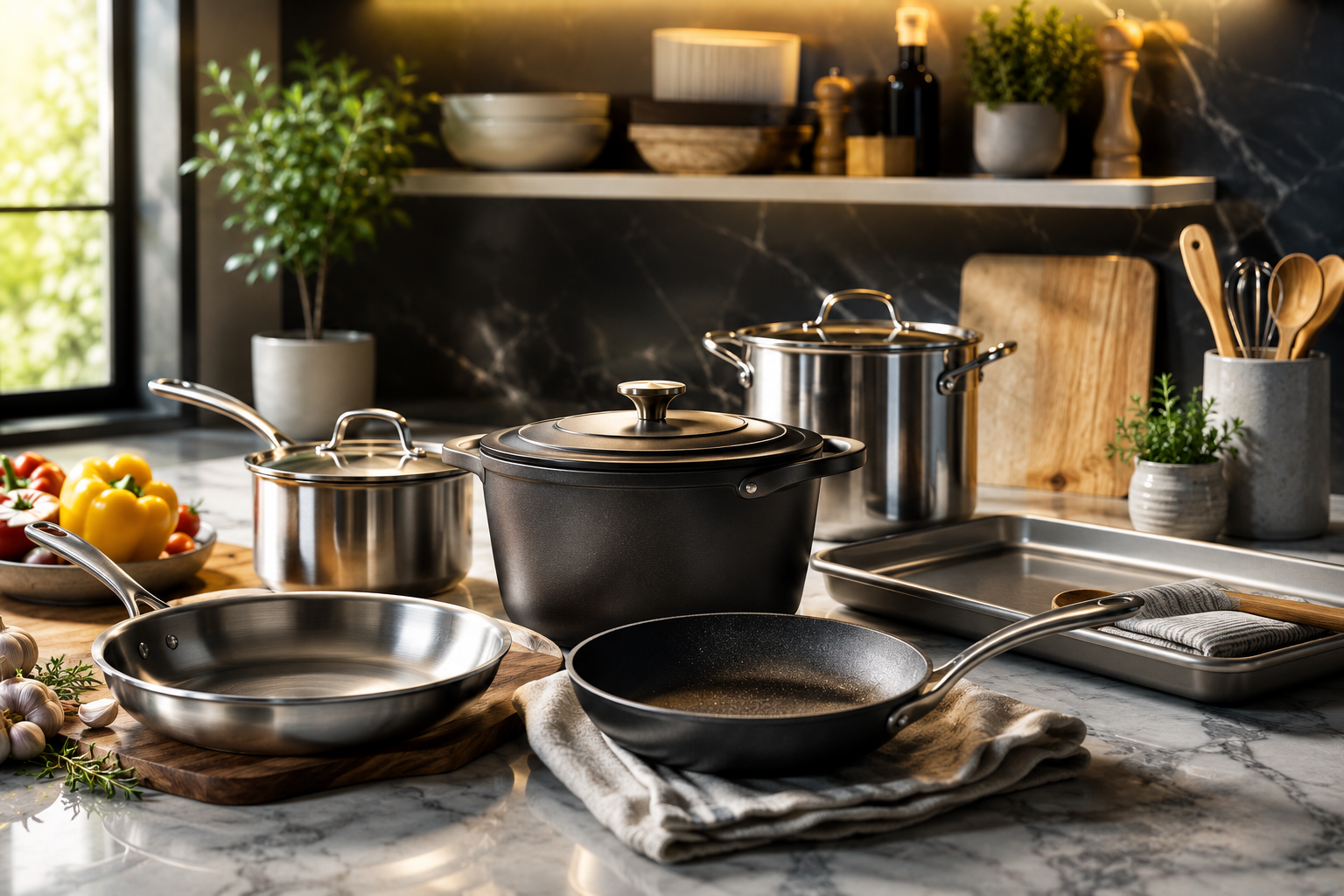
At minimum, a functional kitchen needs a large skillet, a saucepan, a stockpot, and a sheet pan for baking. Beyond these four essentials, a Dutch oven and a small nonstick pan round out what most home cooks consider a genuinely complete starter collection. Everything beyond this core group, specialty woks, griddles, or multiple sizes of the same piece, is worth adding only once your specific cooking habits make the need clear, rather than buying upfront as part of an oversized “complete” set.
The Core Essentials Explained
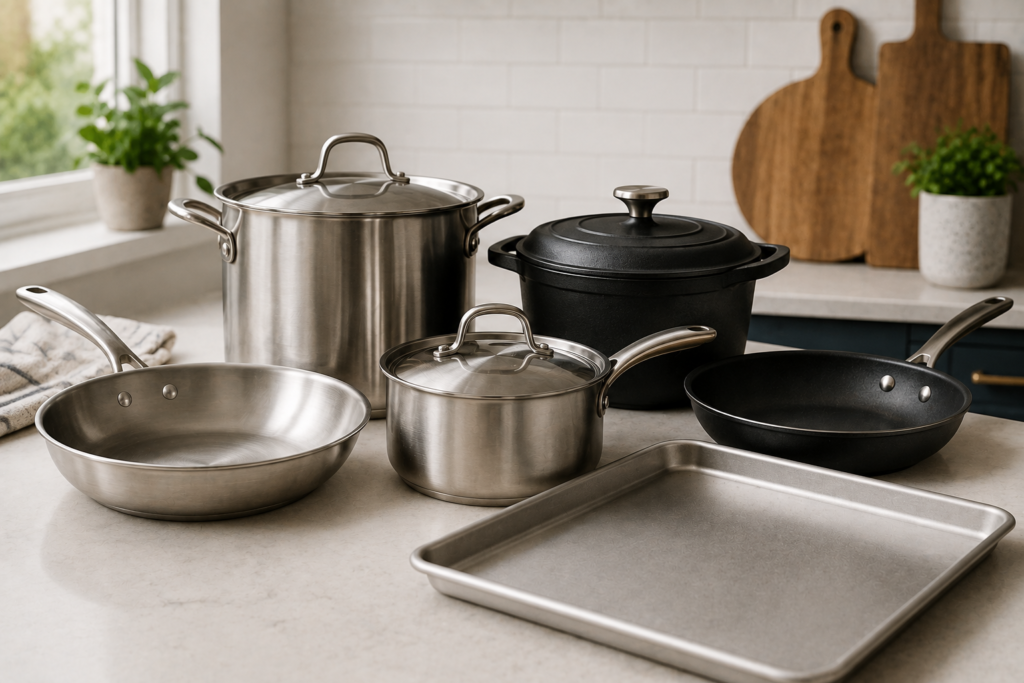
A Large Skillet or Frying Pan (10–12 Inches)
This is the single most versatile piece in nearly any kitchen, used for sautéing vegetables, searing proteins, making pan sauces, and countless other everyday cooking tasks. A 10-to-12-inch size handles most household portions without needing to cook in multiple batches.
Material considerations: Stainless steel offers the most versatility for searing and sauce-making without any coating to wear down, while cast iron delivers superior heat retention for high-heat searing. Either makes an excellent primary choice, with the decision often coming down to personal preference and comfort with technique.
A Saucepan (2–3 Quart)
Essential for sauces, grains, oatmeal, reheating soup, and general small-batch cooking, a mid-sized saucepan with a lid handles a wide range of everyday tasks that a large skillet or stockpot can’t accommodate as efficiently.
Material considerations: Stainless steel remains the standard choice here, given the frequent need to reduce sauces or cook acidic ingredients without any concern about coating degradation.
A Stockpot (6–8 Quart)
Necessary for pasta, soups, stocks, and any larger-batch cooking, a stockpot in this size range comfortably handles family-sized portions without constantly needing to cook in smaller rounds.
Material considerations: Stainless steel is the near-universal choice for stockpots, since their primary use, boiling water and simmering large liquid volumes, doesn’t benefit meaningfully from nonstick coating or cast iron’s heat retention properties.
A Sheet Pan (Half Sheet, 13×18 Inches)
Often overlooked in cookware discussions since it’s technically bakeware rather than a pot or pan, a sturdy sheet pan is genuinely essential for roasting vegetables, baking cookies, reheating leftovers, and countless oven-based tasks.
Material considerations: Heavy-gauge aluminum sheet pans resist warping under high oven heat considerably better than thinner, lightweight versions, which is worth prioritizing even on a budget.
Highly Recommended Additions
A Dutch Oven (5–7 Quart)
While not strictly essential for basic daily cooking, a Dutch oven earns its place quickly for anyone who braises, makes soups or stews regularly, or wants a single vessel that transitions seamlessly from stovetop to oven. Enameled cast iron versions offer excellent heat retention without requiring seasoning, making them particularly beginner-friendly compared to bare cast iron.
A Small Nonstick or Ceramic Pan (8 Inches)
Dedicated specifically to eggs, delicate fish, and other foods prone to sticking, a small coated pan solves a genuine everyday frustration that stainless steel and cast iron handle less gracefully, particularly for less experienced cooks still building confidence with technique.
Essential Cookware at a Glance
| Piece | Size Range | Primary Uses | Recommended Material |
| Large skillet | 10–12 inches | Sautéing, searing, pan sauces | Stainless steel or cast iron |
| Saucepan | 2–3 quart | Sauces, grains, reheating | Stainless steel |
| Stockpot | 6–8 quart | Pasta, soups, stocks | Stainless steel |
| Sheet pan | 13×18 inches | Roasting, baking, reheating | Heavy-gauge aluminum |
| Dutch oven | 5–7 quart | Braising, soups, stovetop-to-oven | Enameled cast iron |
| Small nonstick pan | 8 inches | Eggs, delicate fish | Nonstick or ceramic |
Pieces to Add as Your Cooking Evolves
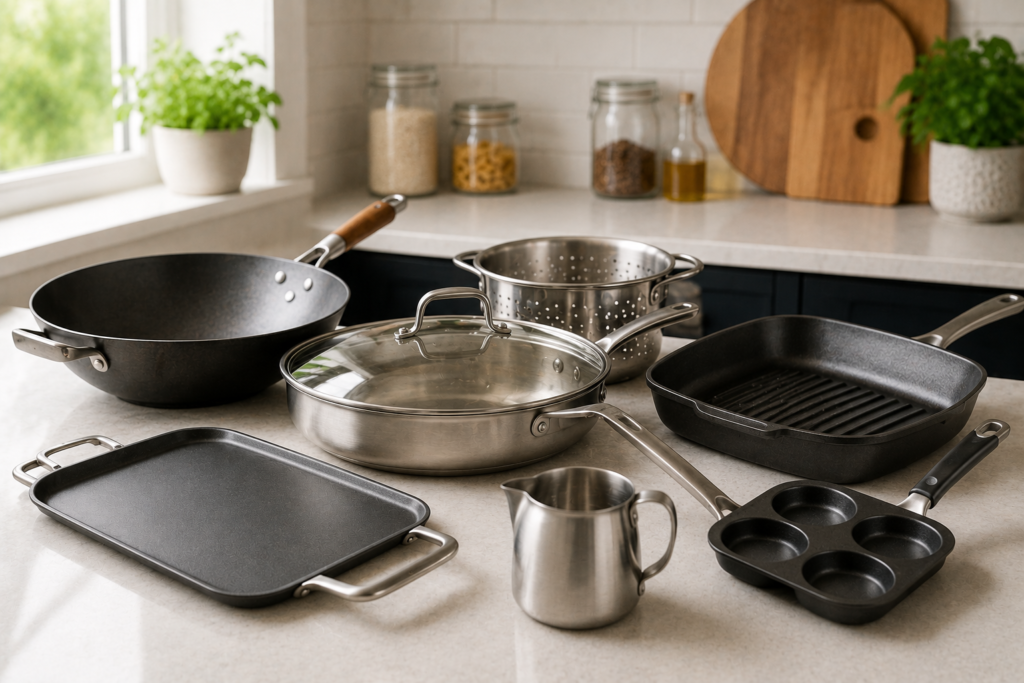
Once your core collection is in place, a few additional pieces become worth considering based on your specific, developing cooking habits, rather than being essential from day one.
- A wok or large sauté pan: Valuable for stir-frying and high-volume vegetable cooking, but a skill and technique investment beyond basic sautéing
- A griddle or grill pan: Useful for pancakes, sandwiches, or indoor grilling, but genuinely optional for many households
- A roasting pan with rack: Worth adding if you regularly roast whole poultry or larger cuts of meat, less essential for smaller households
- Additional skillet sizes: A second, smaller skillet (8 inches) becomes useful once you’re regularly cooking multiple components simultaneously
- A carbon steel pan: An excellent addition for those wanting a lighter alternative to cast iron with quicker heat responsiveness
How to Prioritize Your First Purchases
If You’re Starting From Absolute Zero
Begin with a large skillet and a saucepan, these two pieces alone cover an enormous range of everyday cooking, from breakfast to dinner, before you need anything else.
If You Cook for a Family
Prioritize the stockpot alongside your skillet and saucepan sooner rather than later, since family-sized portions quickly outgrow what a smaller saucepan can efficiently handle.
If You Bake or Roast Regularly
Move the sheet pan up your priority list, since it handles far more than just cookies, roasted vegetables, sheet-pan dinners, and reheating all rely on this single, inexpensive piece.
If You Entertain or Host Often
A Dutch oven becomes more immediately valuable, since braises, large-batch soups, and stovetop-to-oven dishes are common centerpieces for hosting, and a single quality Dutch oven can often replace several other specialty pieces.
Choosing Materials for Your Essential Pieces
Stainless Steel for Versatility
For the pieces used most frequently across the widest range of tasks, your skillet, saucepan, and stockpot, stainless steel offers the best combination of durability, non-reactivity with acidic ingredients, and long-term value without any coating to eventually replace.
Cast Iron for Heat Retention
If searing is a priority, or you want a piece that will genuinely last generations, a cast iron skillet is worth considering either as your primary large skillet or as a complementary second piece alongside a stainless steel version.
Nonstick or Ceramic for Ease
Reserve coated cookware specifically for the tasks it excels at, eggs and delicate foods, rather than relying on it for your primary all-purpose skillet, since coatings inevitably degrade over a few years of regular use regardless of the specific technology.
Enameled Cast Iron for Low-Maintenance Durability
For your Dutch oven specifically, enameled cast iron offers cast iron’s heat retention benefits without requiring seasoning, making it a particularly beginner-friendly choice for a piece you’ll likely use for braising and slow cooking.
Building a Collection: Set vs Piece-by-Piece
The Case for Starting With a Set
A coordinated cookware set can efficiently cover several of these essentials at once, often at better combined value than purchasing each piece individually, particularly for anyone furnishing a kitchen entirely from scratch.
The Case for Buying Individually
Purchasing pieces individually lets you match material specifically to each task, a stainless steel skillet, a dedicated cast iron pan, and a specific nonstick pan for eggs, rather than accepting whatever material a set happens to include uniformly across all its pieces.
A Practical Middle Ground
Many home cooks start with a small set covering the basics, then add specialty individual pieces, a cast iron skillet, a Dutch oven, as specific needs and preferences become clear through actual regular use.
Budget Planning for Essential Cookware
Building Gradually vs All at Once
If your budget doesn’t accommodate every essential piece immediately, prioritize based on the sequence outlined above rather than buying everything at a lower quality level simultaneously. A quality skillet and saucepan purchased first, with additional pieces added over subsequent months, generally serves better than a full set of lower-durability pieces bought all at once.
Where to Spend More vs Where to Save
It’s reasonable to invest more in pieces used daily, your primary skillet and saucepan, while saving on less frequently used specialty items. A sheet pan, for instance, doesn’t need to be a premium purchase, but investing in a heavier-gauge option still meaningfully outperforms the thinnest, most affordable versions in resisting warping over time.
Common Mistakes to Avoid
- Buying an oversized set with duplicate or unnecessary pieces, rather than a smaller, intentional collection matching actual cooking habits
- Skipping the sheet pan, an inexpensive piece that genuinely handles far more cooking tasks than many home cooks initially realize
- Relying entirely on nonstick cookware, missing out on the versatility and durability stainless steel and cast iron offer for searing and sauce-making
- Underestimating stockpot size needs, ending up with a pot too small for family-sized batches of soup or pasta
- Prioritizing specialty pieces (woks, griddles) before covering the core essentials, leaving genuine everyday gaps in the collection
Conclusion
Building a genuinely functional kitchen doesn’t require dozens of specialty pieces, it requires a small, well-chosen core of essential cookware that covers the vast majority of everyday cooking tasks. Start with a large skillet, a saucepan, a stockpot, and a sheet pan, then add a Dutch oven and a dedicated nonstick pan as your next priorities. Everything beyond this genuinely essential collection is worth adding only once your specific cooking habits make the need clear, saving both your budget and your cabinet space for the pieces you’ll actually reach for again and again.
Frequently Asked Questions
1- What is the single most important piece of cookware to own?
A large, versatile skillet is generally considered the most essential single piece, since it handles the widest range of everyday cooking tasks, from sautéing to searing to making pan sauces.
2- Do I need both a nonstick pan and a stainless steel pan?
Yes, ideally. Each excels at different tasks, nonstick for eggs and delicate foods, stainless steel for searing, sauces, and general versatility without coating concerns.
3- Is a Dutch oven really necessary for a basic kitchen?
Not strictly necessary for the most basic cooking, but it’s one of the most versatile additions beyond the core essentials, particularly valuable for braising, soups, and stovetop-to-oven dishes.
4- How many sizes of skillet do I actually need?
Most households do well starting with just one large skillet (10–12 inches), adding a second, smaller size later only once you’re regularly cooking multiple components at the same time.
5- Should I buy a full cookware set or individual essential pieces?
Both approaches work well. A set offers convenience and often better combined value for furnishing a kitchen from scratch, while individual pieces let you match material specifically to each cooking task.
6- What size stockpot do I need for a family of four?
A 6-to-8-quart stockpot generally handles family-sized batches of pasta, soup, or stock comfortably without needing to cook in multiple smaller rounds.
7- Is it worth investing in a Dutch oven early, or can it wait?
This depends on your cooking habits. If you regularly braise, make large-batch soups, or host guests, prioritizing it sooner makes sense. For simpler, everyday cooking, it can reasonably wait until your core essentials are covered.