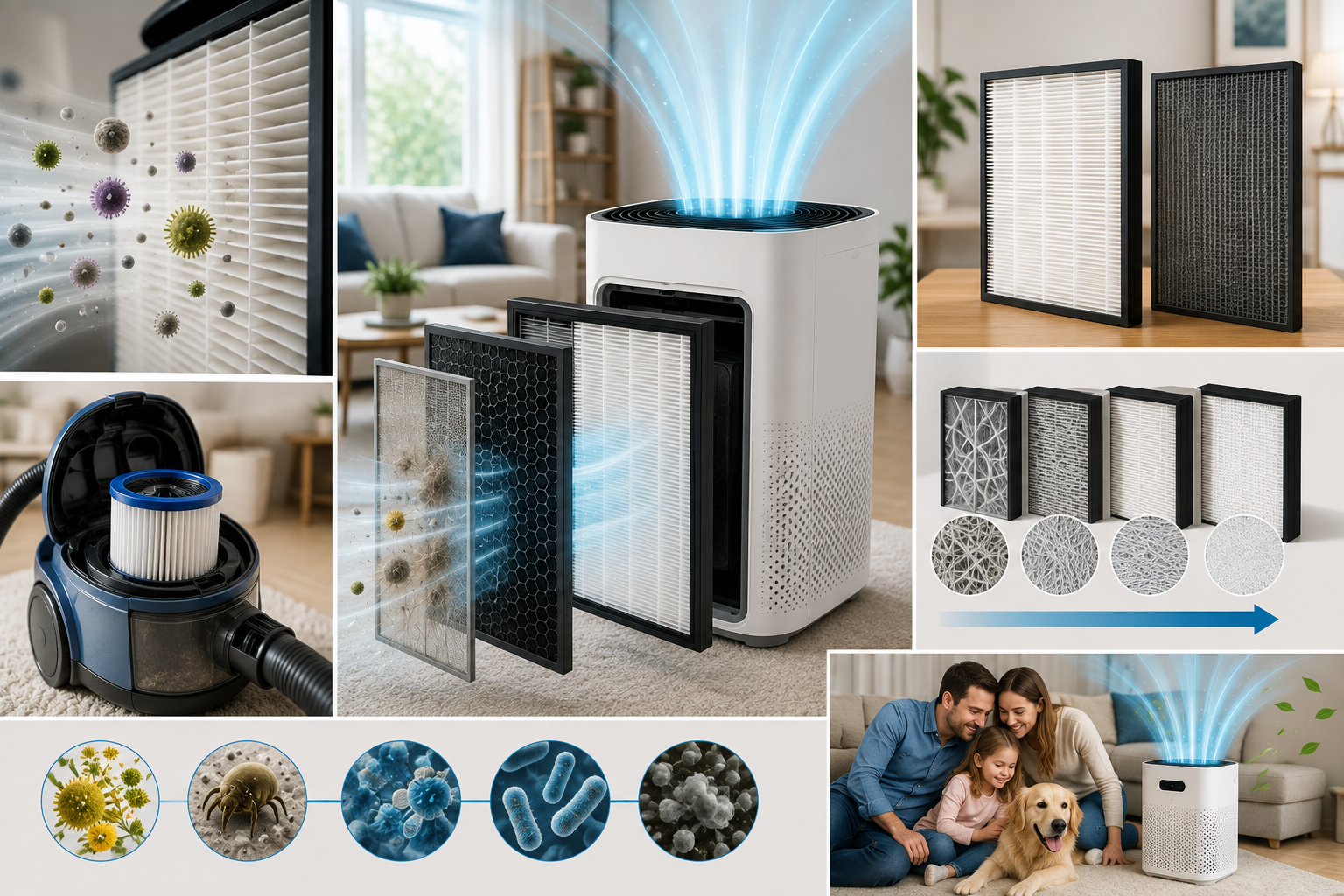
A filter can only legally be called HEPA if it removes at least 99.97 percent of particles at 0.3 microns in diameter, a specific standard set by the U.S. Department of Energy. That single number is the entire definition, and it’s also exactly why so much marketing language around “HEPA-type” or “HEPA-style” filters is deliberately vague, since those terms aren’t standardized and don’t guarantee the same performance at all.
This guide breaks down exactly what a true HEPA filter is, why 0.3 microns is the specific benchmark used, how HEPA compares to the MERV ratings you’ll see on furnace filters, and which one actually belongs in your home. We’ll also cover HEPA grades, True HEPA vs HEPA-type, and practical buying advice for American homeowners trying to cut through genuinely confusing filtration marketing.
By the end, you’ll be able to look at any filter’s packaging and know within seconds whether it’s actually meeting the real HEPA standard or just borrowing the name.
What Makes a Filter Genuinely “HEPA”?
A true HEPA filter must capture at least 99.97 percent of particles measuring 0.3 microns in diameter, a standard defined by the U.S. Department of Energy and equivalent to a MERV rating of 17 to 20. This specific size, 0.3 microns, isn’t arbitrary, it’s known as the Most Penetrating Particle Size, the single hardest particle size for any filter to actually catch, meaning particles both larger and smaller than 0.3 microns are trapped with even greater efficiency than the headline number suggests.
Any filter using softer language like “HEPA-type,” “HEPA-like,” or “HEPA-style” is explicitly not held to this standard, and these marketing terms should be treated as a signal to look more closely rather than proof of genuine HEPA performance.
Where HEPA Technology Actually Came From
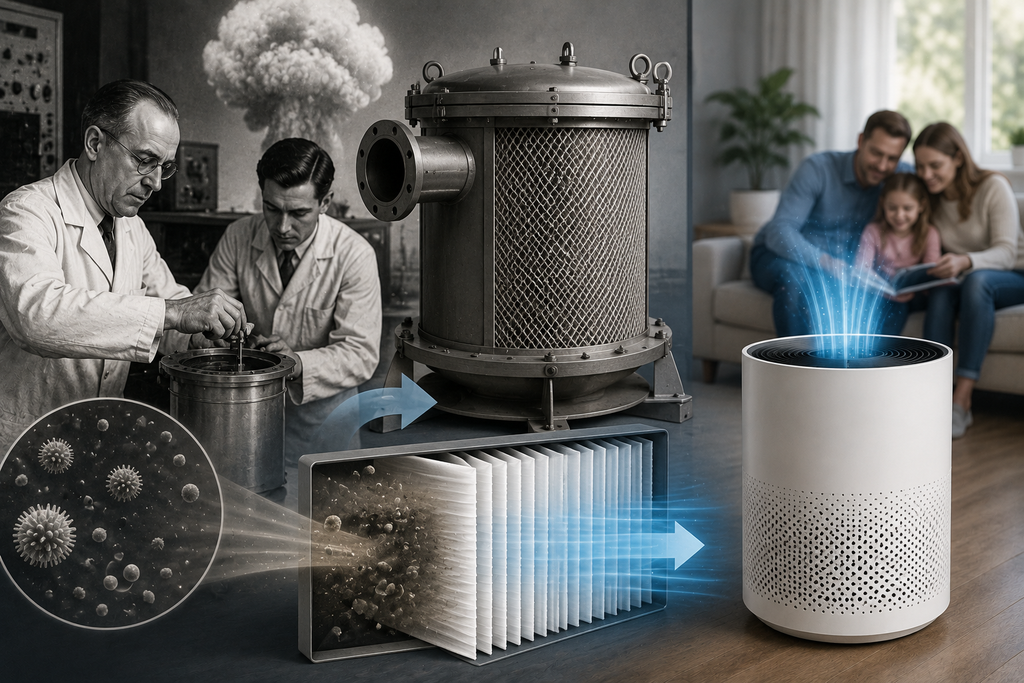
HEPA filtration wasn’t originally designed for allergies or household air quality at all, it has a genuinely different origin story worth knowing.
The technology was developed in the 1940s by the U.S. Atomic Energy Commission, originally created specifically to filter radioactive particles out of the air during the Manhattan Project. That original purpose explains why the standard is so rigorous: filtering genuinely hazardous radioactive particulate matter required a level of precision that consumer allergy filters simply didn’t need at the time, and that same demanding standard carried forward into today’s medical, industrial, and consumer HEPA applications.
Why 0.3 Microns Is the Benchmark That Matters
Understanding why HEPA testing specifically targets 0.3-micron particles clears up a lot of confusion about how the technology actually performs across different particle sizes.
Particles at 0.3 microns represent the Most Penetrating Particle Size, meaning this specific size is genuinely the hardest for any filter media to capture, harder than either larger or smaller particles. Larger particles like pollen and dust get physically trapped through simple interception, while smaller particles bounce around unpredictably through diffusion and eventually get caught too; particles right around 0.3 microns fall into an awkward middle zone where neither mechanism works as efficiently, which is exactly why testing at this size gives you the legitimate worst-case performance number rather than an inflated best-case figure.
True HEPA vs HEPA-Type: The Distinction That Actually Matters
This is genuinely the most important practical distinction for anyone shopping for an air purifier or vacuum, and it’s also where marketing language causes the most confusion.
A filter that conforms 100 percent to DOE standards, trapping 99.97 percent of particles at 0.3 microns, is what’s meant by “true HEPA.” Filters marketed as “HEPA-type” or “HEPA-style” don’t meet this same criteria and may only capture larger particles effectively, missing the finer particulates that genuine HEPA filtration is specifically designed to catch. For households managing genuine allergy or respiratory sensitivity concerns, this distinction isn’t a minor technicality, it’s the difference between a filter that’s actually doing the job you’re paying for and one that’s borrowing familiar terminology without the performance to back it up.
Understanding HEPA Grades: H10 Through H14
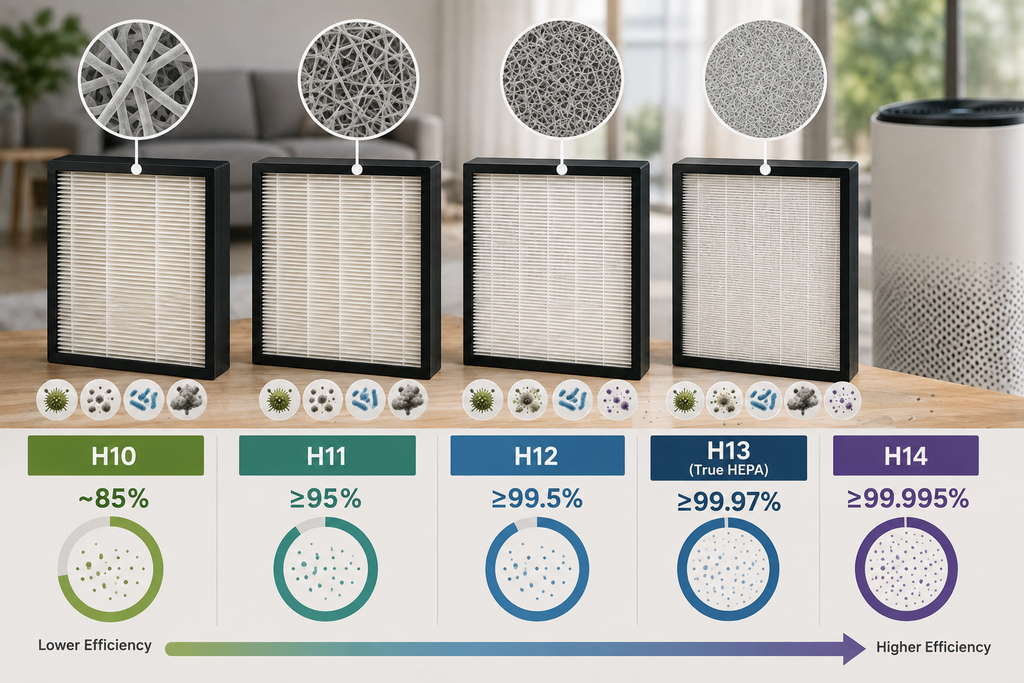
Not all HEPA filters are created equal either, even among those that genuinely qualify for the designation, since an international grading system further breaks down performance levels.
The European EN 1822 standard classifies HEPA filters on a scale from H10, which captures around 85 percent of target particles, up to H14, which captures 99.995 percent. “True HEPA” specifically refers to the H13 grade, which meets the U.S. DOE’s 99.97 percent efficiency standard and represents the practical sweet spot for residential use. H14, sometimes called medical-grade HEPA, costs more but delivers only marginal additional benefit for typical home use, making it a reasonable feature to skip for most households unless you have a specific medical need requiring that extra precision.
Comparing HEPA Grades
| Grade | Approximate Efficiency | Typical Use |
| H10 | ~85% | Basic filtration, lower-cost applications |
| H11 | ~95% | Improved residential filtration |
| H12 | ~99.5% | Higher-performance residential/light commercial |
| H13 (True HEPA) | 99.97% | Standard for quality consumer air purifiers |
| H14 | 99.995% | Medical-grade, hospitals and cleanrooms |
HEPA vs MERV: Two Genuinely Different Systems
If you’ve shopped for furnace filters, you’ve likely seen MERV ratings, and it’s worth understanding exactly how this system relates to, and differs from, HEPA filtration.
MERV, or Minimum Efficiency Reporting Value, is an ASHRAE-developed rating scale running from 1 to 16 for typical residential and commercial filters, testing performance across multiple particle sizes rather than focusing on one specific worst-case benchmark the way HEPA testing does. A MERV 13 filter, often marketed specifically for allergy relief, captures somewhere between 50 and 75 percent of particles in the 0.3 to 1.0 micron range, genuinely useful for whole-home filtration, but still meaningfully short of true HEPA’s 99.97 percent benchmark at that same difficult particle size. Even MERV 16, the highest standard residential rating, only reaches roughly 75 to 95 percent efficiency at that range, still falling short of the H13 True HEPA line.
Comparing HEPA and MERV Ratings
| Rating | Approx. Efficiency at 0.3–1.0 Microns | Typical Application |
| MERV 8 | Low, best for larger particles (3.0–10 microns) | Basic residential HVAC |
| MERV 11 | Moderate | Everyday dust, pollen, pet dander |
| MERV 13 | ~50–75% | Allergy-focused residential HVAC |
| MERV 16 | ~75–95% | Higher-end commercial systems |
| HEPA (H13, “True HEPA”) | 99.97% | Portable air purifiers, cleanrooms |
Why Your HVAC System Probably Can’t Use True HEPA
Here’s a genuinely important practical limitation that trips up a lot of homeowners: true HEPA filters are simply too dense for most standard residential HVAC systems to handle.
Most home furnace and air conditioning systems cannot generate enough airflow to effectively pull air through true HEPA-density filter media without significant strain on the equipment, sometimes requiring specialized fans or modified ductwork to accommodate the added resistance. This is exactly why true HEPA filtration shows up in dedicated portable air purifiers, which are specifically engineered around the filter’s airflow requirements, rather than as a drop-in replacement for your existing furnace filter, where a high-quality MERV 13 filter is generally the more practical, system-appropriate choice instead.
The Practical Two-Layer Approach
Given this HVAC limitation, the most effective real-world strategy for most homes combines both filtration types rather than trying to force one system to do everything.
Using a good MERV 13 filter in your furnace raises the baseline air quality for your entire home continuously, while running a dedicated True HEPA portable air purifier specifically in the rooms where you spend the most time, bedrooms and living rooms particularly, adds a genuinely higher tier of filtration exactly where it matters most. These two approaches are complementary rather than interchangeable, and understanding that distinction prevents the common mistake of assuming one system alone can deliver hospital-grade air quality throughout an entire house.
What HEPA Filters Actually Capture (And What They Don’t)
HEPA filtration is specifically a mechanical particle filter, and it’s worth understanding the boundaries of what that technology can and can’t address.
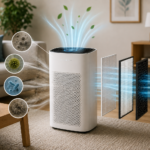
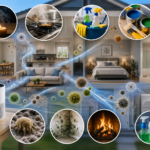
HEPA filters effectively capture solid airborne particles: dust, pollen, mold spores, dust mite debris, pet dander, bacteria, and some virus-carrying droplets, all trapped through physical mechanical filtration as air passes through the dense filter media. What HEPA filters cannot address on their own are gases, odors, and volatile organic compounds, since these require an entirely different filtration approach, typically activated carbon or another sorbent material, working alongside the HEPA layer rather than replacing it.
Maintenance and Replacement: HEPA Filters Aren’t Set-and-Forget
Even a genuine, correctly certified True HEPA filter loses effectiveness over time without proper replacement, and skipping this maintenance undermines the entire investment.
All air cleaning devices, HEPA-equipped or otherwise, require periodic cleaning and filter replacement to continue functioning as intended, and manufacturer-recommended replacement schedules should be followed rather than extended indefinitely to save money. A HEPA filter that’s become saturated with trapped particles doesn’t just lose efficiency, it can also begin restricting airflow significantly, forcing the unit’s fan to work harder while delivering less actual clean air output than a fresh filter would provide.
Practical Buying Advice
A few specific strategies help you shop for HEPA filtration confidently, whether you’re buying an air purifier, vacuum, or furnace filter.
- Look specifically for “True HEPA” or an explicit H13 grade on packaging: Vaguer terms like “HEPA-type” or “HEPA-style” are marketing language without a standardized performance guarantee behind them.
- Match filter type to the actual device: True HEPA belongs in dedicated portable air purifiers and vacuums built to accommodate its airflow resistance, while a quality MERV 13 filter is the more practical, system-appropriate choice for your existing home HVAC system.
- Skip H14 medical-grade unless you have a specific need: For typical residential use, H13 True HEPA delivers the practical sweet spot of performance without the added cost of medical-grade filtration that most households genuinely don’t need.
- Pair HEPA with activated carbon if odors are a concern: Since HEPA only addresses particles, not gases or smells, a combination filter or separate carbon stage is worth adding if odor control matters to you.
- Budget for regular filter replacement: Factor ongoing replacement filter costs into your purchase decision from the start, since neglecting this maintenance undermines even a genuinely high-quality True HEPA system over time.
Check for “True HEPA,” Not Just the Word “HEPA”
Understanding HEPA filtration comes down to one core fact: the word “HEPA” alone guarantees nothing, since only filters explicitly labeled “True HEPA” or rated at the H13 grade actually meet the DOE’s 99.97 percent standard at the genuinely difficult 0.3-micron particle size. For your furnace and whole-home HVAC system, a quality MERV 13 filter remains the more practical choice given true HEPA’s airflow demands, while a dedicated True HEPA portable air purifier delivers genuinely higher-tier filtration exactly where you spend the most time. Whichever combination you choose, verify the specific grade on the packaging rather than trusting the word “HEPA” alone, and commit to regular filter replacement to keep that performance genuinely intact over time.
Frequently Asked Questions
1- What does HEPA actually stand for?
HEPA stands for High Efficiency Particulate Air, officially defined by the U.S. Department of Energy as a filter capable of removing at least 99.97 percent of particles at 0.3 microns.
2- What’s the difference between True HEPA and HEPA-type filters?
True HEPA meets the strict DOE 99.97 percent efficiency standard at H13 grade, while “HEPA-type” or “HEPA-style” filters are unregulated marketing terms that don’t guarantee the same tested performance.
3- Can I put a true HEPA filter in my home’s furnace?
Generally not without modification, since most standard residential HVAC systems can’t generate enough airflow to handle true HEPA’s dense filter media without added strain; a quality MERV 13 filter is usually the more practical choice for whole-home systems.
4- Is a higher HEPA grade always better for home use?
Not necessarily; H13 True HEPA represents the practical sweet spot for residential use, while H14 medical-grade filtration costs more but offers only marginal additional benefit for typical households.
5- Do HEPA filters remove odors and gases?
No, HEPA filtration only captures solid particles through mechanical filtration; removing odors and gases requires a separate activated carbon or sorbent filtration stage working alongside it.
6- How is a MERV rating different from a HEPA rating?
MERV tests filter performance across multiple particle sizes on a 1-to-16 scale for typical residential and commercial filters, while HEPA testing specifically targets the hardest-to-catch 0.3-micron particle size at a much stricter 99.97 percent efficiency threshold.