
Kitchen appliances run more than almost anything else in your home, refrigerators cycle on and off around the clock, dishwashers and ovens see daily use, and even small appliances add up across a busy household. Choosing genuinely energy efficient kitchen appliances can meaningfully lower your utility bills over the life of each appliance, but knowing what to actually look for takes more than spotting a blue label on the shelf.
This guide walks through how energy efficiency ratings work, what’s changed with the ENERGY STAR program recently, and practical, appliance-by-appliance advice for choosing lower-energy options without sacrificing performance.
Understanding ENERGY STAR: What It Is and What Recently Changed
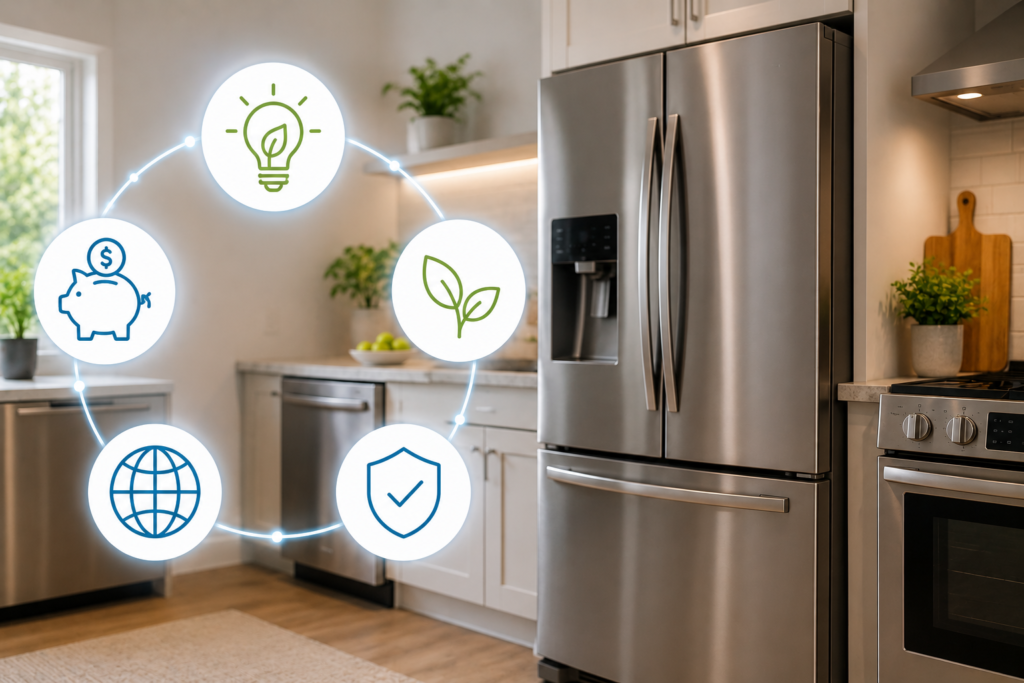
ENERGY STAR is a voluntary certification program that identifies products meeting energy efficiency standards that exceed the federal minimums required by law. A manufacturer submits a product for third-party testing, and if it meets the program’s efficiency thresholds, it earns the ENERGY STAR label.
1- A Recent Change Worth Knowing About
As of March 2026, primary management of the ENERGY STAR program shifted from the Environmental Protection Agency (EPA) to the Department of Energy (DOE), following a formal agreement between the two agencies. This followed a period of uncertainty in 2025, when the EPA had drafted plans to eliminate the program entirely as part of a broader agency reorganization. Congress subsequently allocated funding for the program through 2026, and the program remains active, now under DOE’s lead management, with a transition plan being finalized between the two agencies.
For everyday shoppers, this means ENERGY STAR labels and product certifications remain valid and meaningful, though it’s worth verifying current certification status directly through the official ENERGY STAR product finder, since oversight responsibilities are actively transitioning.
2- A Tax Credit Change to Be Aware Of
If you were counting on a federal tax credit for energy-efficient appliance purchases, note that the Section 25C Energy Efficient Home Improvement Credit, which previously covered certain ENERGY STAR certified products, was terminated by legislation signed in July 2025 and does not apply to equipment installed in 2026. However, many utility companies still offer their own rebates, often in the $50 to $200 range for ENERGY STAR certified refrigerators, along with recycling programs that pay to remove old, inefficient appliances. It’s worth checking your specific utility provider’s current rebate offerings before assuming federal incentives apply.
3- How to Verify a Product Is Actually ENERGY STAR Certified
Don’t rely solely on in-store tags or product descriptions, since certification status is tracked by specific model number, not simply by brand. The most reliable way to confirm current certification is searching the official ENERGY STAR product finder using the exact model number before purchasing, particularly important if you’re hoping to qualify for a utility rebate program that validates claims against the same database.
4- Refrigerators: What Actually Affects Energy Use
Refrigerators run continuously, making them one of the highest cumulative energy users in any kitchen, and small efficiency differences add up considerably over a decade or more of use.
- Size and Configuration
Larger refrigerators generally use more energy than smaller ones, though very old or poorly insulated smaller units can sometimes be less efficient than a modern, well-insulated larger model. Top-freezer configurations tend to be somewhat more energy-efficient than side-by-side or French door models, largely due to simpler mechanical design and fewer added features like ice makers.
- Added Features
Built-in ice makers and water dispensers slightly increase overall energy use, since they add components that require additional power to operate.
- Age Matters More Than You’d Think
A refrigerator manufactured a decade or more ago can use meaningfully more energy than a comparable modern model, even without an ENERGY STAR label, simply due to improvements in insulation and compressor technology over time.
5- Dishwashers: Efficiency Factors to Compare
Water and Energy Use Together
Dishwasher efficiency ratings typically account for both water and energy consumption together, since heating water represents a significant portion of a dishwasher’s total energy use.
Load Sensors and Soil Sensors
Many modern dishwashers include sensors that detect how dirty dishes are and adjust water use and cycle length accordingly, avoiding unnecessary energy use on lightly soiled loads.
Air-Dry Options
Choosing an air-dry setting instead of heated drying can meaningfully reduce a dishwasher’s per-cycle energy use, since heated drying is one of the more energy-intensive parts of a standard cycle.
6- Ovens and Ranges: Gas vs Electric vs Induction
- Gas Ranges
Gas cooktops heat quickly and offer precise, visible flame control, though gas ovens themselves are generally somewhat less energy-efficient than electric ovens for baking specifically, due to how heat is distributed.
- Standard Electric Ranges
Electric ovens tend to maintain more consistent, evenly distributed heat than gas ovens, which can translate to somewhat better baking efficiency, though electric resistance cooktops heat more slowly than gas or induction alternatives.
- Induction Cooktops
Induction technology heats cookware directly through electromagnetic energy rather than heating the cooktop surface itself, making it one of the most energy-efficient cooking methods available, since less heat is lost to the surrounding air during cooking.
7- Small Appliances: Where Efficiency Still Matters
While individual small appliances use less energy than major appliances like refrigerators, cumulative daily use across a household adds up, and a few principles apply broadly.
- Right-size your appliances to your actual needs, since an oversized appliance running for a small task wastes energy unnecessarily
- Choose multi-function appliances where practical, since consolidating functions into fewer, well-used appliances reduces overall standby and operational energy use
- Look for auto shutoff features, which prevent appliances from running or drawing standby power longer than necessary
- Consider cooking method efficiency, since appliances like air fryers, pressure cookers, and toaster ovens generally use less energy than heating a full-size oven for smaller cooking tasks
Comparing Efficiency Across Appliance Types
| Appliance | Key Efficiency Factors | What to Look For |
| Refrigerator | Size, age, added features (ice/water) | ENERGY STAR certification, appropriate capacity for household size |
| Dishwasher | Water and energy use combined, sensors | Soil sensors, air-dry option, ENERGY STAR certification |
| Oven/Range | Fuel type, heat distribution | Induction for cooktops; electric convection for more even oven heat |
| Small appliances | Standby power, task-appropriate sizing | Auto shutoff, multi-function design, right-sized capacity |
Practical Buying Tips for Energy-Efficient Shopping

A handful of practical habits help you shop more effectively for genuinely efficient appliances:
- Always verify current ENERGY STAR certification by exact model number using the official product finder, rather than trusting store signage alone
- Compare the EnergyGuide label’s estimated annual operating cost across similar models, not just the sticker price
- Check with your local utility provider for current rebate programs, since these vary by region and change periodically
- Consider total cost of ownership, purchase price plus estimated energy costs over the appliance’s expected lifespan, rather than upfront price alone
- Recognize that DOE minimum efficiency standards apply to all appliances sold in the U.S., while ENERGY STAR certification indicates performance meaningfully above that baseline
Understanding the Three Layers of Appliance Efficiency Standards
It helps to understand that appliance efficiency in the U.S. operates on three distinct layers:
- DOE minimum standards are the regulatory floor, every appliance sold legally in the U.S. must meet these baseline requirements, covering everything from refrigerators to water heaters.
- EnergyGuide labels are informational, required on most major appliances, showing estimated annual energy use and operating cost to help you compare models directly, regardless of ENERGY STAR status.
- ENERGY STAR certification is voluntary and signifies a product exceeds the DOE minimum standards by a meaningful margin, verified through accredited third-party testing.
A product carrying all three, DOE compliance, an EnergyGuide label, and ENERGY STAR certification, indicates it’s not just legally compliant but genuinely above-average in efficiency and, in most cases, more cost-effective over its lifespan.
Common Mistakes to Avoid
- Trusting store tags without verification, since certification status is tied to specific model numbers and can be misapplied or outdated on physical signage
- Focusing only on upfront price, ignoring the estimated long-term energy costs shown on the EnergyGuide label
- Assuming all ENERGY STAR products save the same amount, when actual savings vary considerably by appliance category and usage patterns
- Overlooking appliance size relative to actual needs, since an oversized refrigerator or dishwasher wastes energy regardless of its efficiency rating
- Missing current rebate opportunities, particularly at the utility level, since federal tax credit programs for ENERGY STAR products have changed recently
Conclusion
Choosing genuinely energy efficient kitchen appliances comes down to looking past the label alone, verifying current certification, comparing EnergyGuide operating costs, and matching appliance size to your actual household needs. With ENERGY STAR now transitioning to Department of Energy management and federal tax credit programs having changed recently, it’s worth double-checking current certification status and available utility rebates directly rather than relying on outdated assumptions. Prioritize appliances that are appropriately sized, genuinely multi-functional where practical, and verified through the official product finder, and you’ll make choices that lower both your energy use and your long-term costs.
Frequently Asked Questions
1- Is the ENERGY STAR program still active in 2026?
Yes. As of March 2026, the program’s primary management shifted from the EPA to the Department of Energy following a formal interagency agreement, but the program itself remains active and funded, and certified products continue to carry meaningful efficiency guarantees.
2- Are there still federal tax credits for ENERGY STAR appliances?
The Section 25C Energy Efficient Home Improvement Credit, which previously covered certain ENERGY STAR certified products, was terminated by legislation signed in July 2025 and doesn’t apply to equipment installed in 2026. Some utility-level rebates remain available separately.
3- How much can I actually save with energy-efficient appliances?
This varies significantly by appliance type, model, and household usage patterns, but the EnergyGuide label on each specific product provides an estimated annual operating cost you can use to compare options directly.
4- Is induction cooking actually more energy-efficient than gas or electric?
Yes, generally. Induction cooktops heat cookware directly through electromagnetic energy, losing less heat to the surrounding air compared to gas flames or traditional electric coil heating.
5- How do I check if a specific appliance model is ENERGY STAR certified?
Search the official ENERGY STAR product finder using the exact model number, since certification is tracked model by model rather than by brand or general product category.
6- Do smaller appliances need to be ENERGY STAR certified to be efficient?
Not necessarily. Many small appliances aren’t covered by ENERGY STAR certification at all, but choosing right-sized, multi-function appliances with auto shutoff features generally supports lower overall energy use regardless of formal certification.
7- Are older appliances always less efficient than new ones?
In most cases, yes, particularly for refrigerators and dishwashers, where insulation, compressor, and sensor technology have improved considerably over the past decade or more, even among non-ENERGY STAR-certified current models.