
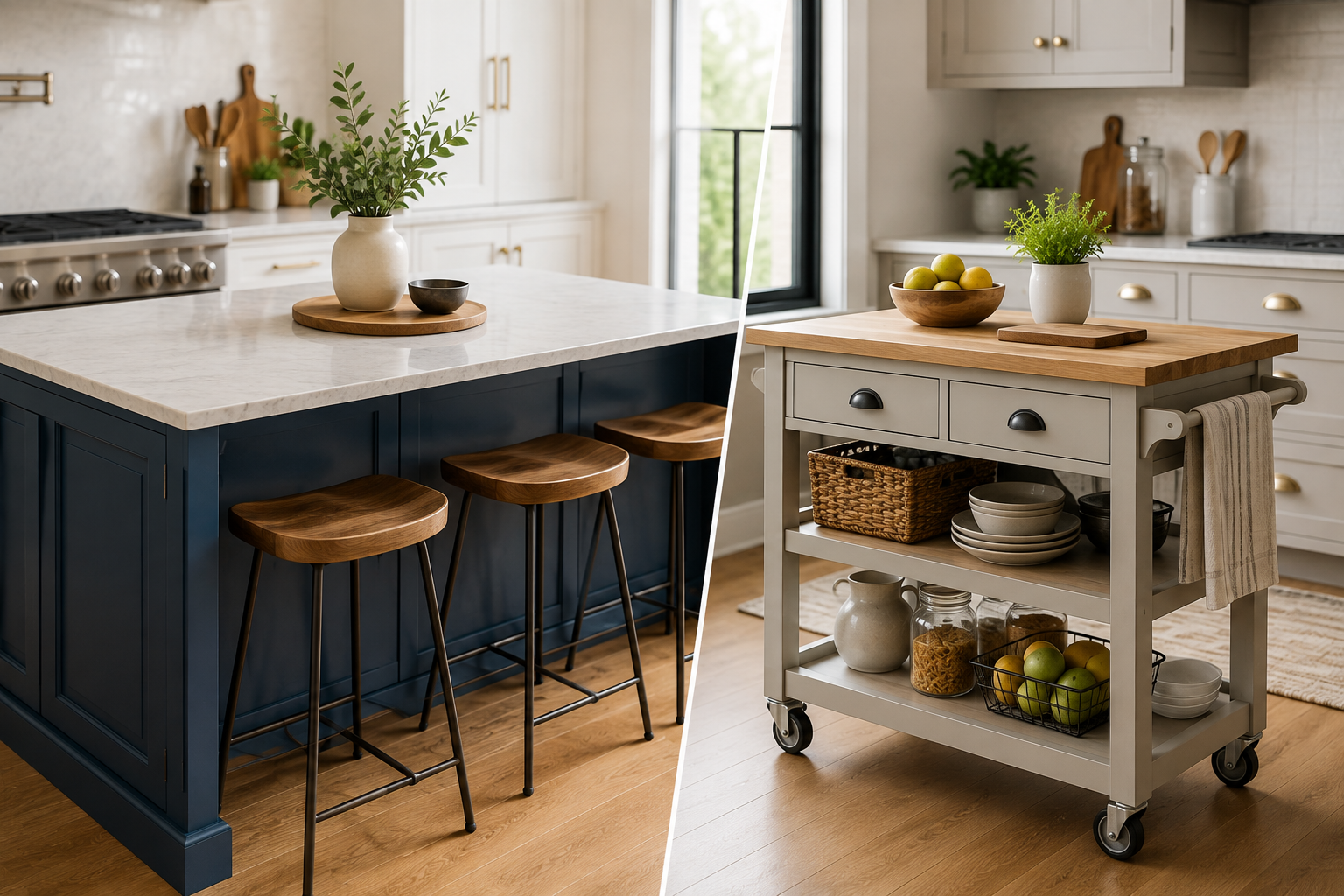
If you’re trying to add more workspace or storage to your kitchen, you’ve likely come across two very different solutions: a kitchen cart or a kitchen island. They solve similar problems: extra counter space, more storage, a place to prep food, but they work in genuinely different ways.
Choosing between them isn’t just about budget, though cost certainly plays a role. It comes down to how your kitchen is laid out, how permanent you want the solution to be, and whether your household needs seating, storage, or simply a bit more elbow room while cooking.
This guide breaks down the real differences in the kitchen island vs kitchen cart decision, covering mobility, storage, cost, materials, and which option suits which type of kitchen. By the end, you’ll know exactly which one fits your space and your budget, and whether one, both, or neither is the right call for your home.
What Is a Kitchen Island?
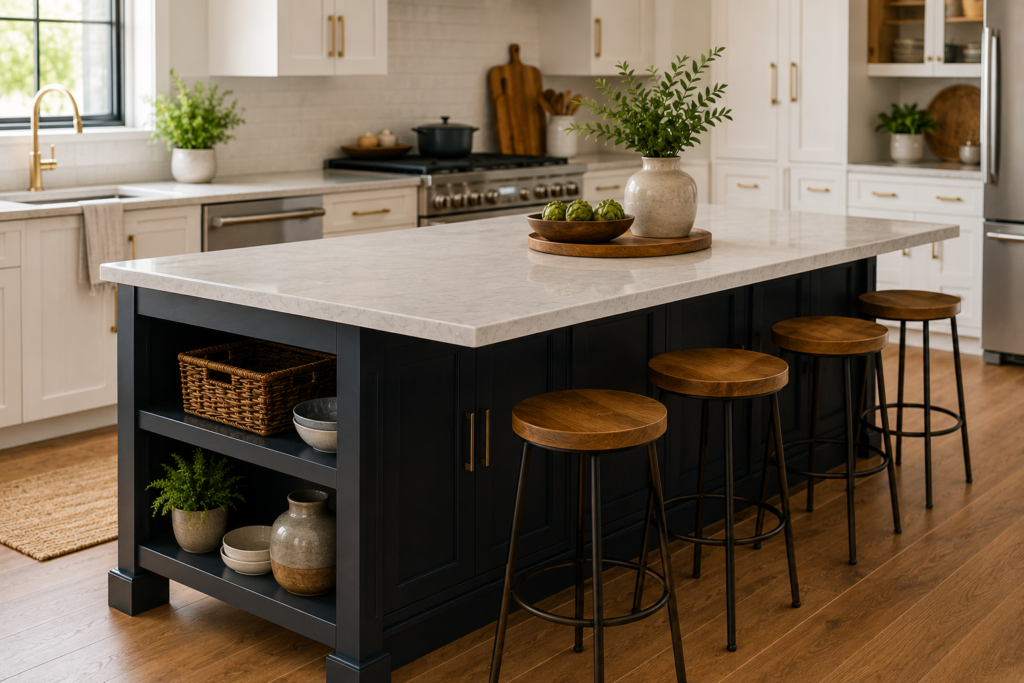
A kitchen island is a standalone or built-in unit that sits in the open floor space of a kitchen, typically offering a mix of countertop space, storage, and sometimes seating. Islands range from simple freestanding units to fully custom, plumbed-in fixtures with a sink or cooktop built in.
Most islands are designed to stay in one place permanently, becoming a core part of the kitchen’s layout rather than a piece of furniture you move around. In many homes, the island effectively becomes the kitchen’s centerpiece, anchoring everything from meal prep to casual dining to conversation while cooking.
Islands typically range from about 40 inches up to 8 feet or more in length, depending on the size of the kitchen and how much function is built into the design. Larger islands often combine several roles at once: workspace, storage, seating, and sometimes even a secondary sink or cooktop.
What Is a Kitchen Cart?
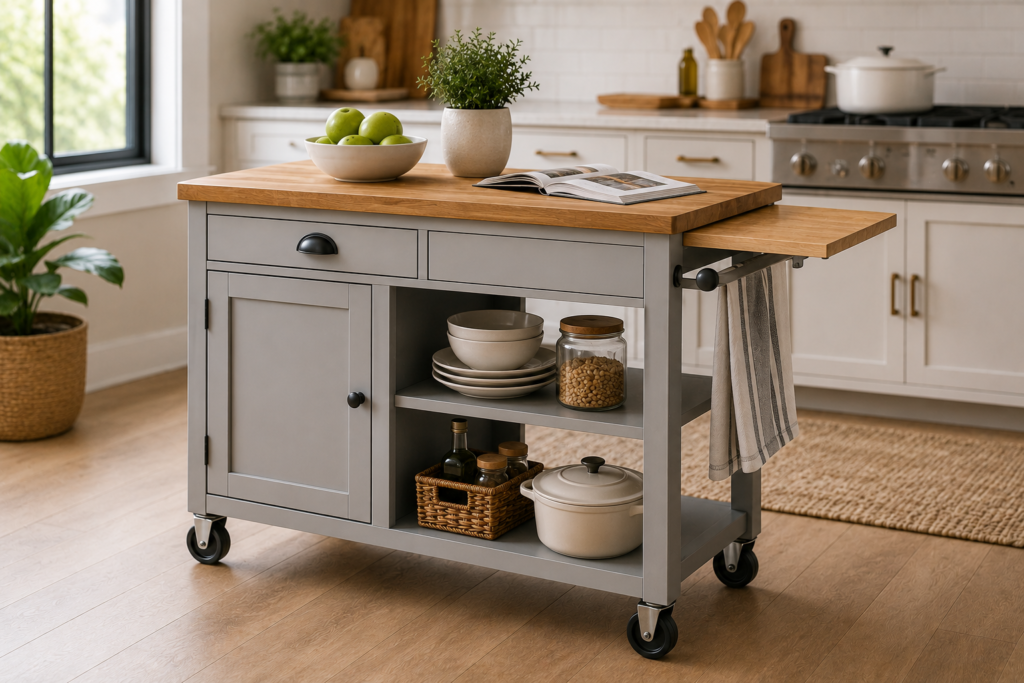
A portable kitchen island, more accurately called a kitchen cart, is a smaller, freestanding unit typically built on wheels. Kitchen carts usually include a countertop, some combination of shelving or drawers, and are designed to be moved easily whenever needed.
Unlike a fixed island, a rolling kitchen cart can be pushed against a wall when not in use, wheeled next to the stove for extra prep space, or repositioned entirely as your kitchen’s needs change. Many carts also fold down, extend, or include drop-leaf sides, adding even more flexibility for households that need extra surface area only occasionally.
Kitchen carts are generally compact, often between 24 and 40 inches wide, making them a practical option for kitchens where a full island simply wouldn’t fit.
Kitchen Cart vs Kitchen Island: Key Differences
| Feature | Kitchen Island | Kitchen Cart |
| Mobility | Fixed in place | Movable, usually on wheels |
| Size | Larger, more substantial | Smaller, more compact |
| Cost | Higher, especially with plumbing | Generally more affordable |
| Installation | May require professional installation | Ready to use out of the box |
| Storage | Extensive, often includes cabinets and drawers | Moderate, usually shelves or small drawers |
| Seating | Often supports stool seating | Rarely designed for seating |
| Countertop Material | Wide range, including stone and quartz | Usually wood, laminate, or stainless steel |
| Best for | Larger, permanent kitchens | Small kitchens, renters, flexible spaces |
1- Mobility: The Biggest Practical Difference
The most significant difference between these two options is mobility. A movable kitchen island offers flexibility that a fixed island simply can’t match.
If you’re renting, frequently rearrange your kitchen, or aren’t sure exactly where you want extra workspace permanently, a cart lets you experiment without commitment. You can wheel it out of the way entirely when hosting guests, or position it right next to your stovetop when cooking, then push it aside afterward to free up floor space again.
A fixed island, by contrast, commits you to a specific layout. This works well if you’ve carefully planned your kitchen’s traffic flow and know exactly where the extra workspace should live permanently. Once installed, particularly if it involves plumbing or electrical connections, moving it later becomes a significant and costly undertaking.
2- Storage Comparison
Storage capacity is another major differentiator. Fixed islands generally offer significantly more storage, often including full-depth cabinets, drawers, and sometimes built-in appliances or a wine rack.
A kitchen cart with storage typically includes open shelving, a small drawer or two, and sometimes a hanging rail for utensils or towels. Some carts also include a lower shelf for baskets or bins, or a small cabinet section behind a door. This works well for supplementary storage but won’t replace a genuine cabinet shortage the way a full island can.
If your kitchen’s biggest problem is a serious lack of storage, a fixed island with cabinetry will likely serve you better long-term than a cart. But if you just need somewhere to keep a few extra pots, a cutting board, or your everyday spices within reach, a cart’s smaller storage footprint may be more than adequate.
3- Cost Differences
Cost is often the deciding factor for many buyers. Kitchen carts are almost always significantly more affordable than islands, since they require no installation, no plumbing, and use less material overall.
Fixed islands vary enormously in price depending on size, materials, and whether they include plumbing or electrical work. A basic freestanding island costs more than a cart but less than a fully custom, built-in option with a sink or cooktop. Adding features like a built-in wine fridge, a second sink, or premium stone countertops can push a fixed island considerably further into a larger renovation budget.
If budget is your primary concern, a cart offers most of the practical benefit of an island, extra counter space and some storage, at a fraction of the cost. It’s also a lower-risk way to test whether extra workspace genuinely improves your kitchen routine before committing to a larger investment.
4- Materials to Consider
Both islands and carts come in a range of materials, though the options differ somewhat between the two.
Kitchen islands often use the same range of countertop materials found elsewhere in the kitchen, including quartz, granite, butcher block, or laminate, paired with wood, engineered wood, or metal cabinetry underneath.
Kitchen carts most commonly use solid wood or stainless steel tops, both of which hold up well to regular food prep. Stainless steel tops resist stains and are simple to sanitize, making them a popular choice for carts used heavily for food prep. Wood tops bring more warmth but need occasional oiling to stay in good condition, particularly if used as a direct cutting surface.
Which Kitchens Benefit From a Cart?
A kitchen cart tends to make the most sense in specific situations:
- Small kitchens where a full island would block natural movement through the room
- Rental properties where permanent modifications aren’t practical or allowed
- Kitchens with an awkward layout that doesn’t have a clear spot for a fixed island
- Households wanting flexibility to rearrange their kitchen as needs change
- Anyone testing whether they’d actually use an island before committing to a larger purchase
- Occasional bakers or entertainers who need extra surface area only some of the time
Which Kitchens Benefit From a Fixed Island?
A fixed island tends to work better in these situations:
- Larger, open-plan kitchens with enough floor space for a substantial island
- Households wanting built-in seating for casual meals
- Kitchens needing significant extra storage, not just supplementary space
- Anyone planning a full kitchen renovation where a plumbed-in sink or cooktop makes sense
- Buyers wanting a permanent visual anchor for the room’s overall design
- Families who regularly gather in the kitchen and want a natural spot for casual seating
Style and Design Considerations
Both options come in a wide range of styles, though islands generally offer more design flexibility since they’re often custom-built or available in larger, more substantial designs. Carts tend to favor simpler, more utilitarian designs, though many now come in styles that match popular kitchen aesthetics, from farmhouse to modern industrial.
If matching your existing cabinetry matters to you, a fixed island offers more opportunity to coordinate finishes, since it can be built or selected specifically to complement your kitchen’s existing cabinets and countertops. A cart works better as a complementary accent piece rather than a perfect match, and many homeowners deliberately choose a cart with a slightly different finish to add visual contrast rather than blending in seamlessly.
Can You Use Both?
Some kitchens genuinely benefit from having both a fixed island and a supplementary cart. In this setup, the island handles the primary workspace, storage, and often seating, while the cart provides flexible, movable extra space for specific tasks like baking, entertaining, or overflow storage during holidays.
This combination works particularly well in larger kitchens with enough floor space to accommodate both without crowding the room. A cart can also serve as a serving station during gatherings, wheeled into the dining room temporarily, then returned to the kitchen afterward.
Maintenance Considerations
Maintenance needs differ slightly between the two options as well. A fixed island, particularly one with a stone countertop, may require periodic sealing depending on the material, along with standard cabinet care. A kitchen cart, especially one with a stainless steel or laminate top, tends to need only regular wiping down, with wheels occasionally checked to make sure they still roll smoothly.
Because carts are lighter and easier to move entirely, they’re also simpler to clean underneath and around, something that can be more difficult with a large, fixed island permanently anchored to the floor.
Making the Right Choice for Your Kitchen
To decide between the two, ask yourself a few honest questions:
- Do I have enough consistent floor space for a permanent, fixed island?
- Is my budget better suited to a smaller, more affordable purchase?
- Do I need built-in seating, or is extra counter space enough?
- Am I renting, or might I move within the next few years?
- Do I want the flexibility to reposition or remove the piece entirely?
- Would my kitchen benefit from both, used for different purposes?
If you answered yes to needing flexibility, a smaller budget, or uncertain long-term plans, a cart is likely the better fit. If you have the space, budget, and a clear, permanent layout in mind, a fixed island will likely serve you better long-term.
Conclusion
The right choice between a kitchen island vs kitchen cart really comes down to your kitchen’s size, your budget, and how permanent you want the solution to be. A cart offers flexibility, affordability, and an easy way to add workspace without commitment, making it a smart starting point for smaller kitchens or anyone still figuring out their needs. A fixed island delivers more storage, seating, and long-term function, provided your kitchen has the space to support it. Whichever you choose, matching the decision to your actual daily habits, not just what looks best in photos, will give you a kitchen that genuinely works better for you.
Frequently Asked Questions
1- Is a kitchen cart as useful as a kitchen island?
For smaller kitchens or supplementary storage needs, yes. For households needing significant storage, seating, or a permanent workspace, a fixed island generally offers more overall function.
2- Can a kitchen cart replace a kitchen island entirely?
In smaller kitchens or for renters, a cart can serve as a practical substitute, though it won’t match the storage capacity or seating options of a full island.
3- Are kitchen carts sturdy enough for food prep?
Most quality kitchen carts include a solid countertop surface, such as stainless steel or solid wood, suitable for regular food prep, though heavier-duty tasks like chopping should still be done on a proper cutting board.
4- Do kitchen islands always need to be permanent?
No. Freestanding islands exist that aren’t bolted down or plumbed in, offering some of an island’s benefits without a fully permanent installation.
5- Which is more affordable, a kitchen cart or a kitchen island?
A kitchen cart is almost always more affordable, since it requires no installation and uses considerably less material than a full island.
6- Can a kitchen cart fit through a standard doorway?
Yes, in most cases. Since carts are compact and often assembled on-site, they’re generally easier to move through doorways and hallways than a large, pre-built island.
7- Do kitchen carts come with electrical outlets?
Some higher-end models include a built-in outlet or power strip, though this is far less common than in fixed islands, which can be wired directly during installation.