If you’ve noticed incandescent bulbs quietly disappearing from store shelves over the past couple of years, you’re not imagining it; federal efficiency regulations have genuinely reshaped what’s available to buy. Understanding LED vs CFL vs incandescent light bulbs means knowing not just which one performs better, but why the market has shifted so dramatically, and which option genuinely makes sense for your home now that the old default choice is largely gone.
This guide breaks down exactly how these three bulb technologies compare on efficiency, lifespan, cost, and safety, plus the real regulatory story behind why incandescent bulbs became so hard to find and why CFLs may be next.
LED vs CFL vs Incandescent
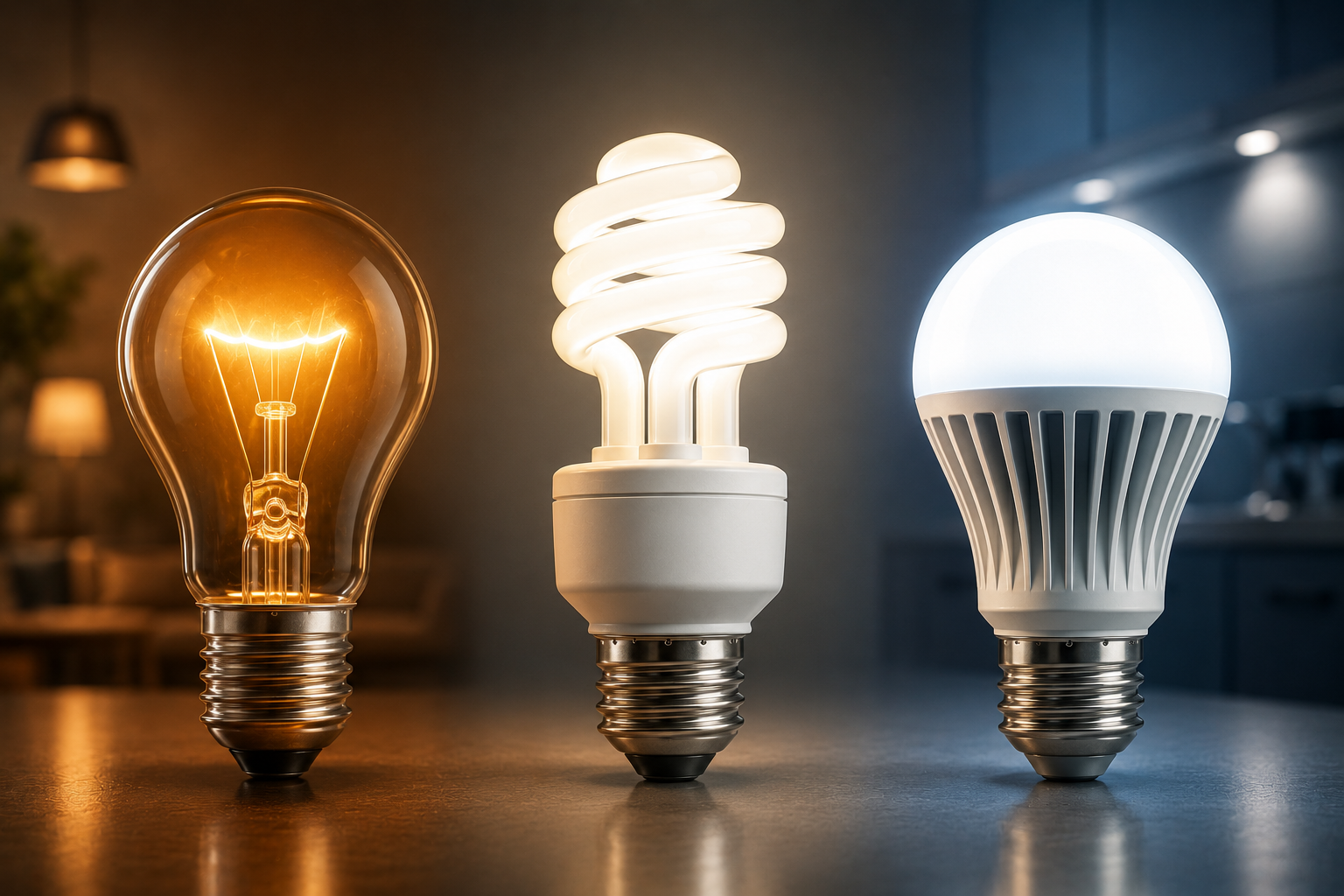
LED is the clear overall winner across nearly every meaningful category, using the least energy, lasting the longest (typically 25,000 to 35,000 hours), running cool to the touch, and containing no toxic materials. CFLs sit in the middle, more efficient than incandescent bulbs but falling well short of LED performance, and they contain mercury, meaning they require careful disposal rather than simply tossing them in regular household trash. Incandescent bulbs, once the default in nearly every American home, are now largely unavailable for general use, current federal efficiency standards require a minimum output most incandescent and halogen bulbs simply can’t meet, which is why LEDs have become the practical default choice for nearly every fixture in a modern home.
How Each Bulb Technology Actually Works
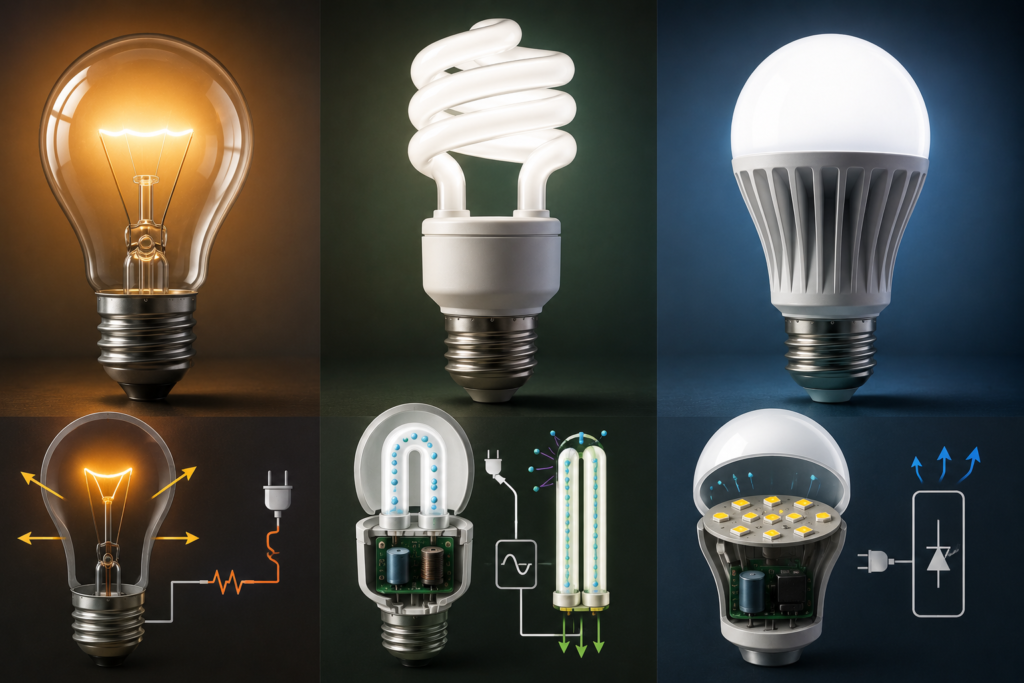
Incandescent: The Original, Now Largely Phased Out
Incandescent bulbs produce light by heating a thin tungsten filament until it glows, a simple, century-old technology that’s genuinely inefficient by modern standards, roughly 90 percent of the energy an incandescent bulb consumes is released as heat rather than usable light.
CFL: The Middle-Generation Compromise
Compact fluorescent lamps (CFLs) generate light by passing an electric current through a tube containing argon gas and a small amount of mercury vapor, producing ultraviolet light that a phosphor coating inside the tube converts into visible light. CFLs represented a genuine efficiency improvement over incandescent bulbs when they became widely available, though they’ve since been surpassed by LED technology on nearly every meaningful measure.
LED: The Current Standard
Light-emitting diodes (LEDs) produce light through a semiconductor process that generates minimal heat as a byproduct, making them dramatically more energy-efficient than either incandescent or CFL technology. This is the same core technology that’s become the practical default across nearly the entire consumer lighting market.
LED vs CFL vs Incandescent: Full Comparison
| Factor | Incandescent | CFL | LED |
| Typical lifespan | 1,000–1,500 hours | 8,000–10,000 hours | 25,000–35,000 hours |
| Energy efficiency | Lowest (about 10% light, 90% heat) | Moderate | Highest |
| Heat output | High | Moderate | Low, cool to the touch |
| Contains mercury | No | Yes | No |
| Instant-on | Yes | Sometimes delayed | Yes |
| Dimmable | Yes, universally | Limited, check compatibility | Widely available, check compatibility |
| Current availability | Largely phased out for general use | Being phased out at state and federal level | Widely available, market standard |
| Upfront cost | Lowest | Low to moderate | Moderate (declining steadily) |
Why Incandescent Bulbs Largely Disappeared
The Regulatory Timeline
The shift away from incandescent bulbs traces back to the Energy Independence and Security Act of 2007, which set the framework for phasing out inefficient general service lighting over time. The first tier of restrictions, phasing out standard 60-watt incandescent bulbs, took effect between 2012 and 2014. A more significant federal rule change followed in 2022, establishing a minimum efficiency standard of 45 lumens per watt for general service lamps, enforced starting in 2023.
Why This Standard Effectively Ended Incandescent Bulbs
Standard incandescent and halogen bulbs simply cannot meet a 45-lumens-per-watt output requirement given how much of their energy is lost as heat rather than usable light, which is why they’ve largely disappeared from general retail shelves, with some exceptions for specialty and appliance-specific bulbs not covered by the general service lamp definition.
Why CFLs Passed This Round, but May Not Pass the Next
CFLs generally produce somewhere between 50 and 70 lumens per watt, comfortably clearing the current 45-lumens-per-watt threshold. However, a stricter federal standard requiring 120 lumens per watt is set to take effect around 2028, a bar that LEDs meet comfortably but most CFL technology cannot, meaning CFLs are expected to face their own federal phase-out in the coming years.
The Mercury Problem: Why CFL Disposal Matters
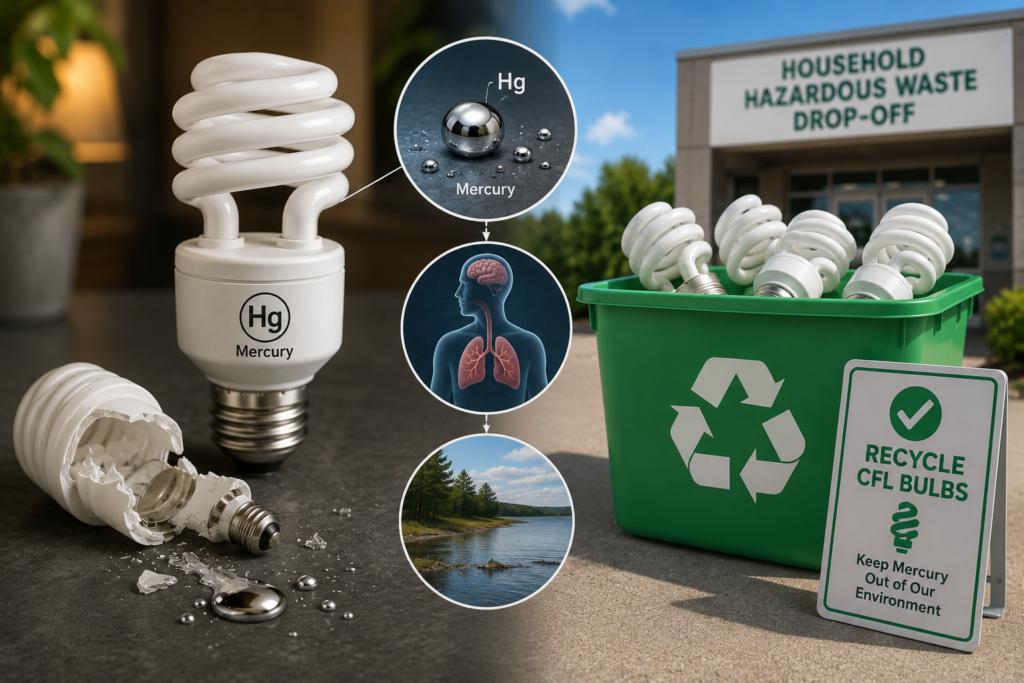
What’s Actually Inside a CFL
CFLs contain a small amount of mercury vapor as part of how they generate light, and mercury is a recognized neurotoxicant, a substance capable of harming the nervous system, making proper disposal a genuine safety and environmental consideration rather than an optional precaution.
Why This Is Driving State-Level Bans
Beyond the federal efficiency timeline, several states have moved to restrict or ban CFL sales specifically because of their mercury content, treating it as an environmental and public health concern independent of the broader efficiency regulations. This trend has continued to expand as more states adopt similar restrictions.
How to Dispose of CFLs Properly
Never throw CFL bulbs directly into regular household trash. Many hardware stores and home improvement retailers offer free CFL recycling drop-off programs, and some municipal waste programs include designated household hazardous waste collection specifically for mercury-containing products like CFLs and fluorescent tubes.
Lifespan and Long-Term Value
The Real Difference Over Time
LED bulbs typically last two to four times longer than a comparable CFL, and 25 to 35 times longer than a standard incandescent bulb, meaning a single LED can realistically outlast dozens of incandescent bulb replacements over its usable lifespan.
Why This Matters Beyond Just Convenience
Replacing far fewer bulbs over time means less recurring cost, less packaging waste, and considerably less hassle changing bulbs in hard-to-reach fixtures like stairwell ceilings or vaulted living rooms, a genuinely practical advantage beyond the direct energy savings alone.
Energy Efficiency and What It Actually Means for Your Bill
Comparing Equivalent Brightness
A 16.5-watt LED bulb can produce roughly the same brightness as a 20-watt CFL and a 75-watt incandescent bulb, illustrating just how much less energy LED technology requires to deliver the same amount of usable light.
The Cumulative Impact
Because LEDs use meaningfully less electricity per bulb and last so much longer before replacement, the cumulative energy savings across an entire home’s lighting adds up considerably over the years, a genuine, ongoing reduction in your electricity bill rather than a one-time saving.
Heat Output: A Genuinely Overlooked Difference
Why This Matters More Than People Expect
Incandescent bulbs release most of their consumed energy as heat, which means they contribute meaningfully to a room’s ambient temperature, particularly noticeable in smaller, enclosed fixtures or during warmer months when your air conditioning has to work harder to compensate. LEDs, by contrast, run cool to the touch, reducing this unwanted heat contribution and, in aggregate across a whole home, potentially easing your cooling system’s workload during hot weather.
Dimmer Compatibility: A Detail Worth Checking Before You Buy
Incandescent’s Universal Compatibility
Incandescent bulbs work with virtually any standard dimmer switch without issue, since dimmers were originally engineered specifically around incandescent bulb electrical characteristics.
Why CFLs and LEDs Need Compatible Dimmers
Not every CFL is dimmable, and many that claim to be offer a limited dimming range compared to incandescent bulbs. LED bulbs similarly require confirmation that both the bulb and your existing dimmer switch are explicitly compatible with each other, since older dimmers designed for incandescent bulbs can cause flickering or buzzing when paired with an LED. If your fixture is on a dimmer, always check compatibility labeling on both the bulb and the switch before purchasing.
Cost Comparison: Upfront vs Long-Term
Why Upfront Price Alone Is Misleading
Incandescent bulbs remain the cheapest to purchase individually, but this upfront savings is misleading once you account for how frequently they need replacing and how much more electricity they consume during their much shorter lifespan.
The Real Long-Term Winner
LED bulbs, despite a higher upfront cost per bulb, deliver the strongest overall value once you factor in dramatically lower energy consumption and a lifespan that can stretch to tens of thousands of hours, meaning far fewer replacement purchases over the same period of use.
Which Bulb Should You Actually Choose Now?
For Nearly Every Standard Fixture
LED is the practical default choice today, both because it delivers the strongest overall performance and because it’s increasingly the primary option genuinely available on store shelves for standard residential fixtures.
If You Still Have CFLs Installed
There’s no urgent need to replace still-functioning CFLs purely for the sake of switching, but as they eventually burn out, replacing them with LED equivalents makes sense given the ongoing regulatory phase-out CFL technology is facing and LED’s clear performance advantages.
For Specialty or Appliance-Specific Fixtures
Certain specialty bulb types, appliance bulbs, some decorative or vintage-style fixtures, may fall outside the general service lamp regulations and remain available in incandescent form, worth checking the specific product category if you’re shopping for one of these niche applications.
Practical Buying Tips
- Choose LED as your default for any standard household fixture, given its combination of efficiency, longevity, and now widespread availability
- Confirm dimmer compatibility explicitly before purchasing LED or CFL bulbs for any fixture on a dimmer switch
- Never dispose of CFL bulbs in regular household trash, use a hardware store recycling program or your local household hazardous waste collection instead
- Don’t rush to replace still-functioning CFLs purely out of urgency, but plan to switch to LED as they naturally reach end of life
- Check specialty or appliance-bulb sections specifically if you need an incandescent-style bulb for a niche application, since general service restrictions don’t cover every bulb category
Common Mistakes to Avoid
- Throwing CFL bulbs directly into household trash, risking mercury contamination when proper recycling options are widely available
- Assuming all incandescent bulbs are entirely banned, when specialty and appliance-specific bulbs may still be available outside general service lamp regulations
- Using a CFL or LED bulb on an incompatible dimmer switch, risking flickering, buzzing, or reduced dimming range
- Comparing bulb types by upfront price alone, missing the considerably stronger long-term value LED delivers through energy savings and extended lifespan
- Continuing to stockpile CFLs, when their federal phase-out is approaching and LED remains the more future-proof choice
Conslusion
The LED vs CFL vs incandescent comparison isn’t really a close call anymore, LED technology has become the clear practical standard for nearly every residential fixture, offering dramatically better efficiency, a far longer lifespan, and none of the mercury disposal concerns that come with CFL bulbs. Incandescent bulbs, once the default in every American home, have largely been phased out by federal efficiency standards, and CFLs are likely following a similar path as stricter regulations approach in the coming years. Whether you’re replacing a single burnt-out bulb or planning a full-home lighting update, choosing LED now means you’re buying into the technology that’s genuinely built to last, both in your fixtures and in the regulatory landscape shaping what’s actually available to buy.
Frequently Asked Questions
1- Are incandescent light bulbs actually banned?
Most standard incandescent and halogen bulbs no longer meet current federal efficiency requirements and have largely disappeared from general retail shelves, though specialty and appliance-specific bulbs outside the general service lamp definition may still be available.
2- Why do CFL bulbs need special disposal?
CFLs contain a small amount of mercury, a toxic substance, meaning they shouldn’t go into regular household trash. Hardware stores and household hazardous waste collection programs typically offer proper recycling options.
3- How much longer do LED bulbs last compared to incandescent?
LED bulbs typically last 25 to 35 times longer than a standard incandescent bulb, and two to four times longer than a comparable CFL, meaning significantly fewer replacements over the bulb’s usable life.
4- Will CFL bulbs eventually be banned too?
A stricter federal efficiency standard requiring 120 lumens per watt is expected to take effect around 2028, a bar most CFL technology can’t meet, meaning CFLs are expected to face their own phase-out in the coming years, alongside state-level mercury-related restrictions already in place in several states.
5- Is LED actually more energy efficient than CFL?
Yes, meaningfully. LEDs require less wattage than CFLs to produce equivalent brightness, and they run cool to the touch rather than losing significant energy as heat, making them the more efficient technology overall.
6- Can I still use incandescent bulbs in dimmer fixtures?
Yes, incandescent bulbs work with virtually any standard dimmer without compatibility concerns, though CFL and LED bulbs require confirming explicit dimmer compatibility before use to avoid flickering or limited dimming range.
7- What should I do with old incandescent bulbs I still have?
Standard incandescent bulbs, unlike CFLs, don’t contain mercury and can generally go into regular household trash, though it’s still worth checking your local municipality’s specific disposal guidelines.