Mattress shopping shouldn’t feel like a coin flip, but with memory foam vs hybrid vs innerspring all promising better sleep, it’s easy to end up choosing based on whichever salesperson talked the fastest. The truth is, each construction type genuinely suits a different kind of sleeper, and once you understand how they’re actually built, the right choice becomes a lot more obvious.
This guide breaks down exactly how these three mattress types differ in comfort, cooling, motion isolation, and durability, plus which one fits specific sleep positions and body types, so you can shop with real confidence instead of guessing.
Which Mattress Type Should You Actually Buy?
If pressure relief and blocking a restless partner’s movement matter most, memory foam is your best bet, particularly for side sleepers dealing with hip or shoulder pain. If you want a balanced feel that works for almost any sleep position, sleeps cooler than pure foam, and still isolates motion reasonably well, a hybrid is the safest all-around choice. If you’re shopping on a budget, sleep hot, or simply prefer a firmer, bouncier, more traditional feel, an innerspring mattress remains a genuinely solid, affordable option.
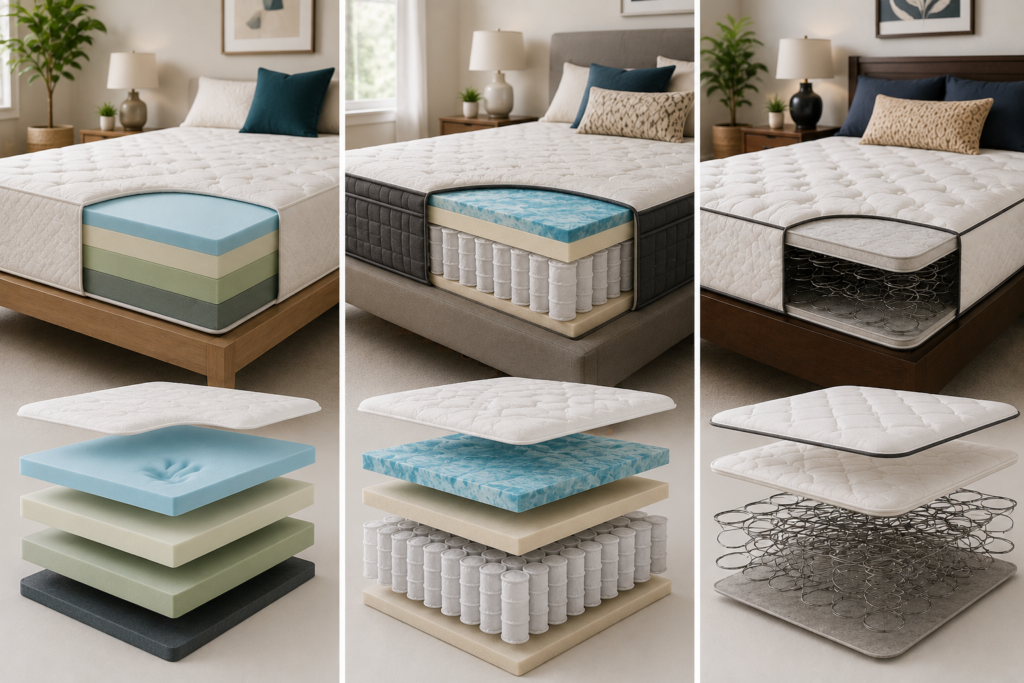
How Each Mattress Type Is Actually Built
Memory Foam: All Foam, All the Way Down
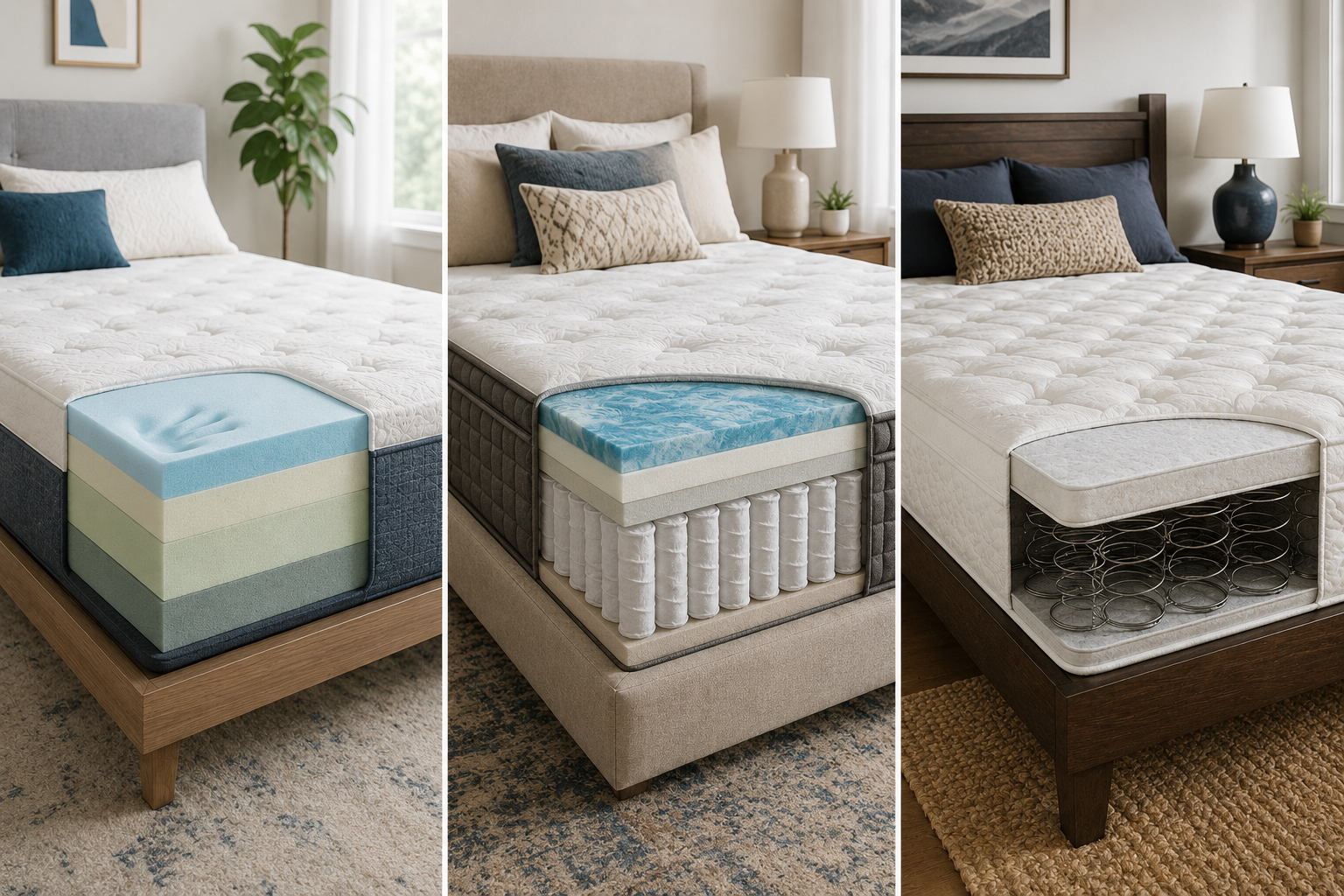
A memory foam mattress is constructed from multiple layers of foam stacked on top of each other, no coils at all. The material is specifically engineered to respond to your body’s heat and pressure, softening and contouring closely around you rather than pushing back the way a spring would.
Innerspring: The Classic Coil-First Design
An innerspring mattress builds its support around a network of steel coils, usually Bonnell (linked, continuous) or pocketed coils, topped with a comparatively thin comfort layer. This is the traditional mattress style most people grew up sleeping on, and it remains popular specifically because of that familiar, bouncy, supportive feel.
Hybrid: The Best-of-Both Combination
Hybrid mattresses pair individually wrapped coils, often 6 to 8 inches deep, with a substantial foam comfort layer on top, frequently gel-infused memory foam, polyfoam, or latex. The coils provide bounce, airflow, and edge support, while the foam layer delivers the body-contouring comfort foam is known for.
Memory Foam vs Hybrid vs Innerspring: Quick Comparison Table
| Feature | Memory Foam | Hybrid | Innerspring |
| Feel | Deep contouring, “in” the bed | Balanced, “on top” of the bed | Firm, bouncy, traditional |
| Motion isolation | Excellent | Good to very good | Weak |
| Cooling | Weakest (unless gel-infused) | Strong (airflow + cooling foam) | Naturally cool |
| Pressure relief | Excellent | Very good | Weakest |
| Edge support | Weak to moderate | Strong | Moderate |
| Typical lifespan | 5–10 years | 10–12 years | 5–8 years |
| Price range | Mid-range | Higher | Most affordable |
| Best sleep position | Side sleepers | Combination sleepers | Back/stomach sleepers |
Comfort and Pressure Relief: Where Memory Foam Wins
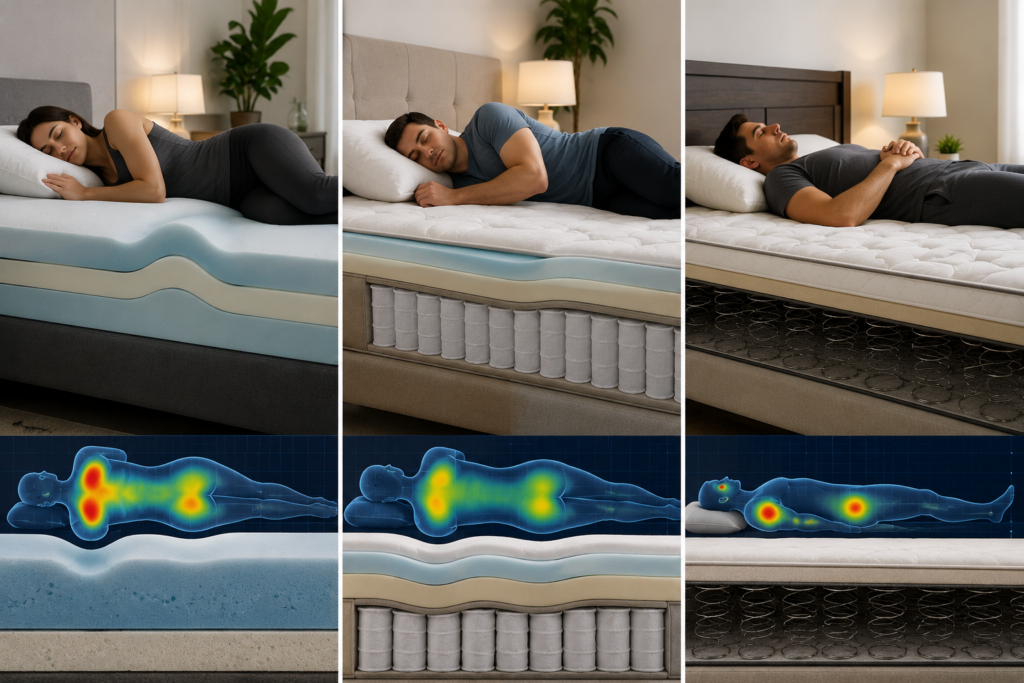
Memory foam’s biggest strength is how closely it molds to your body, cradling shoulders, hips, and joints rather than pushing against them. This makes it especially valuable for side sleepers, whose hips and shoulders bear concentrated pressure against the mattress surface, and for anyone managing ongoing joint or muscle soreness. The trade-off is that classic “sinking in” sensation, which some sleepers find genuinely relaxing, and others find restrictive or overly warm.
Hybrid mattresses offer a noticeably different comfort experience, thanks to the coil layer underneath; you feel more like you’re floating on the surface rather than sinking into it. This buoyant feel still delivers real pressure relief from the foam top layer, just without the fully “swallowed” sensation memory foam creates.
Innerspring mattresses provide the least body-contouring cushioning of the three, since their comfort layer is comparatively thin. Back and stomach sleepers, who need firmer, more even support rather than deep contouring, tend to do best here, particularly at a medium-firm to firm feel.
Cooling and Temperature: Why Hot Sleepers Should Pay Attention
Temperature regulation is one of the biggest differentiators between these three mattress types, and it’s worth taking seriously if you’ve ever woken up overheated in the middle of the night.
- Memory foam has a well-earned reputation for retaining heat, since dense foam naturally traps warmth close to your body. Manufacturers have worked to address this with gel infusions and open-cell foam structures designed to sleep cooler, but even improved memory foam generally runs warmer than the alternatives.
- Innerspring mattresses sleep the coolest of the three almost by default, since the open coil structure allows air to circulate freely beneath you, letting body heat disperse rather than get trapped.
- Hybrid mattresses land in a genuinely strong middle position; the coil layer underneath provides real airflow, while manufacturers frequently add cooling gel or breathable foam on top specifically to offset any heat retention from that comfort layer. For hot sleepers who also want foam’s pressure relief, hybrid is usually the more comfortable long-term compromise.
Motion Isolation: A Genuine Priority for Couples
If you share a bed with a partner who tosses, turns, or gets up during the night, motion isolation deserves serious weight in your decision.
Memory foam absorbs movement remarkably well, its slow-responding material soaks up motion before it ever reaches your side of the bed, making it a strong pick for light sleepers sharing a bed with a restless partner.
Hybrid mattresses also isolate motion effectively, since individually wrapped coils move independently rather than transferring energy across the entire mattress the way older, interconnected coil systems do.
Innerspring mattresses, particularly those using linked Bonnell coils, are the weakest performer here. Movement on one side of the bed can noticeably transfer across the whole surface, a real consideration for couples with different sleep schedules or one partner who moves around a lot. For a deeper breakdown, see our full guide on the best mattress for couples.
Support and Edge Stability
Edge support, how much the mattress sags or feels unstable near the perimeter, matters more than people expect, particularly if you sit on the edge of the bed to get dressed or tend to sleep close to the side.
Hybrid mattresses generally offer the strongest edge support of the three, thanks to their reinforced coil structure extending to the perimeter. Innerspring mattresses also provide reasonably solid edge stability given their coil-based construction. Memory foam tends to be the weakest here, since foam alone doesn’t resist compression at the edges as effectively as a coil system does.
Durability and Lifespan: What to Actually Expect
| Mattress Type | Typical Lifespan | Why |
| Innerspring | 5–8 years | Coils can weaken and sag with repeated use, especially with a consistent sleep position |
| Memory foam | 5–10 years | Foam gradually loses elasticity and contouring ability over time |
| Hybrid | 10–12 years | Combines the durability of coils with a comfort layer that experiences less wear than all-foam construction |
Hybrids generally offer the best long-term durability of the three, which is worth factoring into your overall cost comparison, since a higher upfront price can be offset by several extra years of usable life.
Which Mattress Type Fits Your Sleep Position?
- Side Sleepers
Memory foam is the strongest overall match here, since it cushions the hips and shoulders where side sleepers carry the most pressure. A plush-to-medium hybrid is a solid second choice if you also run warm.
- Back Sleepers
Back sleepers generally do best with a medium-firm to firm feel, whether that’s an innerspring, a firmer hybrid, or a supportive memory foam design, since the priority is keeping the spine aligned rather than deep contouring.
This isn’t just anecdotal preference. A randomized controlled trial published in The Lancet found that people with chronic low-back pain reported significantly better outcomes, less pain and disability, on medium-firm mattresses compared to firm ones. It’s a useful data point when weighing “firm” against “medium-firm” within any of these three mattress types.
- Stomach Sleepers
Similar to back sleepers, stomach sleepers need firmer, more even support to prevent the hips from sinking too deeply, making firmer innerspring or hybrid options generally more appropriate than a plush memory foam bed.
- Combination Sleepers
If you regularly shift between sleep positions throughout the night, a hybrid mattress’s versatility, enough contouring for side sleeping, enough support for back and stomach positions, makes it the most adaptable all-around choice.
Which Mattress Fits Your Body Type and Budget?
- Lighter Individuals
Lighter sleepers generally don’t need as much firm, aggressive support to avoid sinking too deeply, making a softer memory foam or plush hybrid a comfortable, pressure-relieving option.
- Heavier Individuals
Heavier sleepers typically benefit from the stronger, more consistent support a coil-based system, hybrid or innerspring, provides, since these constructions resist excessive sinkage better than foam alone.
- Budget-Conscious Shoppers
Innerspring mattresses remain the most affordable option overall, making them a reasonable choice if budget is your top priority and you don’t have specific pressure-relief or motion-isolation needs driving your decision.
Common Mattress-Buying Mistakes to Avoid
- Choosing based on price alone, without considering whether the construction actually matches your sleep position and body type
- Ignoring temperature needs, ending up with a hot memory foam mattress despite already running warm at night
- Overlooking motion isolation, particularly for couples sharing a bed with different sleep schedules
- Assuming all hybrids perform identically, since coil depth, gauge, and comfort layer material vary considerably by brand
- Not accounting for edge support, especially if you regularly sit or sleep near the perimeter of the bed
Conclusion
There’s no single “best” answer in the memory foam vs hybrid vs innerspring debate, the right mattress depends entirely on how you actually sleep, whether you run hot or cold, and whether you’re sharing a bed with a partner. Memory foam wins on pressure relief and motion isolation, innerspring wins on affordability and natural cooling, and hybrid offers the most balanced, adaptable performance across nearly every category. Match the construction to your sleep position, body type, and temperature preferences rather than price or marketing alone, and you’ll land on a mattress that genuinely earns its place in your bedroom for years to come.
Frequently Asked Questions
1- What is the best mattress type for side sleepers?
Memory foam is generally the strongest choice, since it cushions the hips and shoulders where side sleepers experience the most pressure. A softer hybrid is a good alternative if you also sleep hot.
2- Do hybrid mattresses actually sleep cooler than memory foam?
Yes, generally. The coil layer in a hybrid allows airflow that pure memory foam construction doesn’t have, and hybrids frequently include additional cooling foam or gel infusions to further offset heat.
3- Are innerspring mattresses bad for back pain?
Not necessarily, a medium-firm to firm innerspring can provide solid, even support for back sleepers, though it offers less pressure-point cushioning than foam or hybrid options, which matters more for side sleepers.
4- Which mattress type lasts the longest?
Hybrid mattresses typically offer the longest lifespan, often 10 to 12 years, combining the durability of a coil support system with a comfort layer that experiences less wear than all-foam construction alone.
5- Is memory foam or hybrid better for couples?
Both isolate motion well, memory foam absorbs movement most effectively, while hybrids come close thanks to individually wrapped coils, while also offering a bouncier, cooler feel many couples prefer.
6- Which mattress is the most affordable?
Innerspring mattresses are generally the least expensive of the three, making them a solid choice for budget-conscious shoppers who prioritize a traditional, firmer feel and cooler sleep over deep pressure relief.
7- How do I know if a mattress is too soft or too firm for my body type?
Lighter individuals generally do well with softer options that don’t require as much resistance, while heavier individuals typically need firmer, more supportive constructions like hybrid or innerspring to prevent excessive sinkage.