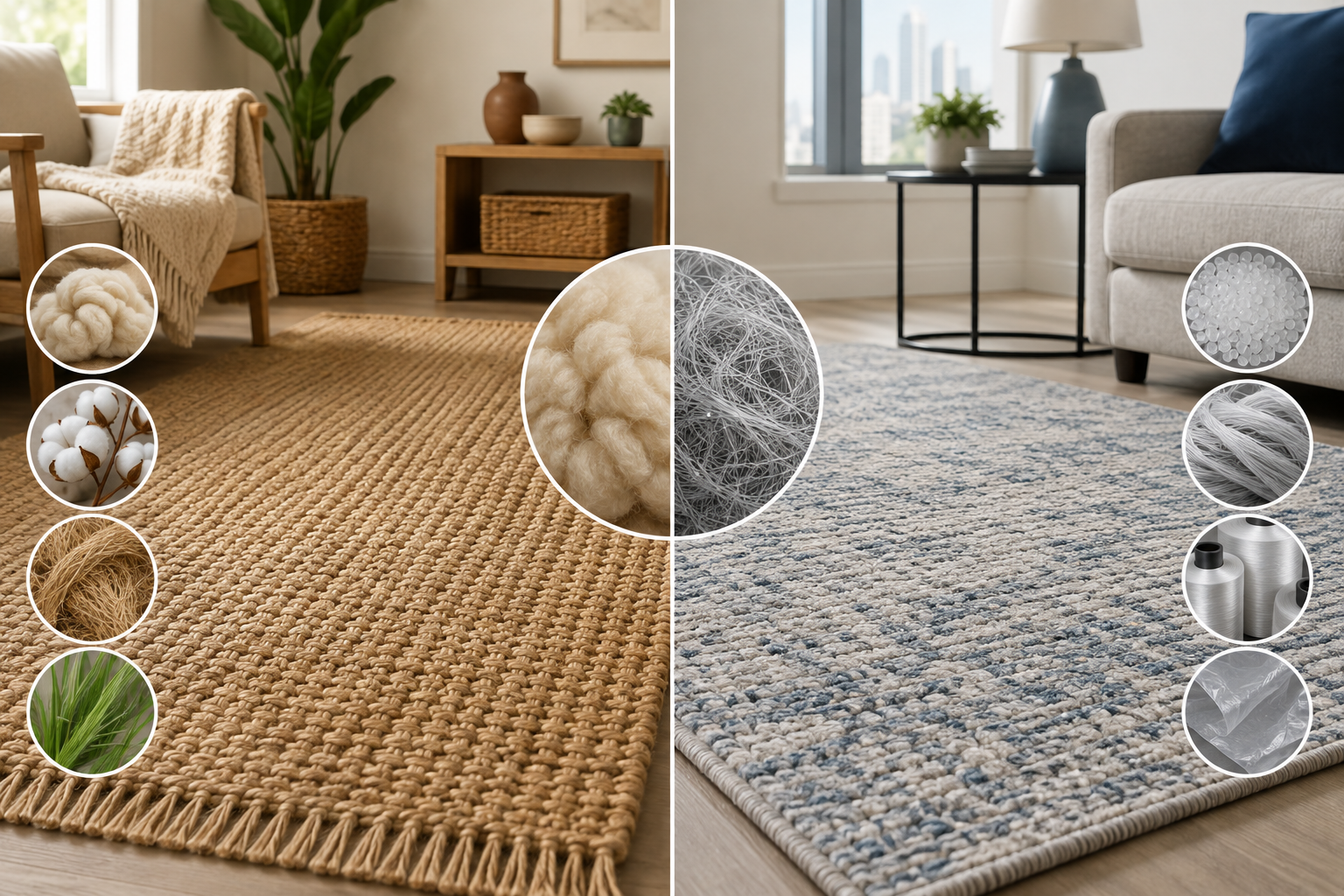
The natural fiber vs synthetic rugs debate goes well beyond how a rug looks or feels underfoot; it touches on indoor air quality, environmental impact, long-term cost, and how a rug actually performs once real life happens to it. Natural fiber advocates point to biodegradability and cleaner indoor air, while synthetic rug makers point to stain resistance, affordability, and genuinely impressive durability that’s improved considerably in recent years.
This guide walks through what actually separates these two categories, what’s genuinely documented about off-gassing and air quality, honest environmental trade-offs on both sides, and how to choose based on your household’s real priorities, rather than assuming one category is automatically “better” across the board.
Natural vs Synthetic Rugs
Neither natural fiber nor synthetic rugs are universally better, they involve genuine, different trade-offs. Natural fibers, wool, jute, sisal, cotton, are biodegradable, generally lower in chemical off-gassing, and often naturally stain-resistant (particularly wool), but they typically cost more, require more careful cleaning, and some (jute especially) don’t hold up well to heavy traffic or moisture. Synthetic fibers, nylon, polypropylene, polyester, are considerably more affordable, highly stain- and fade-resistant, and increasingly available in recycled materials, but new synthetic rugs can release volatile organic compounds (VOCs) during their first weeks in your home, and they aren’t biodegradable at the end of their life. If air quality and sustainability are your top priorities, lean natural. If budget, stain resistance, and easy care matter most, a quality synthetic rug is a genuinely reasonable choice, especially with a few precautions.
What Actually Counts as “Natural” vs “Synthetic”
Natural Fiber Rugs
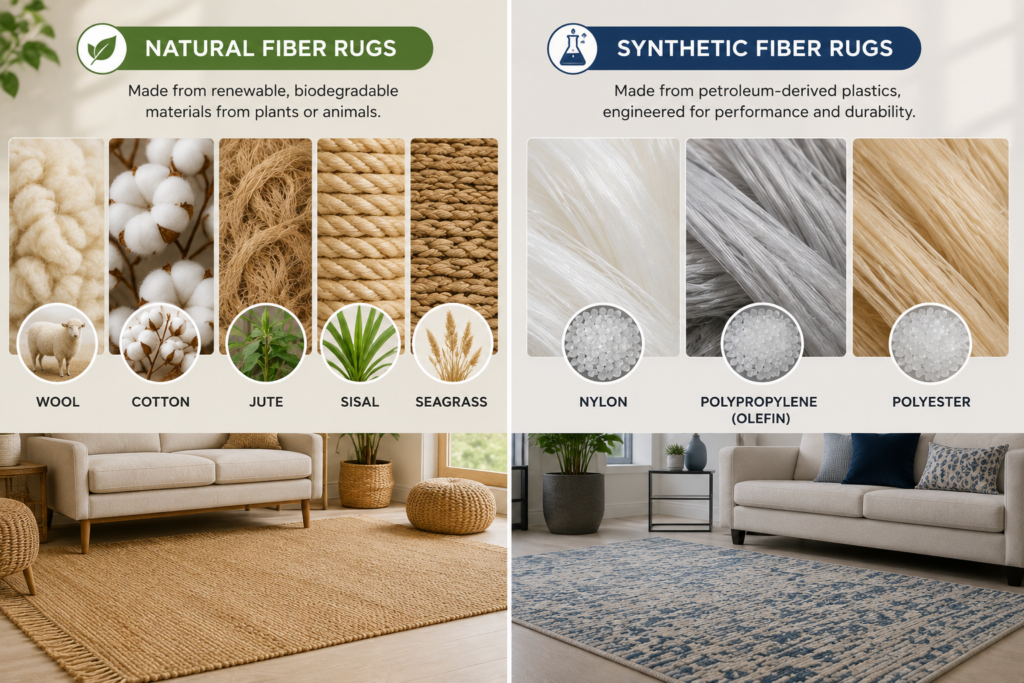
Natural fiber rugs are made from renewable, biodegradable materials that come directly from plants or animals, wool (sheared from sheep), cotton, jute, sisal, and seagrass are the most common. These materials are typically processed with fewer added chemicals than synthetic alternatives, particularly when left undyed or finished with plant-based dyes.
Synthetic Fiber Rugs
Synthetic rugs are manufactured from petroleum-derived plastics, most commonly nylon, polypropylene (also called olefin), and polyester. These materials are engineered specifically for consistent performance, stain resistance, fade resistance, and moisture resistance, at a considerably lower production cost than most natural fibers.
Natural vs Synthetic Rug Comparison
| Factor | Natural Fiber | Synthetic Fiber |
| Biodegradability | Yes | No |
| Typical VOC off-gassing | Low to minimal | Higher, especially new rugs |
| Stain resistance | Good (wool especially); poor (jute) | Excellent |
| Moisture resistance | Varies widely by fiber | Generally strong |
| Fade resistance | Good to moderate | Excellent |
| Cost | Higher | Lower |
| Feel underfoot | Ranges from soft (wool, cotton) to rough (sisal) | Often soft, engineered for comfort |
| End-of-life impact | Compostable/biodegradable | Contributes to landfill, non-biodegradable |
The VOC Question: What’s Genuinely Documented
What VOCs Actually Are
That distinctive “new rug smell” is a real, chemical phenomenon, volatile organic compounds evaporating out of the material at room temperature. New synthetic rugs can release compounds including formaldehyde, toluene, styrene, and 4-phenylcyclohexene (the specific compound often responsible for that characteristic new-carpet odor), several of which the EPA identifies as respiratory irritants at sufficient concentration.
Where the Off-Gassing Actually Comes From
It’s worth being precise here: the concern isn’t always the base synthetic fiber itself, it’s frequently the adhesive backings, synthetic latex, stain-repellent treatments (including PFAS-based “forever chemical” coatings), and flame retardants added during manufacturing that contribute most of the off-gassing and chemical load, not necessarily the polypropylene or nylon fiber on its own.
The Off-Gassing Timeline
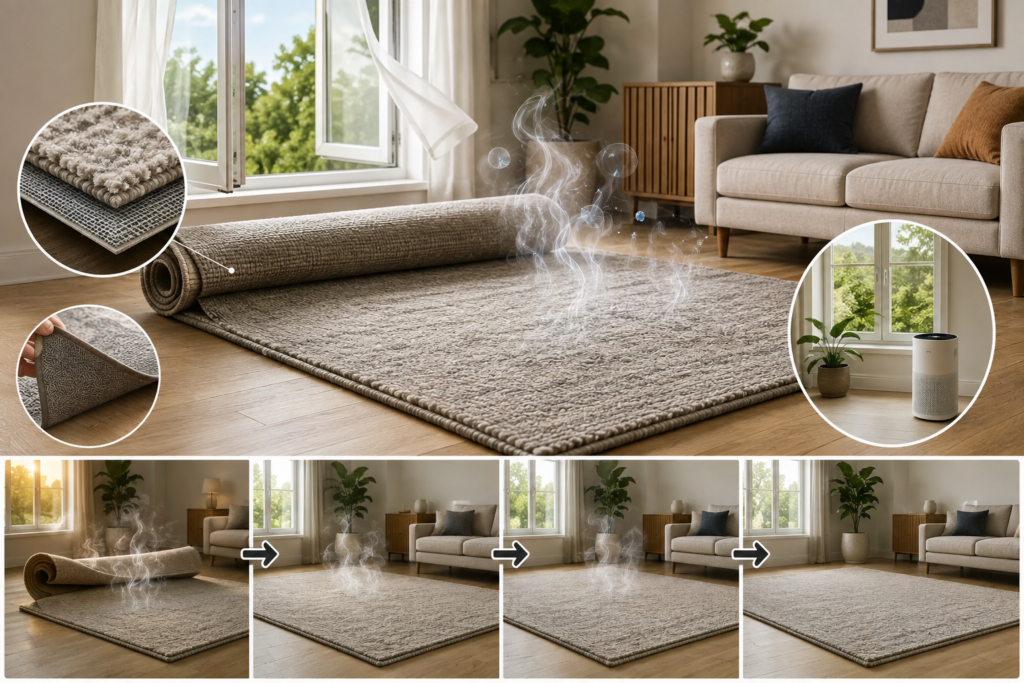
Off-gassing is generally heaviest in the first several days to weeks after a new rug arrives, then tapers off considerably, though it can continue at lower levels for months in some cases. If off-gassing is a genuine concern for your household, unrolling a new synthetic rug outdoors or in a well-ventilated garage for a few days before bringing it inside, and running an air purifier with an activated carbon filter afterward, both meaningfully reduce the exposure during that peak period.
Natural Fibers Aren’t Automatically Chemical-Free
It’s worth avoiding the assumption that “natural” automatically means zero chemical exposure. Bright or fade-resistant dyes, including on some natural fiber rugs, can involve synthetic azo dyes or formaldehyde-based fixatives during processing, so a natural fiber rug with heavy synthetic dye treatment isn’t necessarily cleaner than a well-made, untreated synthetic option. Looking for undyed or plant-dyed natural rugs, or certifications like GOTS or OEKO-TEX, gives you a more reliable indicator than fiber type alone.
Allergy and Sensitivity Considerations
Wool’s Genuine Allergy Advantages
Wool is naturally flame-resistant without requiring additional chemical treatment, and it’s widely considered hypoallergenic thanks to its natural lanolin coating, which also contributes to its stain resistance.
Jute’s Surprising Allergy Benefits
Jute fibers naturally repel dust mites, a genuine advantage for allergy-prone households, and the material is generally low in VOCs as well, provided it hasn’t been heavily treated during processing.
Synthetic Rugs and Static/Dust Concerns
Some synthetic fibers can generate static electricity, which may attract additional dust over time, though modern anti-static treatments have reduced this issue considerably in newer products. The bigger allergy-relevant concern with synthetics tends to be the added chemical treatments rather than the base fiber’s interaction with dust and allergens directly.
Durability: Where the Line Genuinely Blurs
Natural Fiber Strengths and Weaknesses
Wool offers excellent durability, natural elastic memory helps it spring back from compression, though it comes at a premium price. Sisal is exceptionally tough against dirt and abrasion but struggles with moisture and staining. Jute, while pleasant underfoot, genuinely breaks down under sustained heavy traffic and isn’t recommended for busy, high-use spaces.
Synthetic Fiber Strengths and Weaknesses
Nylon is widely considered one of the most durable rug fibers available in either category, highly resistant to staining, fading, and general wear, making it a genuinely strong performer even against premium natural options. Polypropylene doesn’t quite match nylon’s durability but offers excellent stain and fade resistance at a lower price point, particularly in tighter, low-pile constructions.
The Honest Takeaway on Durability
Fiber category alone, natural versus synthetic, doesn’t determine durability nearly as much as the specific fiber and construction chosen within each category. A well-made nylon rug will meaningfully outlast a jute rug in a busy hallway, while a quality wool rug can outlast a budget polyester one in the same space.
Environmental Impact: A Genuinely Complicated Picture
The Case for Natural Fibers
Natural fibers are renewable and fully biodegradable at the end of their usable life, returning to the earth rather than sitting in a landfill indefinitely. Wool, sisal, and jute all come from fast-growing, relatively low-processing-footprint sources compared to petroleum-based synthetics.
The Case Against Assuming Synthetics Are Always Worse
Synthetic fiber production and disposal genuinely contribute to non-biodegradable microplastic pollution, a real, documented environmental concern. That said, recycled PET rugs, made from post-consumer plastic bottles, offer a meaningfully more eco-friendly synthetic option, reducing new petroleum extraction while diverting existing plastic waste from landfills, and these rugs often off-gas less than traditional petroleum-based synthetics, particularly when produced without additional chemical treatments.
Dye Processing Affects Both Categories
Regardless of natural or synthetic fiber choice, dye processing itself contributes meaningfully to environmental impact on both sides, natural cellulose fibers require chemical auxiliaries to bond with dye effectively, contributing to wastewater contamination, while dyeing synthetic fibers carries its own chemical burden. Neither category gets a completely clean pass here.
Cost: The Practical Reality
Why Natural Fibers Cost More
Wool, sisal, and other natural fibers involve more labor-intensive harvesting and processing, and materials like wool in particular have become considerably pricier in recent years, pushing many budget-conscious buyers toward synthetic alternatives specifically for cost reasons.
Why Synthetics Remain the Budget-Friendly Default
Synthetic fibers dominate the affordable end of the rug market precisely because they’re cheaper and faster to manufacture at scale, while still delivering genuinely strong performance, particularly from nylon and polypropylene, that easily justifies the lower price point for many households.
Factoring In Long-Term Value
A pricier wool rug that lasts 15-plus years with proper care can end up costing less per year of use than a cheaper synthetic rug replaced every few years, so it’s worth thinking about cost per year of expected lifespan rather than upfront price alone when comparing across categories.
Cleaning and Maintenance Differences
Natural Fibers Often Need More Careful Handling
Wool generally requires professional cleaning periodically, alongside regular vacuuming, and can be susceptible to mold or mildew if kept in consistently damp conditions. Sisal and jute are typically cleaned with light sweeping or vacuuming, but they don’t tolerate wet cleaning methods well given their high moisture absorption.
Synthetic Fibers Are Often Easier to Maintain
Many synthetic rugs, particularly polyester and polypropylene options, resist moisture absorption effectively enough that spills can simply be blotted up before they set, and some modern synthetic rugs are even fully machine-washable, a genuine convenience advantage for busy households or those with young kids and pets.
Choosing Based on What Actually Matters to Your Household
Choose Natural Fiber If:
- Air quality and minimizing chemical exposure is a top household priority, particularly for nurseries or bedrooms
- You’re specifically prioritizing biodegradability and long-term environmental impact
- Budget allows for a higher upfront investment in exchange for potential longevity
- You have wool allergies ruled out and want its natural stain resistance and insulation
Choose Synthetic Fiber If:
- Budget is a significant factor in your decision
- You need strong stain and moisture resistance for a high-traffic or spill-prone space
- Easy, low-maintenance cleaning (including machine-washable options) matters for your household
- You’re specifically choosing a recycled PET or low-VOC certified synthetic option to reduce environmental and chemical concerns
Practical Buying Tips
- Look for certifications like GOTS, OEKO-TEX, or MADE SAFE regardless of fiber type, these indicate genuinely reduced chemical treatment rather than relying on the “natural” or “synthetic” label alone
- If choosing a new synthetic rug, unroll and air it out in a well-ventilated space for a few days before bringing it into a bedroom or nursery
- Consider recycled PET synthetic rugs as a genuine middle ground between traditional synthetics and natural fiber sustainability
- Match specific fiber choice within each category to the room’s actual conditions, moisture-prone spaces favor nylon or wool over jute or unsealed sisal
- Factor cost per year of expected use into your budget comparison, not just the sticker price
Common Mistakes to Avoid
- Assuming “natural” automatically means chemical-free, when heavily dyed or treated natural fiber rugs can still involve synthetic dye chemicals
- Choosing jute or untreated sisal for a spill-prone, high-moisture room, despite their genuine allergy and sustainability benefits elsewhere
- Bringing a new synthetic rug directly into a nursery or bedroom without airing it out first, missing an easy way to reduce peak off-gassing exposure
- Comparing only upfront cost without considering expected lifespan, when a pricier natural fiber rug can sometimes cost less per year of actual use
- Overlooking recycled PET options, assuming all synthetic rugs carry the same environmental footprint as traditional petroleum-based versions
Conclusion
The natural fiber vs synthetic rugs decision ultimately comes down to genuinely weighing what matters most for your household, air quality and biodegradability against affordability and stain resistance, rather than assuming either category wins outright. Wool and quality nylon both perform impressively in their own right, while jute’s allergy benefits come with real durability trade-offs, and recycled synthetic options are narrowing the sustainability gap that once clearly favored natural fibers alone. Look past the natural-versus-synthetic label itself, check for genuine chemical certifications, and match the specific fiber to your room’s actual conditions, and you’ll land on a rug that’s honestly right for your home, not just right on paper.
Frequently Asked Questions
1- Are synthetic rugs actually toxic?
Not inherently, the base fibers themselves (like polypropylene) generally don’t off-gas significantly at room temperature, but added treatments, adhesive backings, and stain-repellent chemicals used in manufacturing are the more genuine source of VOC concerns in many synthetic rugs.
2- Is wool the safest rug material?
Wool is widely considered one of the least toxic options, since it’s naturally flame-resistant and doesn’t typically require heavy chemical treatment, though dyed wool rugs can still involve synthetic dyes depending on the specific product.
3- How long does new rug off-gassing actually last?
Off-gassing is generally heaviest in the first 72 hours to a few weeks, then tapers off considerably, though trace off-gassing can continue for a few months in some synthetic rugs with adhesive backing.
4- Are natural fiber rugs always more sustainable than synthetic ones?
Generally yes for biodegradability, but the full picture is more nuanced, dye processing affects both categories, and recycled PET synthetic rugs offer a genuinely more eco-friendly synthetic alternative than traditional petroleum-based options.
5- Which is better for allergies, natural or synthetic rugs?
Both wool and jute offer genuine natural allergy benefits (lanolin’s stain resistance and dust mite repellency, respectively), while synthetic rugs’ allergy concerns are tied more to added chemical treatments than the base fiber itself.
6- Are synthetic rugs less durable than natural fiber rugs?
Not necessarily, nylon in particular is widely considered one of the most durable rug fibers available in either category, often outperforming natural options like jute in high-traffic, heavy-use spaces.
7- How can I reduce chemical exposure from a new rug regardless of material?
Look for certifications like GOTS, OEKO-TEX, or MADE SAFE, choose undyed or plant-dyed options where possible, and air out any new rug, natural or synthetic, in a well-ventilated space before placing it in a frequently occupied room.