
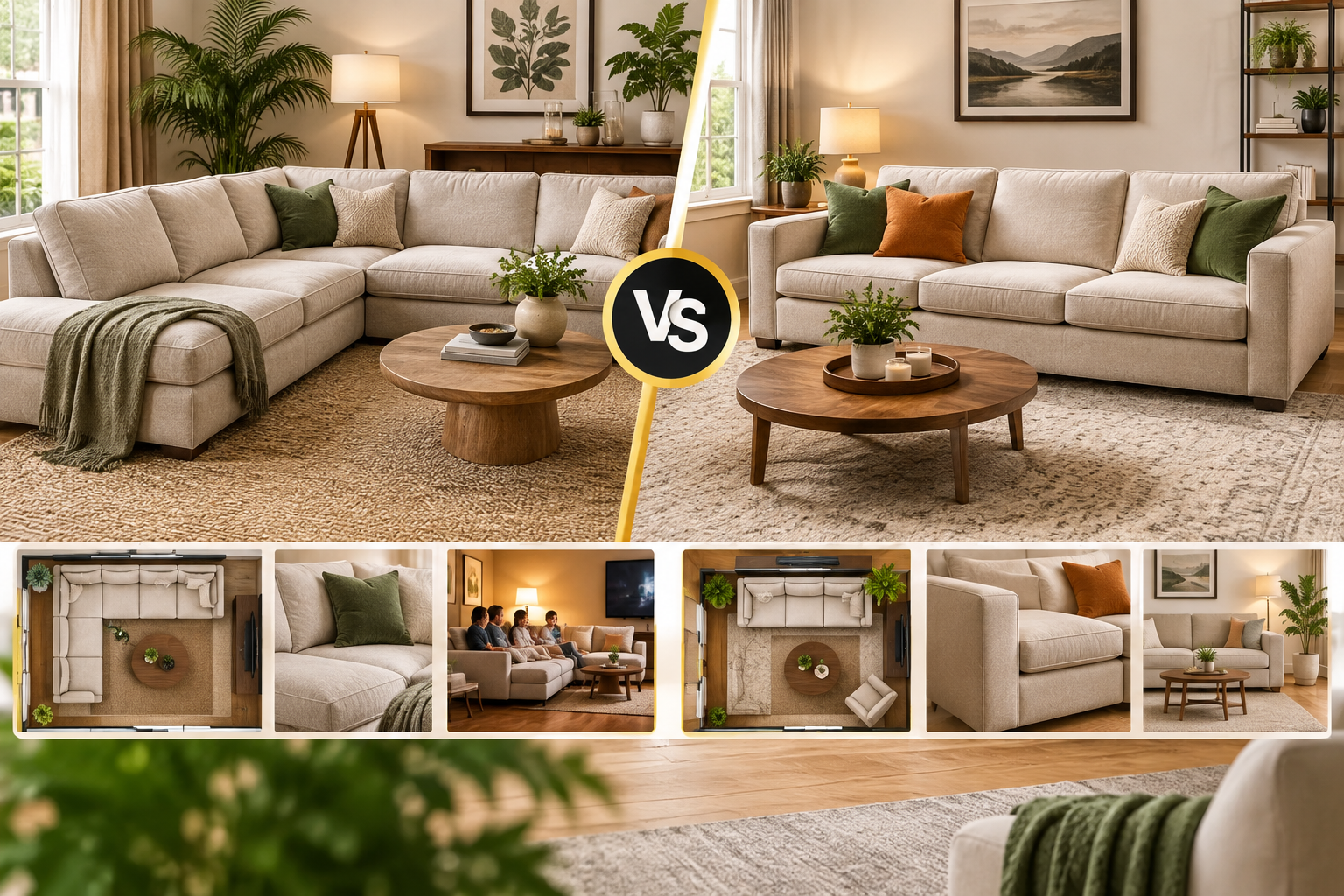
Standing in a furniture showroom trying to decide between a sprawling sectional and a classic standard sofa is one of the most common furniture dilemmas homeowners face. Both look great in photos, but only one is going to actually work in your specific room.
Sectionals are the better choice for larger, open-concept rooms and households that need more total seating, thanks to their L- or U-shaped modular design. Standard sofas work better in smaller or more traditionally shaped rooms, offer more layout flexibility over time, and are generally easier to move and rearrange. Neither is universally “better”; the right choice depends on your room’s size and shape, how many people you regularly seat, and how often you like to change your layout.
This guide breaks down exactly how sectionals and standard sofas compare, so you can choose based on how you actually live, not just what looks good in a showroom.
What’s the Real Difference Between a Sectional and a Standard Sofa?
- Before comparing pros and cons, it helps to define each clearly.
- A standard sofa (also called a couch) is a single, fixed-shape piece of upholstered furniture, typically seating two to three people. It has a classic, streamlined silhouette and works as one cohesive unit.
- A sectional is a modular sofa made up of multiple connected sections, most commonly arranged in an L-shape or U-shape. Because it’s built from separate pieces, a sectional can often be reconfigured or partially rearranged to adapt to different room layouts.
Sectional vs Standard Sofa: Quick Comparison
| Feature | Standard Sofa | Sectional |
| Typical Seating | 2–3 people | 4+ people |
| Shape | Fixed, straight silhouette | L-shape, U-shape, or modular configurations |
| Best Room Size | Small to medium | Medium to large, open-concept |
| Layout Flexibility | High (easy to move, pair with other pieces) | Lower (tends to anchor and define the room layout) |
| Ease of Moving | Easier, especially in tight spaces | Harder — larger footprint, may need disassembly |
| Cost | Generally lower upfront | Generally higher, but can replace multiple seating pieces |
| Style | Classic, versatile | Bold, casual, statement-making |
| Doorway/Hallway Fit | Usually easier | Requires careful measuring, especially for larger pieces |
When a Standard Sofa Makes More Sense
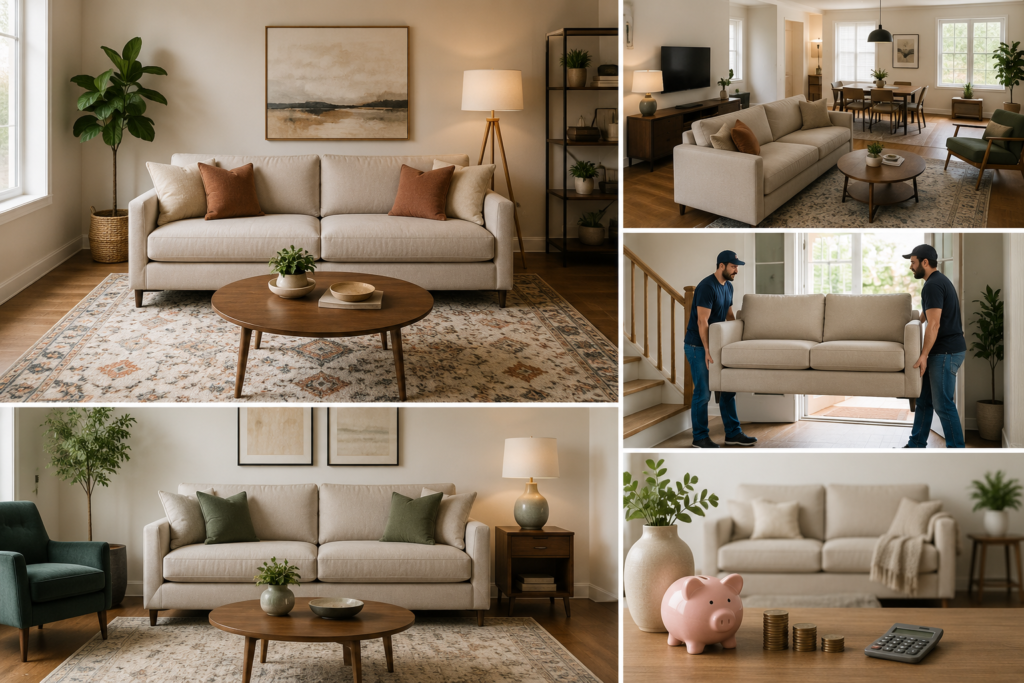
1. You Have a Smaller or Irregularly Shaped Room
A standard sofa’s fixed, compact shape adapts more easily to smaller rooms, narrow layouts, or spaces with awkward angles. A large sectional in a small room can overwhelm the space and block natural walking paths.
2. You Want Long-Term Layout Flexibility
Because a sectional’s L-shape often anchors and defines the room’s entire layout, changing your furniture arrangement later moving the TV, adding a chair, reworking the flow can be more limiting. A standard sofa, especially paired with separate pieces like a loveseat or accent chairs, gives you more freedom to rearrange as your needs change over time.
3. You Move Frequently or Live in a Multi-Story Home
Standard sofas are generally easier to move through doorways, stairwells, and tight hallways. Even sectionals that arrive in separate pieces can be surprisingly difficult to reassemble cleanly in a new layout, especially in apartments or homes with tighter access points.
4. You Prefer a Classic, Versatile Look
A standard sofa’s streamlined silhouette blends easily with a wide range of design styles, from traditional to modern, and pairs naturally with additional seating pieces like armchairs.
5. Budget Is a Bigger Priority
Standard sofas generally cost less upfront than sectionals, making them a practical choice if you’re furnishing on a tighter budget or need to prioritize other purchases.
When a Sectional Makes More Sense
1. You Have a Larger or Open-Concept Room
Sectionals are designed to fill generous square or rectangular layouts, and they tend to look proportionate in larger rooms where a standard sofa might feel small or lost.
2. You Regularly Host Guests or Have a Larger Household
If you need to comfortably seat four or more people without adding multiple separate pieces, a sectional consolidates that seating into one cohesive unit often more efficient than combining a sofa, loveseat, and chairs to reach the same capacity.
3. You Want a Cozy, Lounge-Style Living Room
Sectionals, especially those with a chaise section, are well-suited to households that prioritize lounging, movie nights, or a laid-back, casual feel over a more formal seating arrangement.
4. You Want the Seating to Be the Room’s Main Feature
A sectional has a commanding presence and works well when you want the seating itself to define the room, rather than sharing visual weight with several separate furniture pieces.
5. You Value Configuration Flexibility Within the Piece Itself
While a sectional can be less flexible for the room’s overall layout, many modular sectionals allow you to rearrange the individual sections switching the chaise side, for example giving you some adaptability without buying new furniture.
Sizing Considerations: What to Measure Before You Buy
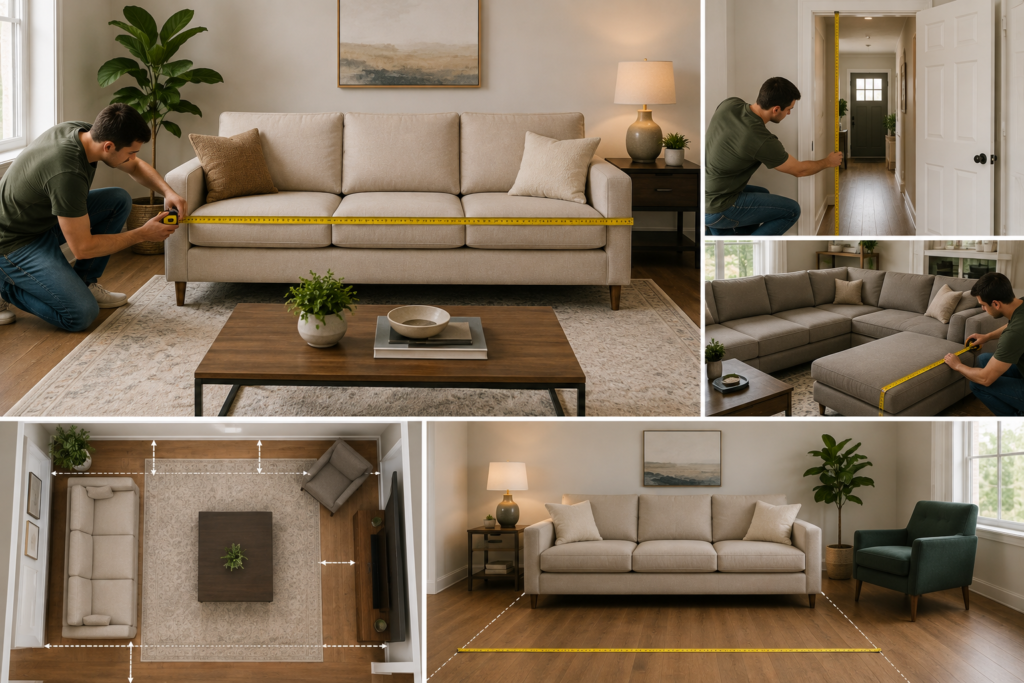
Both sofa types require careful measuring, but sectionals demand extra attention due to their larger footprint.
Standard Sofa Sizing
- Width: Typically 76 to 90 inches
- Depth: Typically 35 to 44 inches
- Seat depth: Usually 19 to 24 inches, depending on the model
Sectional Sizing
- Width: Standard sectionals often range from about 95 to 120 inches, with larger models reaching 150+ inches
- Depth: Typically 36 to 40 inches, with chaise extensions adding further length on one side
The Measuring Checklist
- Measure the room itself, accounting for walking paths, other furniture, and TV placement.
- Measure every doorway, hallway, and stairwell the piece needs to pass through this matters even more for sectionals, since larger sections may need to be maneuvered around tight corners.
- Check the piece’s ability to disassemble. Many sectionals separate into individual sections for easier transport, which can make a big difference in tight spaces.
- Confirm walking space around the sofa or sectional once placed a general guideline is leaving at least 30 to 36 inches for comfortable movement around the piece.
Comfort Considerations: Seat Depth and Back Height
Beyond shape and size, a few comfort details apply to both sectionals and standard sofas.
Seat Depth
- Shallower seats (around 19–21 inches) suit people who prefer sitting upright and are easier to get in and out of — often a better fit for more formal spaces.
- Deeper seats (22–24 inches or more) suit those who like to lounge or stretch out, which is especially common with sectionals designed around a chaise section.
Back Height
- Higher-backed pieces offer more head and neck support, ideal for relaxing or reading.
- Lower-profile pieces create a sleeker, more contemporary look and help keep sightlines open in rooms with large windows or an open floor plan.
Cost Comparison: What to Expect
Sofas generally cost less upfront than sectionals, but the comparison isn’t always as simple as it looks.
- Standard sofas are typically the lower-cost entry point, especially for a single seating piece.
- Sectionals cost more initially, but can effectively replace the need for a separate sofa, loveseat, or additional chairs meaning the total cost of achieving similar seating capacity may end up more comparable than the sticker price alone suggests.
If you’re comparing total seating cost rather than a single piece, it’s worth pricing out what a standard sofa plus the additional chairs or pieces needed to match a sectional’s capacity would actually cost.
Practical Buying Advice
- Start with your room’s shape, not the furniture’s shape. A sectional works best when your room has a natural corner or open layout to accommodate its footprint; a standard sofa adapts more easily to narrower or irregular rooms.
- Think about how often your layout changes. If you rearrange furniture frequently or anticipate future layout changes, a standard sofa (or modular pieces) offers more long-term flexibility.
- Count your actual regular seating needs, not just occasional guest capacity buying more seating than you typically use adds cost and floor space without daily benefit.
- Measure your access points before falling in love with a specific piece. A sectional that can’t make it through your hallway or stairwell isn’t a workable option, regardless of how well it fits the room.
- Consider a modular sectional if you want some flexibility. Some sectionals allow you to rearrange individual sections, offering a middle ground between a fixed sofa and a fully committed large-scale sectional.
Conclusion
The sectional vs standard sofa decision isn’t really about which piece is objectively better — it’s about which one fits your room’s size and shape, how many people you regularly seat, and how much flexibility you want going forward. A sectional shines in larger, open-concept spaces built around lounging and hosting. A standard sofa offers more adaptability, easier mobility, and a better fit for smaller or more traditionally shaped rooms.
Measure your space carefully, think honestly about how you actually use your living room day to day, and choose the option that supports that not just the one that looks most impressive in a showroom. The right seating should make your room feel comfortable and functional for years, not just photograph well on move-in day.
FAQ
1- Is a sectional always better for a large family?
Not necessarily “better,” but it’s often more practical a sectional consolidates more seating into one piece, which can be more space-efficient than combining several separate pieces to reach the same capacity.
2- Can a sectional fit in a small living room?
It can, but it requires careful measuring and often works best with a more compact sectional design. In many small living rooms, a standard sofa remains the safer, more flexible choice.
3- Which is easier to move, a sectional or a standard sofa?
Standard sofas are generally easier to move, especially through tight doorways, stairwells, or apartment hallways. Sectionals, even when they separate into individual pieces, often have a larger overall footprint that can complicate transport and reassembly.
4- Do sectionals cost more than standard sofas?
Generally, yes, for the piece itself. However, since a sectional can replace the need for multiple separate seating pieces, the total cost difference may be smaller than it initially appears when comparing equivalent seating capacity.
5- Can I rearrange a sectional after it’s placed in a room?
Many modular sectionals allow you to reposition individual sections, such as switching which side the chaise sits on, offering some flexibility. However, sectionals generally still commit the room to a layout centered around the piece more than a standard sofa would.
6- What’s the best option if I might move in a few years?
A standard sofa, or modular seating pieces that can be rearranged individually, generally offers more flexibility for adapting to a new home’s layout compared to a large, fixed-configuration sectional.