
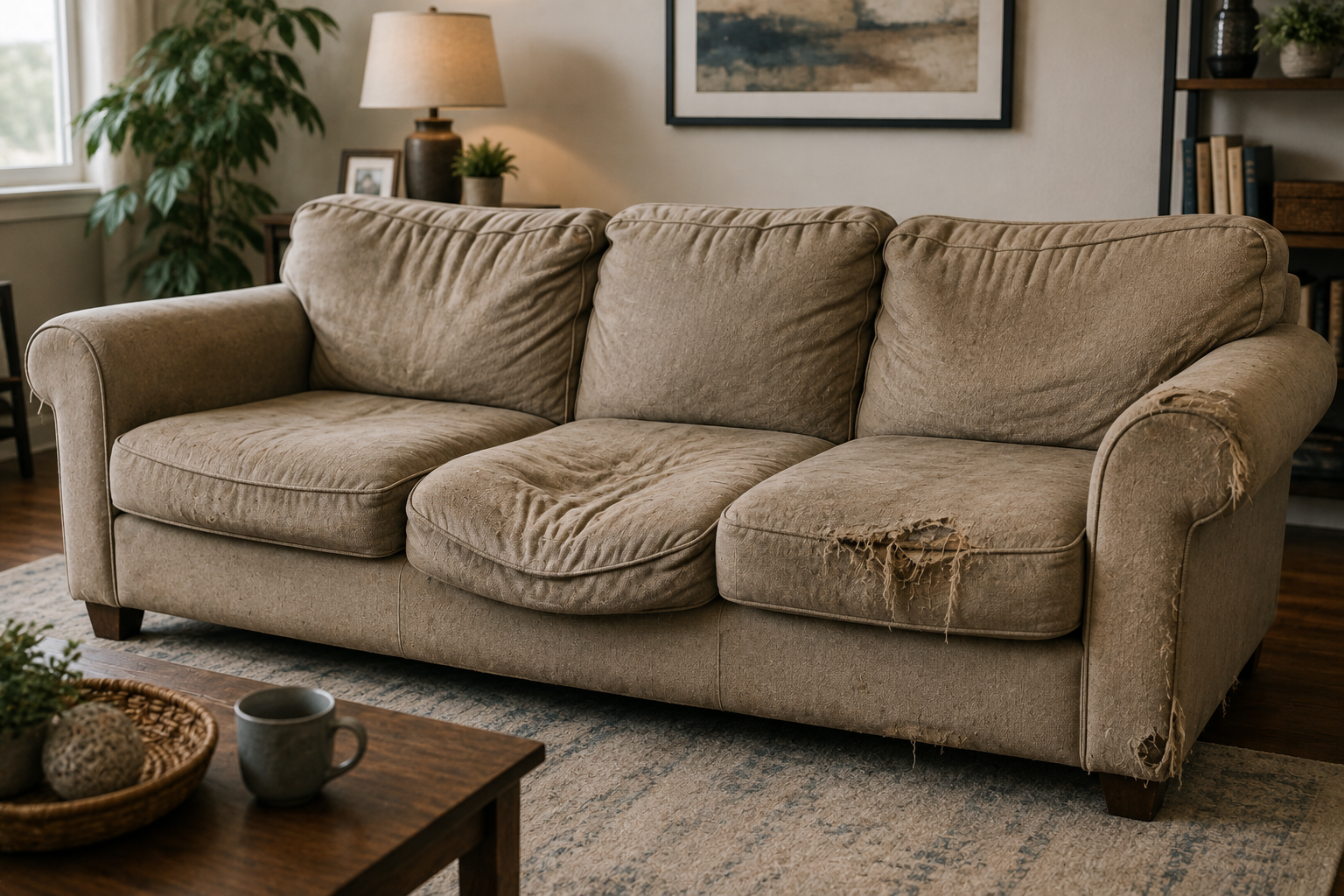
Not sure if your sofa just needs a quick fix or if it’s genuinely time to start shopping for a new one? You’re not alone; sofas break down gradually, which makes it hard to know whether you’re dealing with a simple repair or a sofa that’s truly reached the end of its useful life.
It’s time to replace your sofa if you notice visible sagging that doesn’t bounce back, creaking or wobbling in the frame, cushions that no longer recover their shape, structural instability when you sit down, or upholstery damage beyond what cleaning or minor repair can fix. A simple at-home test, removing the cushions and pressing on the seat base, can help you tell the difference between a cushion problem (often fixable) and a frame problem (usually a sign to replace).
This guide walks through each warning sign in detail, explains what’s actually happening inside your sofa, and gives you a practical way to test your own sofa before deciding what to do next.
Why It’s Hard to Tell When a Sofa Is “Done”
Unlike a mattress that either supports your body or doesn’t, a sofa’s wear is more layered a worn cushion can look like a bigger problem than it is, while a genuinely failing frame can hide underneath cushions that still look fine on the surface. That’s exactly why so many homeowners either replace a sofa too early (when a simple repair would have worked) or hang onto one too long (when the frame is already structurally compromised).
The key is learning to separate cushion problems from frame and support problems, because they call for very different solutions.
Signs Your Sofa Needs To Be Replaced
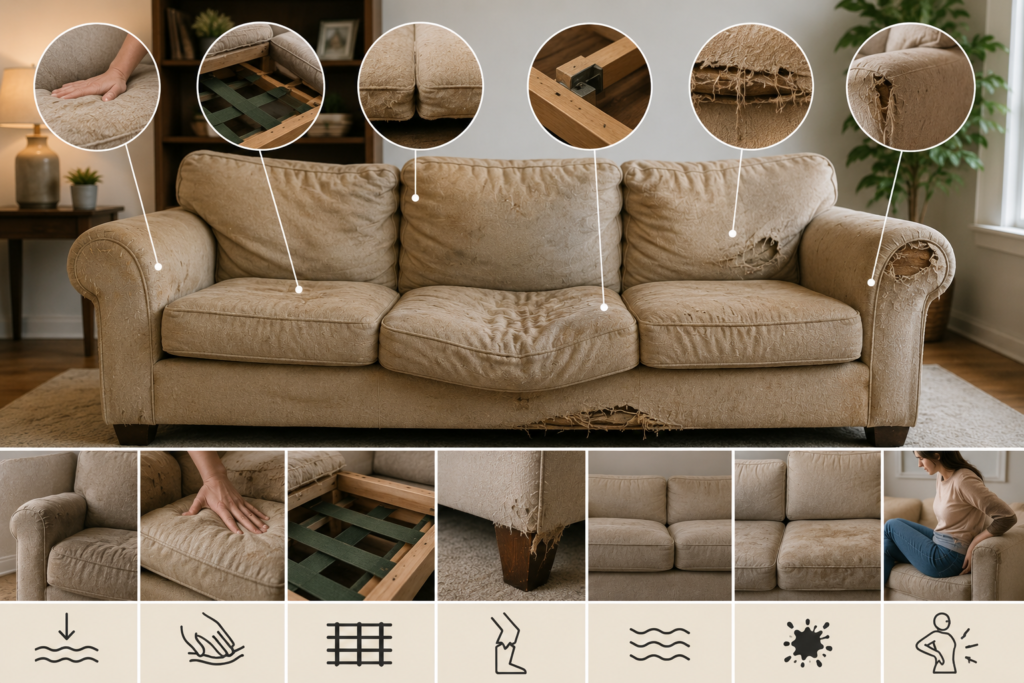
1. Sagging That Doesn’t Bounce Back
Some sagging is completely normal cushions naturally soften with regular use. The concern is when sagging becomes deep, permanent, or uneven across the seat.
How to Check
Press firmly into the center of each cushion, then release.
- Springs back quickly: The foam core is likely still in good shape.
- Slow to recover, or stays visibly indented: The foam has lost its resilience and needs replacing.
- Immediately feels like the hard floor is right there: The foam core has broken down significantly.
If sagging is concentrated in one seat (usually the most-used spot), that’s a sign of localized cushion wear rather than a full sofa failure often still fixable with a new cushion insert.
2. A Sagging or Unstable Seat Base (Not Just the Cushion)
This is the detail most people miss: sometimes the cushion itself is fine, but what’s underneath it the webbing, springs, or seat deck has failed.
The Simple At-Home Test
- Remove all seat cushions and set them aside on a flat surface.
- Press the cushions individually do they spring back quickly on their own? If yes, the foam is likely fine.
- Press down on the empty seat base front edge, center, and corners. A healthy base should feel consistently firm across the whole area.
- Notice any soft zones or sudden drop-offs. Uneven give across the seat base points to stretched webbing, a bent spring, or a broken support component underneath.
What the results tell you:
| Test Result | Likely Cause | Fixable? |
| Cushion sags on its own, off the sofa | Worn cushion foam or fill | Usually — replace/rebuild cushion insert |
| Cushion is fine off the sofa, but sinks when placed back on | Failing webbing, springs, or seat base | Possibly — support repair may help if frame is sound |
| Seat base itself feels soft or gives way | Structural support failure | Depends on frame condition |
3. Creaking, Popping, or Groaning Sounds
If your sofa makes noise every time someone sits down or shifts position, that’s a mechanical warning sign not just an annoyance.
What different sounds usually indicate:
- Creaking or scraping: Loose hardware or joints
- Popping sounds: Detached spring clips or connectors
- A cracking sound: Possible damage to the wooden frame itself
A silent, stable frame is generally a healthy one. Persistent noise, especially if it’s gotten louder or more frequent over time, suggests the underlying structure is starting to fail.
4. A Wobbly, Rocking, or Unstable Frame
This is one of the clearest signs that a sofa has moved from “needs a repair” to “may need replacing.”
How to Check
- Check each leg individually it should sit firmly on the floor without rocking or wobbling.
- Lift the front of the sofa slightly (with help, if needed) and check for flimsiness or visible cracks in the wooden rails.
- If you can safely flip the sofa over, check whether the base feels rigid. A frame that shifts, or a seat rail that feels cracked or loose, points to a structural not cosmetic problem.
A wobbling frame isn’t just uncomfortable; it can also affect stability when sitting down or standing up, which matters more than people initially realize.
5. Cushions Sliding Forward or Losing Their Fit
If your seat cushions keep sliding forward, or there’s a growing gap between the backrest and the seat, this often points to a sagging frame rather than a cushion issue on its own. As the frame or seat deck settles unevenly, cushions no longer sit securely in their intended position a sign that the structural support underneath has weakened.
6. Visible Upholstery Damage Beyond Repair
Some upholstery issues are cosmetic and fixable; others signal it’s time to move on.
Generally fixable:
- Minor fading
- Small, isolated stains
- A loose seam or small tear
Usually a sign to replace (or invest in a full recover):
- Deep, set-in stains that professional cleaning can’t remove
- Cracked leather across large areas
- Widespread fraying, pilling, or fabric breakdown
- Torn upholstery in multiple spots
If the upholstery is damaged but the frame and support system are still structurally sound, reupholstering can be a cost-effective alternative to full replacement but that only makes sense if what’s underneath the fabric is genuinely in good shape.
7. Persistent Odors That Cleaning Can’t Remove
Years of spills, pet use, and general daily life can cause a sofa to absorb odors that regular cleaning no longer resolves. If a deep clean appropriate to your sofa’s cleaning code doesn’t meaningfully improve a lingering smell, that’s often a sign the padding or internal materials have absorbed moisture or buildup that’s now difficult to reverse.
Cushion Problem vs. Frame Problem: Why the Distinction Matters
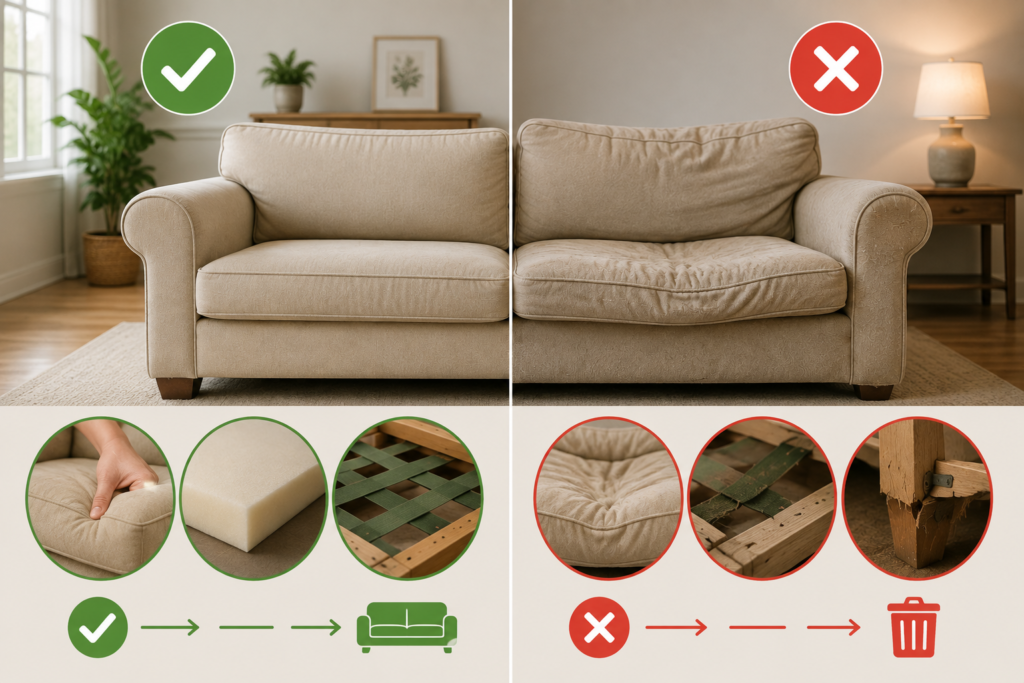
This is the single most useful thing to determine before deciding whether to repair or replace.
| Cushion Problem | Frame/Support Problem | |
| What’s affected | Foam or fill inside the cushion | Webbing, springs, seat deck, or wooden frame |
| Common signs | Cushion sags on a flat surface when tested alone | Sofa creaks, wobbles, or the seat base feels soft even without cushions |
| Fix | Replace or rebuild cushion inserts | Requires structural repair — or replacement if damage is extensive |
| Cost to address | Generally lower | Can be significant, sometimes approaching the cost of a new sofa |
If your at-home test shows the cushions are the main issue and the frame feels solid, a repair is often the smarter move. If the frame itself is unstable, cracked, or making noise, replacement is typically the more practical long-term decision.
When Repair Makes More Sense Than Replacement
- The frame is still solid, rigid, and free of visible cracks
- The main issue is worn cushion foam, fill, or minor upholstery damage
- You have sentimental attachment or a genuinely well-built, high-quality frame worth preserving
- The estimated repair cost is meaningfully lower than a comparable replacement sofa
When Replacement Is the Better Investment
- The frame wobbles, creaks persistently, or shows visible structural damage
- Multiple issues (frame, cushions, upholstery) are present at the same time
- Repair costs approach or exceed a significant portion of a new sofa’s price
- The sofa no longer fits your household’s needs, regardless of its condition
Practical Buying Advice If You’re Replacing
- Prioritize frame construction this time around. A kiln-dried hardwood frame with reinforced joints is far less likely to develop the wobble and creaking issues that often trigger early replacement.
- Choose removable, reversible cushions. This makes future maintenance rotating, rebuilding, or replacing inserts — much easier than sofas with permanently attached cushions.
- Ask about the suspension system. Sinuous springs or hand-tied coil systems generally outlast basic webbing, especially under regular daily use.
- Check the warranty length and coverage. A longer warranty on the frame specifically is often a reasonable signal of the manufacturer’s confidence in long-term durability.
- Factor in your household’s actual use. If pets, kids, or heavy daily use are part of your routine, prioritize performance fabric or leather alongside a strong frame and suspension system.
But Wait, Test Before You Decide
The most reliable way to know whether your sofa needs a repair or a full replacement isn’t guessing based on age it’s a quick, hands-on test. Remove the cushions, check how they recover on their own, press on the seat base, and pay attention to any creaking, wobbling, or instability in the frame.
If the problem is mainly worn cushions and the frame still feels solid, a repair can add meaningful life to a sofa you already know and like. But if the frame itself is unstable, cracked, or persistently noisy, that’s a clear signal it’s time to start shopping for something new — one that, with the right construction and a little regular care, can comfortably serve your home for years to come.
FAQ
1- How do I know if it’s the cushions or the frame that’s the problem?
Remove the cushions and test them individually on a flat surface. If they spring back quickly on their own but sink when placed back on the sofa, the issue is likely in the frame or support system underneath, not the cushion itself.
2- Can a sagging sofa always be fixed instead of replaced?
Not always. If the sagging is limited to worn cushion foam and the frame is still solid, a repair is often effective. But if the frame itself is wobbly, cracked, or the seat base feels soft even without cushions, repair may only be a short-term fix.
3- Is it normal for a sofa to creak occasionally?
Occasional, minor sound isn’t necessarily alarming, but persistent or worsening creaking, popping, or cracking sounds typically indicate loosening joints, detached springs, or frame damage that’s worth investigating.
4- Should I replace my sofa if only the fabric looks worn but everything else feels solid?
Not necessarily. If the frame and support system are structurally sound and only the upholstery shows wear, reupholstering can be a more cost-effective option than full replacement.
5- How long should I expect a sofa to last before these signs show up?
Most sofas last between 7 and 15 years, depending on construction quality and how heavily they’re used, though budget sofas can show these signs significantly sooner, and well-built sofas may go much longer before any real warning signs appear.
6- Is it safe to keep sitting on a sofa with a wobbly frame?
It’s best to address it soon rather than continuing regular use. A wobbling or unstable frame can affect comfort and stability when sitting down or standing up, and the issue typically worsens with continued weight-bearing use.