
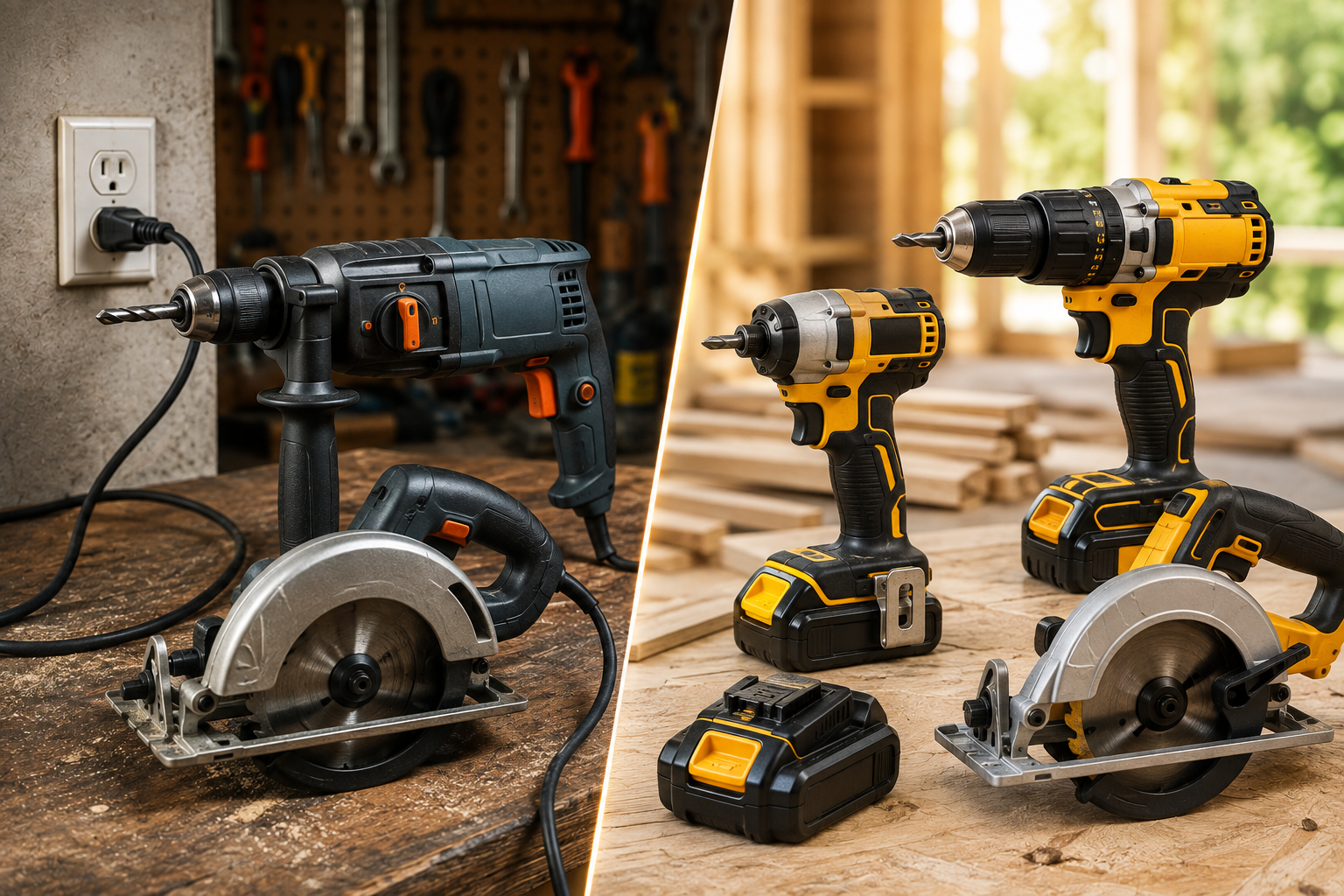
Once you’ve decided a project calls for a power tool, a second decision follows almost immediately: corded or cordless? The corded vs cordless power tools question has shifted considerably in recent years as battery technology has improved, but it’s still not a simple universal answer, the right choice depends on the specific tool, your typical projects, and how much you value uninterrupted power versus mobility.
This guide breaks down exactly how these two power sources compare, where each one clearly wins, and how to decide which format makes the most sense for your specific tools and projects.
Corded vs Cordless Power Tools
Cordless tools have become the practical default for most homeowners, offering genuine mobility and, for many tool categories, power that now rivals corded equivalents for typical residential use. Corded tools still hold a meaningful edge for tasks requiring continuous, uninterrupted high power, heavy-duty cutting, extended sanding sessions, or any job where stopping to recharge a battery would be genuinely disruptive. For most household projects, a cordless drill and a handful of other cordless essentials cover the vast majority of needs, with corded tools reserved for specific higher-demand tasks or as a budget-friendly option for occasional use.
How Each Power Source Works
1- Corded Tools
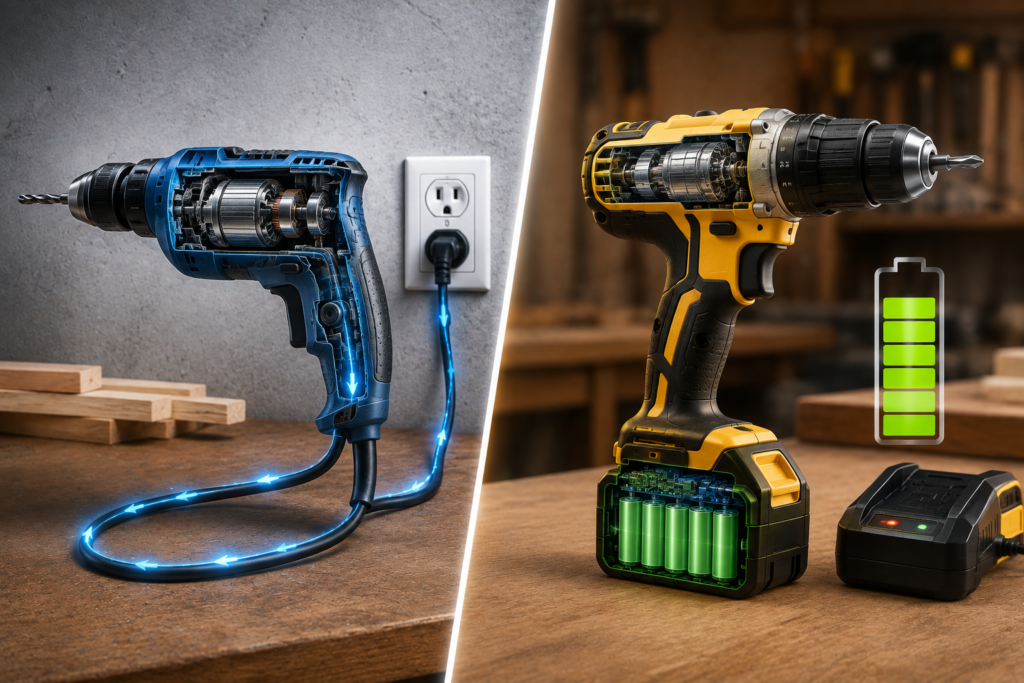
Corded power tools draw continuous electricity directly from a wall outlet via a power cord, providing steady, uninterrupted power for as long as the tool remains plugged in and the outlet supplies electricity.
2- Cordless Tools
Cordless tools run on rechargeable batteries, typically lithium-ion in modern tools, storing power that depletes with use and requires periodic recharging. Battery voltage (commonly 12V, 18V/20V, and higher for heavier-duty tools) generally correlates with available power and runtime.
Side-by-Side Comparison
| Factor | Corded Tools | Cordless Tools |
| Power consistency | Constant, uninterrupted | Gradually decreases as battery depletes |
| Mobility | Limited by cord length and outlet access | Full mobility |
| Runtime | Unlimited (while plugged in) | Limited by battery charge |
| Weight | Generally lighter (no battery) | Heavier (battery adds weight) |
| Upfront cost | Generally lower | Generally higher (battery + charger) |
| Long-term cost | Lower (no battery replacement) | Battery eventually needs replacement |
| Maintenance | Minimal | Battery care and storage habits |
| Best for | Extended, heavy-duty, stationary work | Mobile, varied, shorter-duration tasks |
| Storage | Simple | Requires battery charging/storage |
Power and Performance Comparison
- Corded Tools’ Power Advantage
Corded tools draw power directly from your home’s electrical system, which means they don’t experience the gradual power decline that occurs as a battery depletes during use. For tasks demanding sustained, maximum power, cutting through thick lumber repeatedly or extended heavy-duty drilling, corded tools maintain consistent performance from start to finish.
- How Much Cordless Has Closed the Gap
Modern cordless tools, particularly higher-voltage models (18V/20V and above), have significantly closed the performance gap for typical residential use. For most home projects, drilling holes, driving screws, light-to-moderate cutting, a quality cordless tool now performs comparably to its corded equivalent, a genuine shift from just a decade or so ago when cordless tools were noticeably weaker.
- Where Corded Still Clearly Wins
Heavy-duty, continuous-use applications, extended table saw or circular saw work, prolonged sanding sessions, or professional-level demands, still generally favor corded tools or higher-end cordless models specifically engineered for sustained heavy use.
Mobility and Convenience
- Cordless Tools’ Clear Advantage
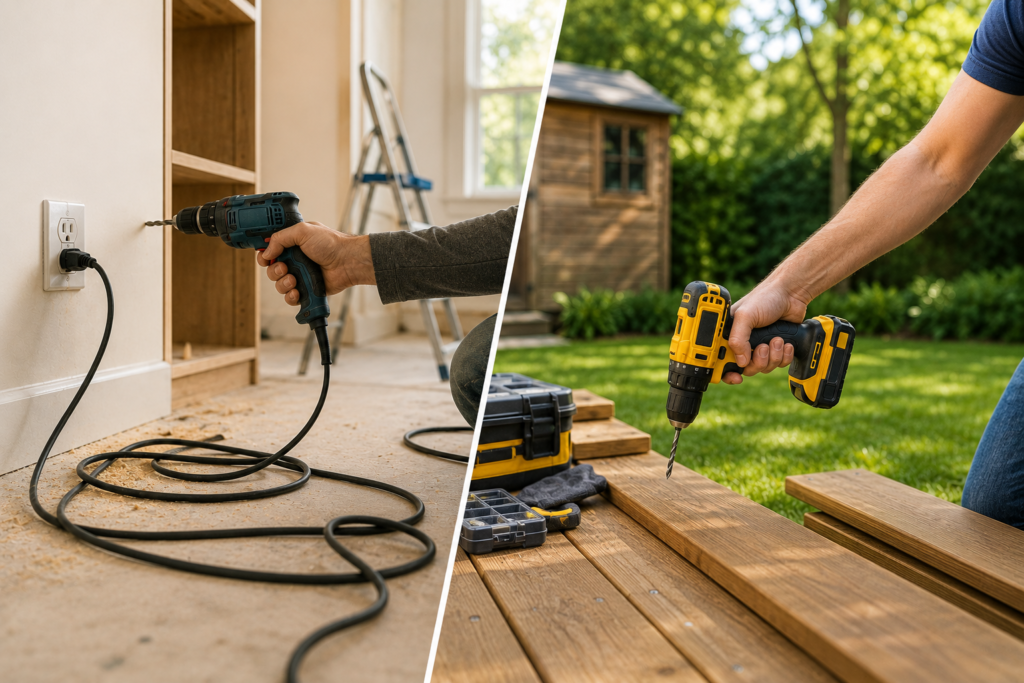
The ability to move freely without being tethered to an outlet or managing a trailing cord is cordless’s most significant practical benefit, particularly valuable for outdoor projects, work in areas without convenient outlet access, or tasks that require moving frequently between locations.
- Where Cords Aren’t Actually a Problem
For stationary work near an existing outlet, a workbench project, indoor repairs close to a wall outlet, a cord isn’t a meaningful inconvenience, and some homeowners find a cord simply more predictable than needing to monitor battery charge throughout a project.
Cost Comparison
- Upfront Cost
Corded tools are generally less expensive upfront, since they don’t require the added cost of a battery and charger. Cordless tools typically cost more initially, reflecting the battery technology built into the purchase.
- Battery Platform Economics
Once you own one cordless tool from a specific brand’s battery platform, additional tools from that same platform, sold as “tool only” without a separate battery and charger, often cost meaningfully less than the first purchase, since you’re not paying for a duplicate battery and charger each time.
- Long-Term Costs
Cordless tool batteries degrade over years of charge cycles and will eventually need replacement, an ongoing cost corded tools simply don’t have, since they draw power directly rather than storing it in a component that wears out over time.
Runtime and Battery Management
- Understanding Battery Life
Cordless tool runtime varies significantly based on battery voltage and capacity (measured in amp-hours, or Ah), as well as the specific task’s power demands. Higher-demand tasks, like continuous drilling into dense material, drain a battery faster than lighter, intermittent use.
- Managing Runtime for Larger Projects
For projects likely to exceed a single battery charge, having a second battery on hand lets you swap in a fresh one and continue working without a lengthy charging pause, a practical solution many cordless tool owners adopt once they identify this as a recurring need.
- Battery Storage and Longevity
Lithium-ion batteries generally last longer when stored at a moderate charge level (rather than fully depleted or, in some cases, left at 100 percent for extended periods) and kept in a moderate temperature environment, away from extreme heat or cold.
This isn’t just a rule of thumb. According to Battery University’s technical guidance on lithium-ion storage, storing a lithium-ion battery at roughly 40 percent charge in a cool environment preserves capacity far better than storing it fully charged, since high charge levels combined with heat are what accelerate permanent capacity loss.
- Weight and Ergonomics
Cordless tools carry additional weight from their battery pack, which can matter for tasks involving extended overhead use or prolonged handling, like extensive ceiling work or lengthy sanding sessions. Corded tools, without a battery, are generally somewhat lighter, though the trade-off is the cord itself, which some users find equally cumbersome to manage during active use.
Which Tools Benefit Most From Being Cordless?
- Drills and Drivers
This is the category where cordless has become the clear standard, given how frequently drills are used in varied locations throughout a project, hanging shelves in different rooms, working outdoors, or assembling furniture away from a convenient outlet.
- Impact Drivers
Similarly benefiting from mobility, impact drivers are commonly used alongside drills for driving larger fasteners, and cordless models handle the vast majority of residential tasks without needing corded power.
- Handheld Sanders
Cordless sanders offer meaningful convenience for furniture refinishing or projects that move between locations, though extended heavy sanding sessions may still favor a corded model for sustained power.
Which Tools Often Still Favor Corded?
- Table Saws and Stationary Equipment
Larger, stationary power tools used for extended cutting sessions generally benefit from corded power’s consistent, uninterrupted output, particularly for demanding woodworking projects.
- Extended-Use Shop Tools
Tools used for long, continuous sessions in a fixed workshop location, where mobility isn’t a genuine concern, often make more practical sense as corded models, avoiding any need to manage battery charge during extended work.
- Budget-Conscious, Occasional-Use Tools
For a tool you’ll use rarely and don’t need to move around much, a corded option can offer solid performance at a lower price point than an equivalent cordless model.
Battery Platform Compatibility: A Key Cordless Consideration
If you’re building a cordless tool collection, it’s worth choosing a single brand’s battery platform early and sticking with it for future purchases. Most major tool brands design their cordless tools to share batteries across their entire lineup, a drill, impact driver, sander, and other tools can often all use the same battery. This significantly reduces the number of separate chargers and battery types you need to manage, and lets you buy future tools at a lower “tool only” price once you already own compatible batteries.
Choosing Between Corded and Cordless for Your Situation
Choose Cordless If:
You value mobility and work in varied locations, want the flexibility to use tools outdoors or away from outlets, and are doing typical residential projects that don’t demand continuous, maximum power output.
Choose Corded If:
You’re doing extended, heavy-duty work in a fixed location, want to avoid battery management and eventual replacement costs, or are working with a tighter budget where a corded tool’s lower upfront cost matters more than mobility.
Consider a Mixed Approach
Many well-equipped homeowners and DIYers own both, cordless tools for everyday mobility and convenience, plus a corded tool or two for specific heavy-duty, stationary tasks where consistent power matters most.
Practical Buying Tips
- For your first power tool purchase, particularly a drill, cordless is generally the more practical, versatile choice, see our complete home DIY starter guide for building out the rest of your toolkit.
- Check battery voltage and capacity (Ah) specifications when comparing cordless models, since these directly affect power and runtime
- Commit to a single tool brand’s battery platform if you plan to buy multiple cordless tools over time, to avoid managing multiple incompatible chargers
- Consider a second battery for tools you’ll use frequently or for extended sessions, avoiding mid-project charging delays
- For heavy-duty, stationary shop equipment, compare corded options directly, since mobility often matters less for these specific tools
Common Mistakes to Avoid
- Assuming cordless is always the better choice, when corded tools still offer genuine advantages for extended, heavy-duty, stationary work
- Buying cordless tools across multiple incompatible battery platforms, resulting in several separate chargers and battery types to manage
- Underestimating battery runtime needs for larger projects, leading to frustrating mid-task charging interruptions
- Choosing based on price alone, without considering how battery replacement costs factor into a cordless tool’s true long-term cost
- Neglecting proper battery storage and charging habits, shortening a cordless battery’s usable lifespan unnecessarily
Getting your power tool choice wrong is one of the more expensive versions of the broader DIY buying mistakes beginners tend to make.
Conclusion
The corded vs cordless power tools decision comes down to matching power source to your specific tasks, project locations, and budget priorities, rather than assuming one option is universally superior. Cordless tools have become the practical default for most everyday home projects, thanks to genuine mobility and steadily improving battery performance, while corded tools still hold real value for sustained, heavy-duty, or stationary work where consistent power and lower upfront cost matter more than portability. For most homeowners, a solid cordless drill paired with select corded tools for specific heavy-duty needs offers the most practical, well-rounded approach to building a genuinely useful power tool collection.
Frequently Asked Questions
1- Is a cordless drill as powerful as a corded drill?
For most typical residential tasks, modern higher-voltage cordless drills now perform comparably to corded models. Corded drills still hold an edge for sustained, heavy-duty drilling demands.
2- Do cordless tool batteries wear out over time?
Yes, lithium-ion batteries gradually lose capacity through repeated charge cycles and will eventually need replacement, an ongoing cost that corded tools don’t have since they draw power directly.
3- Is it worth paying more for cordless tools?
For most homeowners prioritizing mobility and convenience across varied projects and locations, yes. For stationary, budget-conscious, or occasional-use tools, a corded option can offer solid value at a lower price.
4- Can I use tools from different brands with the same battery?
Generally, no. Most battery platforms are brand-specific, meaning tools from different manufacturers typically require their own separate, incompatible battery and charger system.
5- What voltage cordless drill do I need for home use?
An 18V or 20V cordless drill generally provides more than enough power for typical household drilling and driving tasks, with higher voltage options available for more demanding, heavier-duty applications.
6- Should I buy a second battery for my cordless tools?
This depends on your typical project length and frequency of use. For longer projects or frequent use, a second battery avoids mid-task charging delays and is a reasonable investment for tools you rely on often.
7- Are corded tools becoming obsolete?
No, corded tools remain a practical, often more affordable choice for stationary, heavy-duty, or occasional-use applications, even as cordless technology continues to improve and expand its practical use cases.