
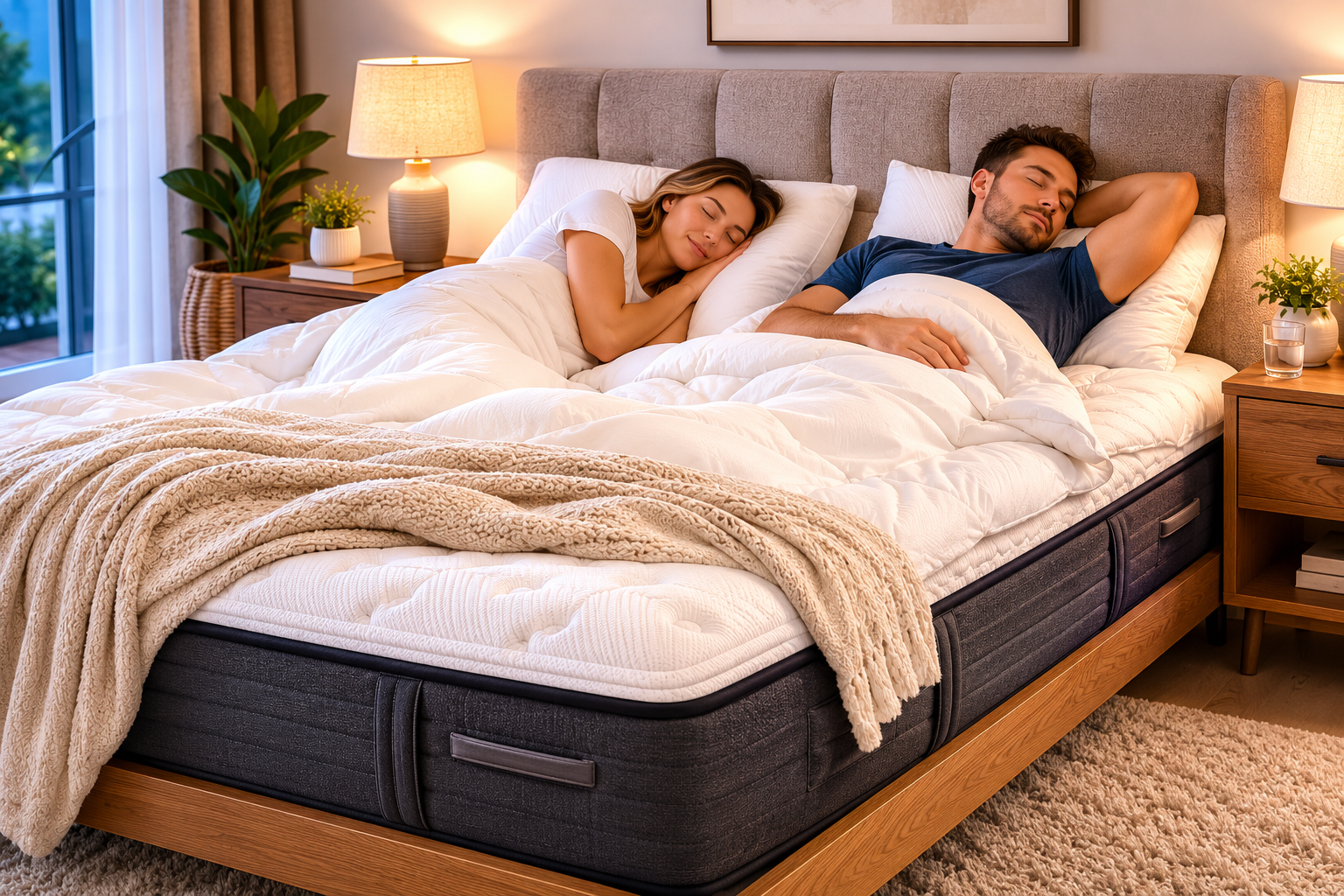
Shopping for a mattress alone is hard enough. Shopping for one that satisfies two different bodies, two different sleep positions, and often two very different opinions on firmness turns it into an entirely different challenge. Finding the best mattress for couples means solving for variables a single sleeper never has to think about: whose movement wakes whose, who runs hot, and what happens when one partner wants soft and the other wants firm.
This guide walks through exactly what matters most when two people share a bed, motion isolation, firmness compromise, temperature regulation, edge support, and size, along with the real solutions (including split mattresses) for when compromise genuinely isn’t an option.
Mattress for Couples
For most couples, a medium-firm hybrid mattress is the strongest starting point, since it balances motion isolation, edge support, and cooling better than any single construction, and its firmness works reasonably well across the widest range of body types and sleep positions. If motion transfer is your biggest concern, particularly if one partner tosses and turns or gets up during the night, memory foam or a hybrid with individually wrapped coils will isolate movement far better than a traditional innerspring. If you and your partner genuinely can’t agree on firmness even after trying a compromise, a split mattress or an adjustable air bed with independent settings on each side solves that disagreement directly rather than forcing one person to lose the debate.
Why Shopping Together Actually Matters
The Biggest Mistake Couples Make
One of the most common missteps is shopping separately, one partner researching and choosing a mattress based entirely on their own preferences without factoring in what the other person actually needs. A mattress that feels perfect to one sleeper can feel completely wrong to their partner, especially when body weight, sleep position, or temperature preferences differ meaningfully.
Test Together, Not Just Individually
Whenever possible, lie down on a mattress together during the testing or trial process, not just separately at different times. How a mattress performs with two people’s combined weight and movement is genuinely different from how it feels with just one person on it.
Motion Isolation: The Feature That Saves Relationships
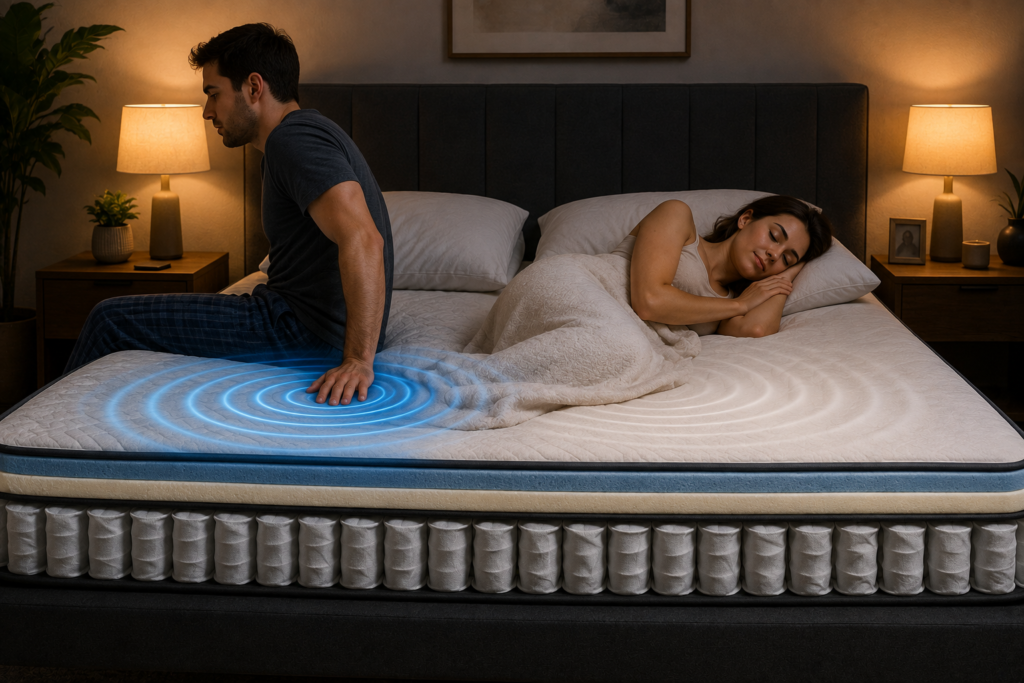
Why This Matters So Much for Couples
If either partner tosses and turns, gets up during the night, or simply moves more than the other, poor motion isolation means every shift ripples across the entire mattress and disturbs the other person’s sleep. This single factor is one of the most frequently cited priorities in couples’ mattress decisions, right alongside firmness itself.
Which Materials Actually Isolate Motion Well
- Memory foam is widely considered the strongest performer here. Its viscoelastic structure absorbs movement into localized “zones” rather than transferring it across the surface, meaning your partner can toss and turn on their side while you sleep soundly on yours.
- Hybrid mattresses with individually wrapped coils come in a close second, since each coil compresses independently rather than the whole coil bed shifting together, meaningfully reducing motion transfer compared to older, interconnected coil systems.
- Latex offers a bit more responsiveness than memory foam but still delivers solid motion isolation, a good middle ground for couples who want some of foam’s motion-blocking benefits without feeling too deeply “stuck” in the mattress.
- Traditional innerspring mattresses, particularly older designs using linked Bonnell coils, generally perform the worst here and are typically not recommended for couples where one partner is easily disturbed by movement.
Motion Isolation Comparison Table
| Material | Motion Isolation | Best For |
| Memory foam | Excellent | Light sleepers, restless partners |
| Hybrid (wrapped coils) | Very good | Balance of motion isolation + responsiveness |
| Latex | Good | Couples wanting bounce with less motion transfer |
| Traditional innerspring | Poor | Not recommended if either partner is a light sleeper |
Solving the Firmness Disagreement
Start With the Compromise Everyone Can Live With
When partners have different firmness preferences, a medium-firm mattress is the most commonly recommended starting point, since it accommodates the widest range of body types and sleep positions without leaning too far toward either extreme.
There is also clinical evidence behind the medium-firm recommendation. In a randomised trial of 313 adults with chronic low-back pain, published in The Lancet, people who slept on medium-firm mattresses had better results for pain and disability after 90 days than those on firm mattresses. The study looked at people with back pain rather than couples, so it doesn’t settle every firmness disagreement, but it does challenge the idea that firmer is always better.
When Body Weight Creates the Real Divide
Firmness preference often isn’t purely about taste, it’s frequently driven by body weight. Lighter partners (under roughly 130 pounds) tend to gravitate toward softer settings, since their weight doesn’t compress firmer material enough to feel supported. Heavier partners generally need medium-firm to firm settings for the same support to actually register. This is worth discussing honestly before assuming your disagreement is simply about preference.
When Compromise Isn’t Enough: Split and Adjustable Options
If a medium-firm compromise genuinely doesn’t satisfy either partner, there are real solutions built specifically for this problem:
- Split king mattresses use two separate Twin XL mattresses (often in different firmness levels) placed side by side under one set of bedding, giving each partner their own dedicated feel with zero compromise.
- Adjustable air mattresses let each side of the bed be independently firmed or softened, sometimes with dozens of precise settings, through a remote or app, without needing two physically separate mattress units.
- Flippable mattresses offer a different firmness on each side of a single mattress, letting couples (or even a single household over time) switch between two feel options as needs change.
A Word of Caution on Adjustable Beds
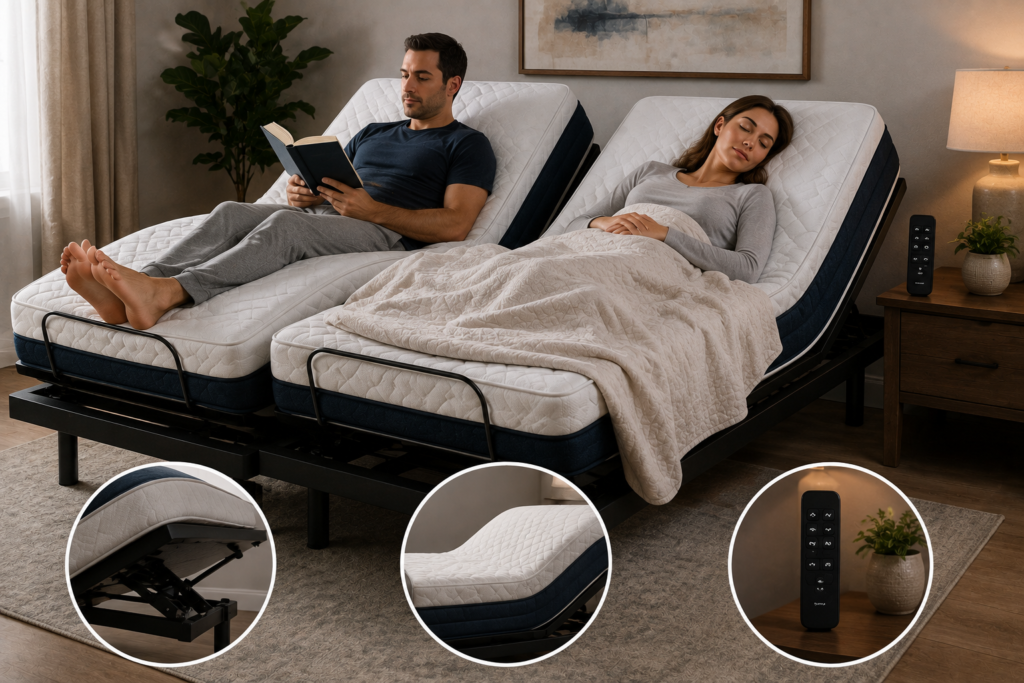
If you choose an adjustable air mattress, avoid setting each side to dramatically different firmness levels. A big gap between settings can create a noticeable “dip” toward the softer side in the middle of the bed, which can undercut the comfort you were trying to achieve on both sides in the first place.
Temperature Regulation: Solving the “I’m Hot, You’re Cold” Problem
Why Couples Often Disagree on Temperature
It’s genuinely common for one partner to run warm and the other to run cold, and a mattress that traps heat can turn that mismatch into a nightly source of tension, one person kicking off the covers while the other reaches for another blanket.
Which Constructions Sleep Cooler
Hybrid mattresses generally sleep cooler than all-foam options, since the coil layer allows airflow that dense foam construction doesn’t. Many higher-performing hybrids also add cooling covers, gel infusions, or moisture-wicking fibers specifically to offset heat buildup from the comfort layer on top.
For Couples Where Both Partners Run Hot
If temperature regulation is a top priority for both of you, prioritize a hybrid with an explicitly marketed cooling cover or gel-infused comfort layer over a standard all-foam mattress, which tends to retain more heat regardless of how it’s marketed.
Edge Support: More Important for Couples Than You’d Think
Why Two People Need Stronger Edges
With two people sharing a bed, edge space actually gets used, sitting on the side to get dressed, sleeping closer to the edge for extra room, or simply spreading out toward opposite sides of a larger mattress. Weak edge support means the perimeter compresses or feels unstable under weight, effectively shrinking your usable sleep surface.
What to Look For
Hybrid mattresses with reinforced perimeter coils generally offer the strongest edge support of common construction types, letting both partners use the full width of the mattress without feeling like they’re about to roll off a soft, sagging edge.
Choosing the Right Size
Why Size Matters as Much as Material
Even the best mattress construction won’t solve a problem caused by simply not having enough room. Queen, king, and California king are generally considered the best sizes for couples, with the right choice depending on your bedroom’s dimensions and how much personal space each partner wants.
Queen: The Most Popular Choice
A queen is the most common size couples choose, offering a reasonable balance of shared space and manageable footprint for most bedroom sizes.
King: More Room, Particularly Useful With Kids or Pets
A king gives each partner significantly more personal space and is genuinely worth considering if your bedroom can accommodate it, especially relevant if pets or children regularly end up in the bed as well.
California King: Extra Length for Taller Sleepers
A California king offers similar overall space to a standard king but with extra length rather than extra width, a better fit for couples where one or both partners are notably tall.
Mattress Size Comparison for Couples
| Size | Dimensions (approx.) | Best For |
| Queen | 60″ x 80″ | Most common choice, fits most bedrooms |
| King | 76″ x 80″ | Couples wanting more personal space, or sharing with pets/kids |
| California King | 72″ x 84″ | Taller couples needing extra length |
| Split King | Two 38″ x 80″ units | Couples needing independent firmness settings |
Responsiveness for Intimacy: A Practical, Often Overlooked Factor
Beyond sleep quality, mattress responsiveness genuinely matters to many couples for intimacy as well. Extremely soft, deep-contouring memory foam can feel restrictive for movement, while a more responsive hybrid or latex construction tends to offer a better balance of comfort and ease of movement without sacrificing the motion isolation you need for actual sleep.
Matching Mattress Type to Sleep Position (For Both of You)
If you and your partner sleep in different positions, side and back, for example, a medium-firm hybrid with some contouring in the comfort layer generally accommodates both reasonably well, offering enough cushioning for a side sleeper’s shoulders and hips while still providing the firmer support a back sleeper needs.
Practical Buying Tips
- Test mattresses together whenever possible, not just individually, since combined weight and movement change how a bed performs
- Prioritize memory foam or wrapped-coil hybrid construction if motion isolation is a top concern for either partner
- Consider a split king or adjustable air bed if firmness disagreements are genuinely unresolvable through compromise
- Choose king or California king sizing if your bedroom allows, particularly with pets, kids, or notably different heights involved
- Look specifically for reinforced edge support if either partner regularly sits or sleeps near the perimeter
Common Mistakes to Avoid
- Shopping separately without factoring in your partner’s needs, ending up with a mattress that satisfies only one of you
- Choosing traditional innerspring when either partner is a light sleeper, missing out on the motion isolation memory foam or hybrid construction provides
- Setting a split adjustable bed to dramatically different firmness levels, creating an uncomfortable dip at the center of the mattress
- Underestimating how much size matters, staying with a queen when a king would genuinely solve ongoing space complaints
- Overlooking temperature regulation, assuming firmness is the only meaningful disagreement between partners
Conclusion
Finding the best mattress for couples comes down to solving for more variables than a single sleeper ever has to consider, motion isolation, firmness compromise, temperature, edge support, and size, all at once. A medium-firm hybrid remains the strongest general starting point for most couples, while a split king or adjustable air bed offers a genuine solution when firmness preferences simply can’t be reconciled through compromise. Shop together, test together, and prioritize the factors that actually affect both of your sleep, and you’ll land on a mattress that finally lets you both wake up rested instead of one of you quietly suffering through the other’s choice.
Frequently Asked Questions
1- What is the best mattress for couples with different firmness preferences?
A medium-firm hybrid is usually the best starting compromise, since it works for the widest range of body types and sleep positions. If that still doesn’t satisfy both partners, a split king or adjustable air bed with independent settings solves the disagreement directly.
2- What mattress material offers the best motion isolation?
Memory foam generally offers the strongest motion isolation, followed closely by hybrid mattresses with individually wrapped coils. Traditional innerspring mattresses transfer the most motion and are generally not recommended for couples where one partner is a light sleeper.
3- What size mattress is best for couples?
Queen is the most popular choice, offering a solid balance of space and footprint. King or California king sizes give each partner more personal room, particularly worth considering if pets, kids, or notably different heights are part of the equation.
4- Is a split king mattress worth it for couples?
Yes, if you and your partner genuinely can’t agree on firmness. A split king uses two separate Twin XL mattresses under shared bedding, letting each partner have their own dedicated feel without either person compromising.
5- Do hybrid mattresses sleep cooler than memory foam for couples?
Generally, yes. The coil layer in a hybrid allows airflow that dense, all-foam memory foam construction doesn’t, and many hybrids add cooling covers or gel infusions to further offset heat buildup.
6- How important is edge support for couples?
More important than many people expect, since two people sharing a bed regularly use the full width of the mattress, sitting on the edge or sleeping closer to the perimeter. Weak edge support effectively shrinks your usable sleep space.
7- Can couples with different sleep positions use the same mattress?
Yes, in most cases. A medium-firm hybrid with some contouring in the comfort layer generally accommodates both side and back sleepers reasonably well, without requiring separate mattresses.