
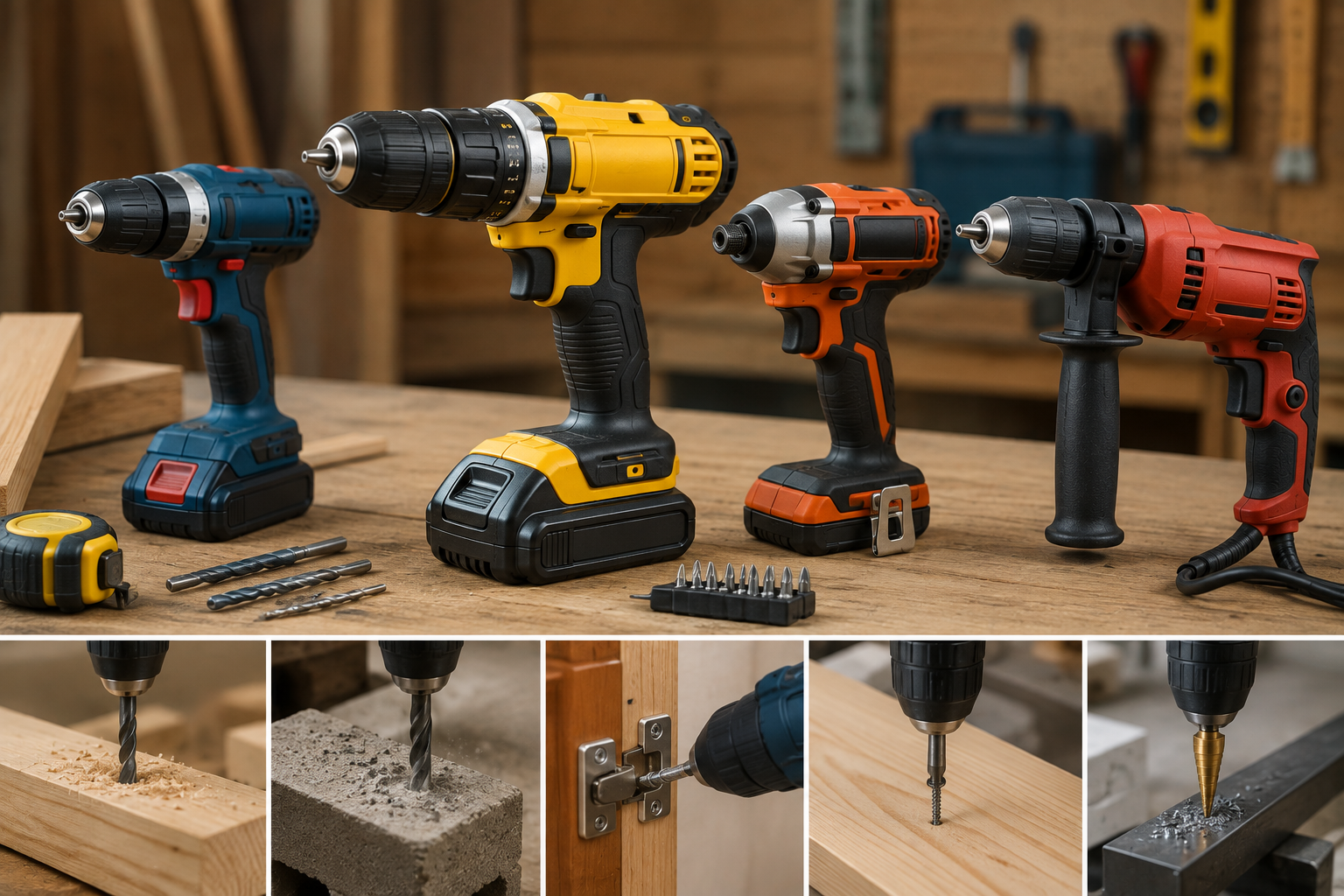
A drill is often the very first power tool a homeowner buys, and for good reason; it handles an enormous range of tasks, from assembling furniture to hanging shelves to drilling pilot holes for a fence. But walk into any hardware store, and you’ll find dozens of options varying in type, voltage, chuck size, and features, making how to choose a drill a genuinely confusing question without some basic guidance.
This guide breaks down every major decision point, drill type, power source, voltage, and features, so you can choose a drill that actually matches your specific projects rather than paying for capability you’ll never use.
Choose the Right Drill for Your Home Projects
For most homeowners, an 18V or 20V cordless drill/driver with a 1/2-inch chuck, variable speed control, and an adjustable clutch covers the vast majority of household tasks, drilling holes, driving screws, and light assembly work. If you regularly work with masonry or concrete, add a hammer drill function or a separate hammer drill to your consideration. If you frequently drive larger fasteners, like deck screws or lag bolts, an impact driver alongside your drill will make that specific work considerably easier and faster.
Steps To Choose the Right Drill for Your Home
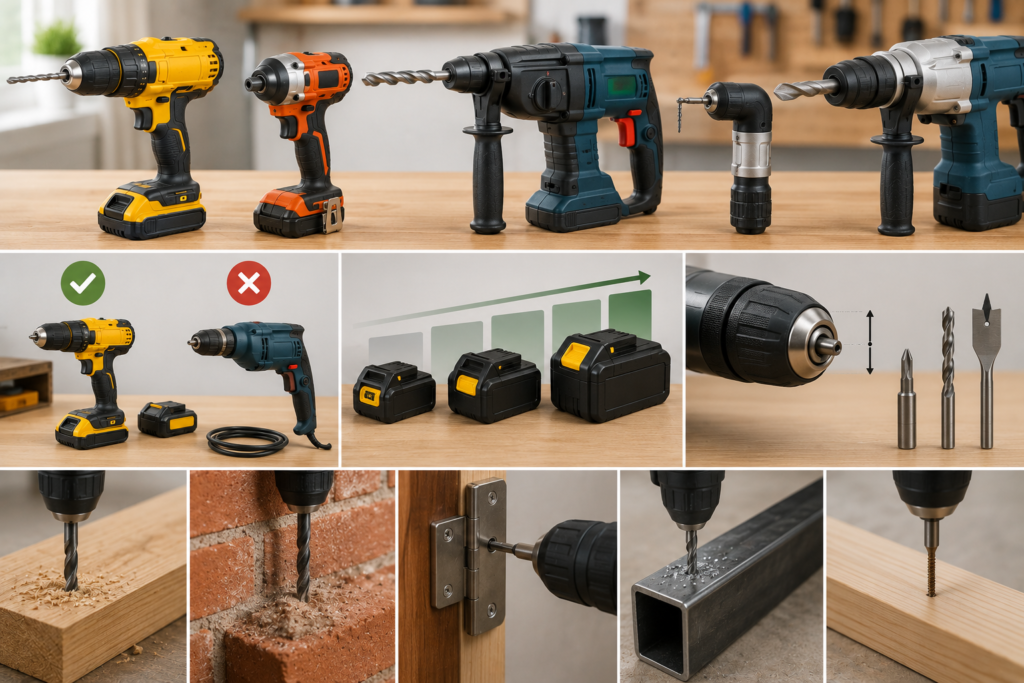
Step 1: Understand the Different Drill Types
- Drill/Driver
This is the standard, most versatile option, and what most people picture when they think of a basic power drill. It drills holes and drives screws, covering the widest range of everyday household tasks in a single tool.
- Impact Driver
Designed specifically for driving screws and fasteners, an impact driver delivers rotational force in quick, powerful bursts (rather than a drill’s continuous torque), making it especially effective for driving longer screws or fasteners into denser material without stripping the screw head or stalling the tool.
- Hammer Drill
Built for drilling into masonry, concrete, or brick, a hammer drill combines rotational drilling with a rapid hammering action, delivering the additional force needed to penetrate hard materials that a standard drill would struggle with or damage itself attempting.
- Right-Angle Drill
A specialized option designed for drilling in tight, confined spaces where a standard drill’s length won’t fit or maneuver, common in plumbing or electrical work but less commonly needed for typical homeowner projects.
- Rotary Hammer
A heavier-duty version of a hammer drill, built for more demanding, extended masonry or concrete work, generally more relevant for serious renovation projects than typical household use.
Drill Type Comparison
| Drill Type | Primary Use | Best For |
| Drill/driver | Drilling holes, driving screws | General household use |
| Impact driver | Driving larger/longer fasteners | Deck building, heavy fastening tasks |
| Hammer drill | Drilling into masonry, concrete, brick | Renovation, outdoor masonry projects |
| Right-angle drill | Tight, confined-space drilling | Plumbing, electrical work |
| Rotary hammer | Heavy-duty masonry/concrete drilling | Serious renovation, professional use |
Step 2: Decide Between Corded and Cordless
- Cordless Drills
Cordless drills offer full mobility, letting you move freely between rooms or work outdoors without needing to stay near an outlet. This has become the practical default for most homeowners, given how significantly cordless battery technology has improved in recent years.
- Corded Drills
Corded drills provide consistent, uninterrupted power without any battery to charge or eventually replace, and they’re generally more affordable upfront. They remain a reasonable choice for stationary work near an outlet or for anyone specifically prioritizing lower initial cost over mobility.
- Which to Choose
For most household use, a cordless drill’s mobility genuinely outweighs the modest cost premium. For the fuller trade-off breakdown, see our corded vs cordless power tools guide, particularly since most projects involve moving between different areas of a home or working outdoors at some point.
Step 3: Understand Voltage and What It Actually Means
- Common Voltage Options
Cordless drills typically come in 12V, 18V/20V, and higher voltage options (sometimes 40V or higher for heavier-duty models). Voltage generally correlates with available power and how demanding a task the drill can comfortably handle.
- 12V Drills
Compact and lightweight, 12V drills suit light-duty tasks, small screws, drilling into softer materials, and situations where reduced weight matters more than maximum power, useful for extended overhead work or tight spaces.
- 18V/20V Drills
This has become the most common voltage range for general household use, offering a solid balance of power, battery life, and manageable weight for the vast majority of drilling and driving tasks homeowners encounter.
- Higher Voltage Options
Drills in the 40V-plus range are generally built for more demanding, heavier-duty tasks, larger holes, denser materials, or more frequent professional-level use, representing more capability than most homeowners genuinely need for typical projects.
Voltage Comparison
| Voltage Range | Weight | Power Level | Best For |
| 12V | Lightest | Light-duty | Small tasks, overhead work, tight spaces |
| 18V/20V | Moderate | Solid, versatile | Most household drilling and driving needs |
| 40V+ | Heavier | Heavy-duty | Demanding tasks, frequent heavy use |
Step 4: Choose the Right Chuck Size
- What Chuck Size Means
The chuck is the part of the drill that holds the drill bit or driver bit in place, and its size determines the maximum bit shank diameter the drill can accommodate.
- Common Chuck Sizes
A 3/8-inch chuck suits lighter-duty tasks and smaller bits, common on compact or lower-voltage drills. A 1/2-inch chuck is the most common size for general household drills, accommodating a wider range of standard bit sizes for typical projects.
- Keyless vs Keyed Chucks
Keyless chucks let you tighten and loosen bits by hand, offering quick, convenient bit changes without needing a separate tool. Keyed chucks require a small chuck key to tighten securely, offering a marginally more secure grip but adding an extra step (and a small part that’s easy to misplace) to every bit change. Keyless chucks have become the standard choice for most modern household drills given their convenience.
Step 5: Look at Speed and Torque Settings
- Variable Speed Control
Nearly all modern drills include variable speed triggers, letting you control drilling speed based on the specific task, slower for starting a hole precisely or working with delicate materials, faster for drilling through more resistant material once started.
- Two-Speed Gearing
Many drills include a low and high gear setting, with low gear providing more torque (rotational force) for driving screws or drilling larger holes, and high gear providing faster rotation for drilling smaller holes more quickly.
- Adjustable Clutch
An adjustable clutch lets you set a maximum torque limit, causing the drill to stop applying force once a screw is properly seated rather than continuing to drive it (and potentially stripping the screw head or damaging the material). This is a genuinely valuable feature for anyone regularly driving screws into furniture, drywall, or other materials where over-driving is a common frustration.
Step 6: Consider Battery Life and Capacity
- Amp-Hours (Ah) Explained
Battery capacity is measured in amp-hours (Ah), with higher numbers indicating longer runtime before needing a recharge. A drill’s actual runtime depends on both this rating and how demanding the specific task is.
Amp-hour ratings also affect long-term battery health, not just single-session runtime. According to Battery University’s guidance on battery capacity, higher-capacity batteries generally experience less strain per charge cycle for the same task, which can translate into a longer usable lifespan alongside the longer single-charge runtime.
- Balancing Runtime and Weight
Higher-capacity batteries generally provide longer runtime but add more weight to the tool, worth considering if you’ll be using the drill for extended periods or overhead work where weight becomes more noticeable over time.
- Battery Platform Compatibility
If you already own other cordless tools, or plan to buy more in the future, choosing a drill within the same brand’s battery platform lets you share batteries and chargers across multiple tools, a practical consideration that can meaningfully reduce future costs and clutter.
Step 7: Decide If You Need a Hammer Function
- When Hammer Drilling Matters
If your projects regularly involve drilling into concrete, brick, or masonry, anchoring fence posts, mounting items to a concrete wall, or similar outdoor and structural tasks, a drill with hammer function (or a dedicated hammer drill) will handle this considerably more effectively than a standard drill/driver.
- When You Can Skip It
For typical indoor household tasks, wood, drywall, and general furniture assembly, a standard drill/driver without hammer function covers your needs perfectly well, and adding this capability unnecessarily increases both cost and, often, the tool’s overall weight.
Drill vs Impact Driver: Do You Need Both?
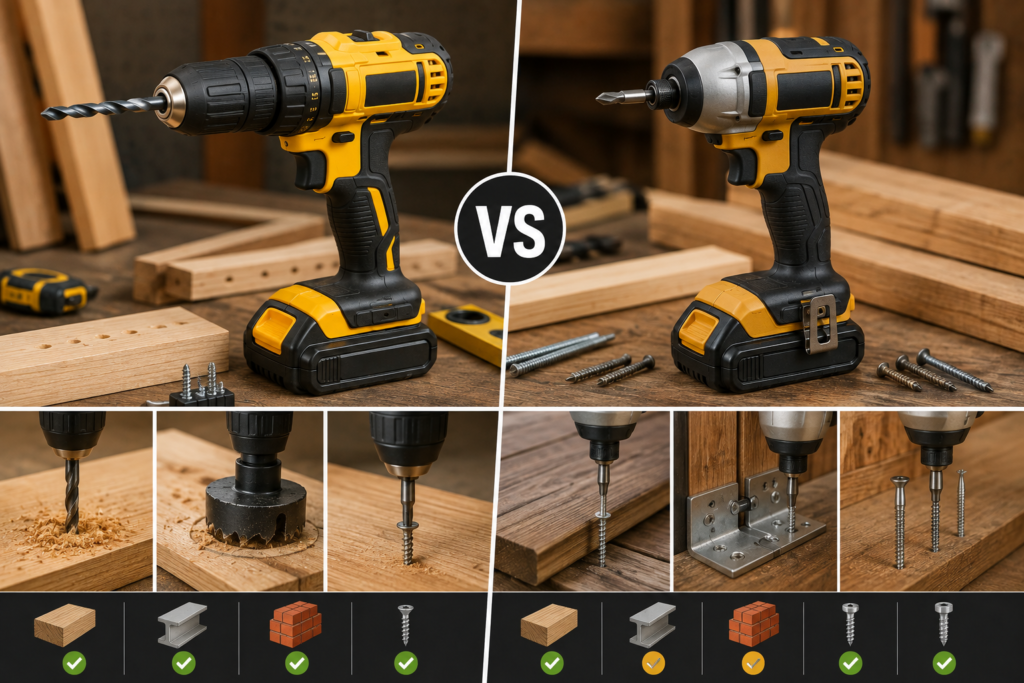
What Each Tool Does Best
A drill/driver offers more precise control, better suited to drilling clean holes and driving smaller or more delicate screws where over-torquing is a concern. An impact driver excels at driving larger screws and fasteners quickly and efficiently, particularly into denser material, using its rapid rotational bursts to prevent stalling.
Do You Need Both?
Many homeowners find a single quality drill/driver sufficient for typical household needs. An impact driver becomes a worthwhile addition specifically if you’re regularly tackling larger projects involving substantial fastening, like deck building, fence construction, or larger furniture assembly projects with many screws.
Best Drill Setup by Homeowner Type
| Homeowner Type | Recommended Setup |
| Light, occasional use | 12V or 18V drill/driver, keyless chuck |
| Typical household projects | 18V/20V drill/driver with adjustable clutch |
| Frequent DIY, larger projects | 18V/20V drill/driver + impact driver combo |
| Masonry/outdoor structural work | Drill with hammer function or dedicated hammer drill |
Practical Buying Tips
- Match voltage to your actual typical tasks rather than defaulting to the highest available option
- Prioritize a keyless chuck and adjustable clutch for everyday convenience and control
- Consider battery platform compatibility if you already own, or plan to buy, other cordless tools from a specific brand
- If unsure whether you need an impact driver, start with a quality drill/driver alone and add one later once a specific project makes the need clear
- Test the drill’s weight and grip in person where possible, part of choosing the right home improvement tools overall, since comfort during extended or overhead use matters more than specs alone suggest
Common Mistakes to Avoid
- Buying more voltage or power than you genuinely need, paying extra for heavy-duty capability that typical household tasks won’t use
- Skipping the adjustable clutch feature, leading to frequent over-driven and stripped screws
- Choosing incompatible battery platforms if you already own other cordless tools from a different brand
- Assuming a drill and impact driver are interchangeable, when each genuinely excels at different specific tasks
- Overlooking chuck size, ending up with a drill that can’t accommodate certain bit sizes you actually need
Conclusion
Choosing the right drill comes down to matching drill type, voltage, and features to your actual, typical projects rather than defaulting to the most powerful or feature-packed option available. For most homeowners, an 18V or 20V cordless drill/driver with a keyless chuck and adjustable clutch covers the overwhelming majority of household tasks. Add a hammer drill function or a separate impact driver only once your specific projects genuinely call for that added capability, and you’ll end up with a drill setup that’s both practical and genuinely well-matched to how you actually work.
Frequently Asked Questions
1- What voltage drill is best for home use?
An 18V or 20V cordless drill offers the best overall balance of power, runtime, and weight for most typical household drilling and driving tasks.
2- Do I need a hammer drill for home projects?
Only if you regularly drill into concrete, brick, or masonry. For typical indoor wood and drywall projects, a standard drill/driver is sufficient.
3- What’s the difference between a drill and an impact driver?
A drill/driver offers more precise control for drilling holes and driving smaller screws, while an impact driver delivers powerful rotational bursts better suited to driving larger or longer fasteners quickly.
4- Is a keyless chuck better than a keyed chuck?
For most homeowners, yes, keyless chucks offer quicker, more convenient bit changes without needing a separate tool, and they’ve become the standard on most modern household drills.
5- How do I know what chuck size I need?
A 1/2-inch chuck accommodates the widest range of standard bit sizes for typical household projects, making it the most versatile and common choice for general-purpose drills.
6- Should my first drill be corded or cordless?
For most homeowners, cordless offers more practical versatility given the mobility it provides across different rooms and outdoor projects, though corded remains a reasonable, more affordable choice for stationary use.
7- What is an adjustable clutch, and do I need it?
An adjustable clutch lets you set a maximum torque limit so the drill stops once a screw is properly seated, preventing over-driving and stripped screws. It’s a genuinely valuable feature worth prioritizing for most everyday use.